
AI consulting and an AI consultant are closely related, but they are not exactly the same thing.
AI consulting is the service.
An AI consultant is the person or advisor delivering the service.
That sounds simple.
But for business leaders, enterprise teams, and government organizations, the difference matters.
Because many organizations know they need help with AI.
They just do not know what kind of help they need.
Do they need a strategy?
Do they need automation?
Do they need training?
Do they need governance?
Do they need workflow improvement?
Do they need an implementation roadmap?
Do they need someone to choose tools?
Do they need someone to manage vendors?
Do they need someone to identify real use cases instead of chasing AI hype?
That is where AI consulting becomes valuable.
And that is where the right AI consultant can help turn confusion into a practical plan.
What Is AI Consulting?
AI consulting is a professional advisory service that helps organizations understand, plan, adopt, manage, and implement artificial intelligence in a practical business context.
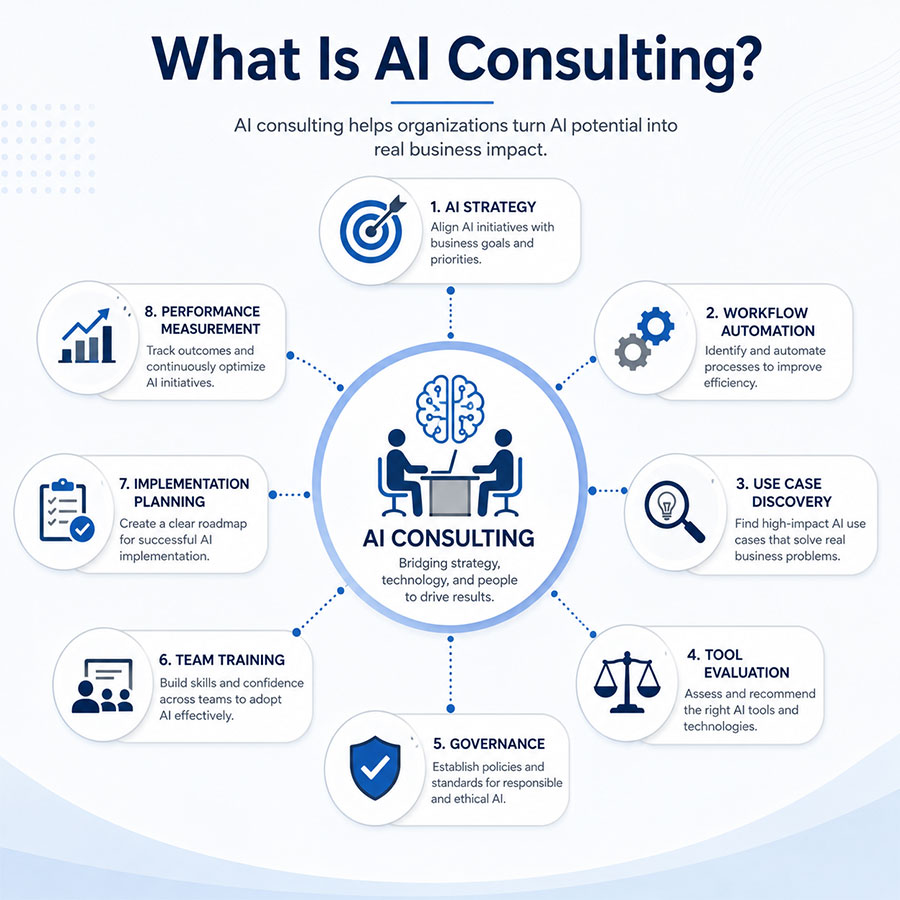
AI consulting may include:
AI strategy
AI adoption planning
AI readiness assessment
Workflow automation
Use case identification
Tool evaluation
AI governance
Prompting standards
Team training strategy
Vendor coordination
Implementation planning
Risk review
Data and process assessment
Executive advisory
Change management
Performance measurement
The goal of AI consulting is not to use AI just because it is popular.
The goal is to identify where AI can create actual business value.
That value may come from:
Reducing manual work
Improving internal workflows
Supporting customer service
Improving research and analysis
Speeding up content production
Improving reporting
Automating repetitive tasks
Supporting sales and marketing
Improving decision-making
Helping teams work more efficiently
Strong AI consulting should connect technology to business outcomes.
Not just tools.
Not just demos.
Not just “AI ideas.”
A good consulting engagement should answer:
Where can AI help us?
Where should we avoid AI?
What tools make sense?
What workflows should change?
What risks need to be managed?
Who needs training?
What should we implement first?
How will we measure success?
What Is an AI Consultant?
An AI consultant is a senior advisor who helps an organization apply AI consulting to real business problems.
The consultant may work with executives, department heads, operations teams, marketing teams, IT teams, HR teams, customer service teams, agencies, vendors, and project leaders.
Their role is to guide the organization through AI adoption.
That does not always mean building custom software.
Sometimes it means helping leadership make better decisions before any software is built.
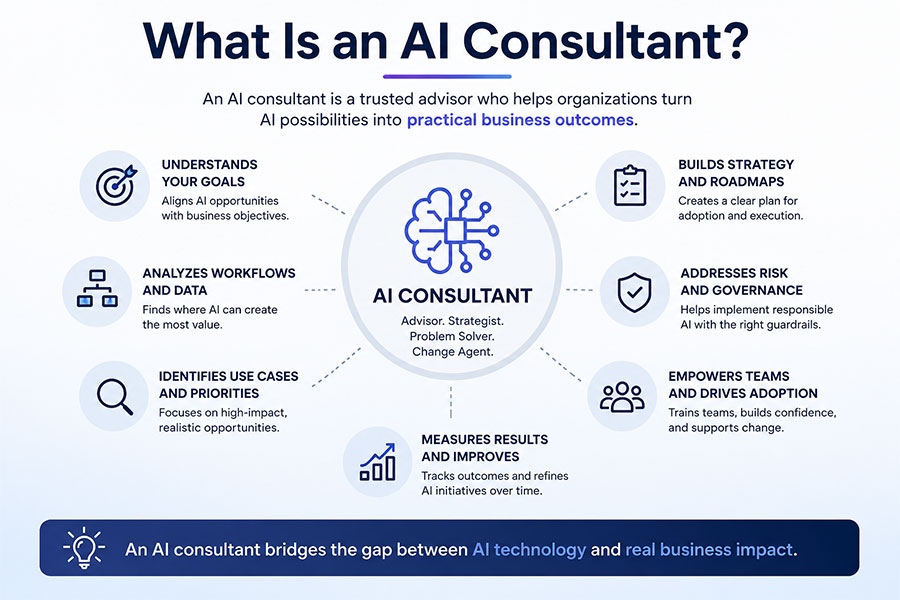
An AI consultant may help:
Identify AI opportunities
Map internal workflows
Prioritize use cases
Compare AI platforms
Create an AI adoption roadmap
Build pilot project plans
Create internal AI policies
Recommend automation opportunities
Support team training
Review vendor proposals
Oversee implementation
Translate AI possibilities into business language
The best AI consultants understand that AI is not only a technical issue.
It is also a strategy issue.
A workflow issue.
A people issue.
A governance issue.
A project management issue.
And often, a leadership issue.
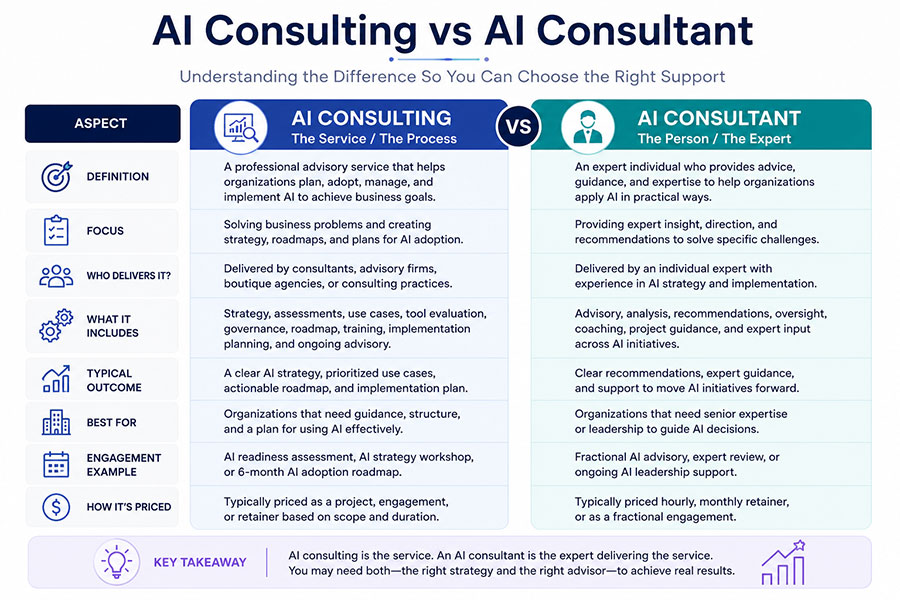
AI Consulting vs AI Consultant
The simplest way to understand the difference is this:
| Term | Meaning |
| AI consulting | The advisory service or process |
| AI consultant | The person or expert delivering the advisory work |
| AI strategy | The plan for how AI should support business goals |
| AI implementation | The process of putting AI tools, workflows, or systems into use |
| AI governance | The rules, standards, and controls that guide responsible AI use |
A company may say:
“We need AI consulting.”
That usually means they need help understanding what to do.
A company may say:
“We need an AI consultant.”
That usually means they need a specific expert to guide them.
In practice, the two terms often overlap.
But the buying decision is different.
AI consulting describes the need.
An AI consultant describes the solution provider.
Why Businesses Are Searching for AI Consulting
Many organizations are under pressure to “do something with AI.”
Leadership is asking about it.
Teams are experimenting with tools.
Competitors are talking about automation.
Employees are using AI quietly.
Vendors are pitching AI features.
Customers are starting to expect faster service.
But internal clarity is usually low.
That creates problems.
Some teams use AI without standards.
Some leaders invest in tools without clear use cases.
Some departments duplicate efforts.
Some vendors overpromise.
Some employees avoid AI completely.
Some workflows could be improved, but nobody has mapped them.
AI consulting helps create structure before AI adoption becomes scattered.
What Does AI Consulting Actually Include?
AI consulting should be shaped around the organization’s needs.
But most useful engagements include several core areas.
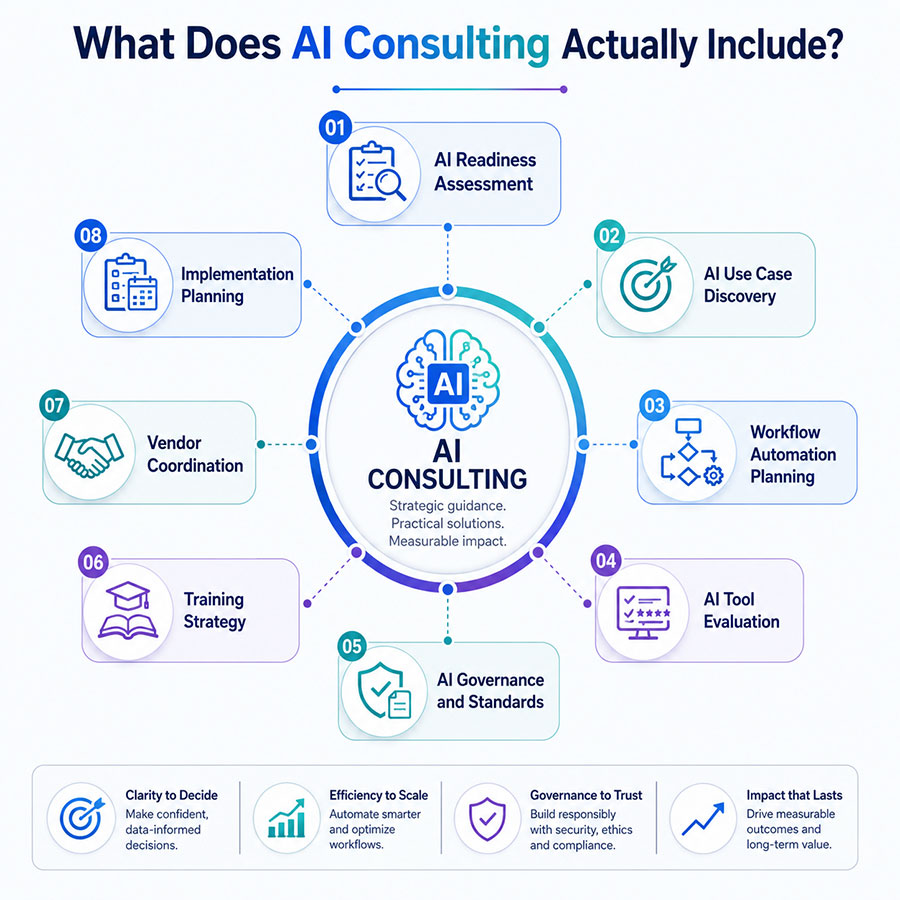
AI Readiness Assessment
Before implementing AI, the organization needs to understand where it stands.
This may include reviewing:
Current workflows
Existing software tools
Manual tasks
Data availability
Team skill levels
Policy gaps
Risk exposure
Leadership priorities
Vendor relationships
Technical limitations
The purpose is to identify what is realistic.
Not every organization is ready for advanced AI implementation.
Some need workflow cleanup first.
Some need better documentation.
Some need staff training.
Some need governance.
Some need a pilot project.
A readiness assessment helps prevent wasted investment.
AI Use Case Discovery
Most organizations have dozens of possible AI use cases.
But not all of them are worth pursuing.
An AI consultant helps identify which use cases are practical, valuable, safe, and realistic.
Examples may include:
Customer support automation
Internal knowledge search
Proposal writing support
Marketing content workflows
Sales research
Report generation
Document review
Meeting summaries
Project tracking
Data analysis
Recruiting workflows
Operations support
Website and search optimization
The key is prioritization.
A good consultant should help identify which AI opportunities can create value soon and which ones should wait.
Workflow Automation Planning
AI is most useful when it improves a real workflow.
That means the consultant needs to understand how work actually gets done.
Not just how leadership thinks it gets done.
Workflow automation planning may involve mapping:
Who does the task now
How long it takes
What tools are used
Where errors happen
Where approvals are needed
Where repetitive work exists
Where AI can assist
Where humans must stay involved
This is where AI consulting overlaps with digital transformation consulting.
The goal is not just to add AI.
The goal is to improve the way the organization operates.
AI Tool Evaluation
There are many AI tools.
Most organizations do not need all of them.
An AI consultant can help evaluate tools based on:
Business fit
Security considerations
Ease of adoption
Integration needs
Cost
Training requirements
Vendor credibility
Workflow impact
Scalability
Governance requirements
The right tool is not always the most advanced tool.
It is the tool the organization can actually use well.
AI Governance and Standards
AI adoption without governance can create risk.
Teams may upload sensitive information into the wrong tools.
Employees may publish inaccurate AI-generated content.
Departments may use different standards.
Executives may not know which tools are being used.
Governance helps define responsible AI use.
This can include:
Approved tools
Data handling rules
Prompting standards
Review requirements
Human oversight
Content accuracy checks
Vendor guidelines
Security expectations
Role-based permissions
Internal AI policies
For enterprise and public-sector organizations, governance is especially important.
The larger the organization, the more important the rules become.
AI Consultant vs AI Developer vs Automation Specialist
Many organizations confuse these roles.
They are related, but different.
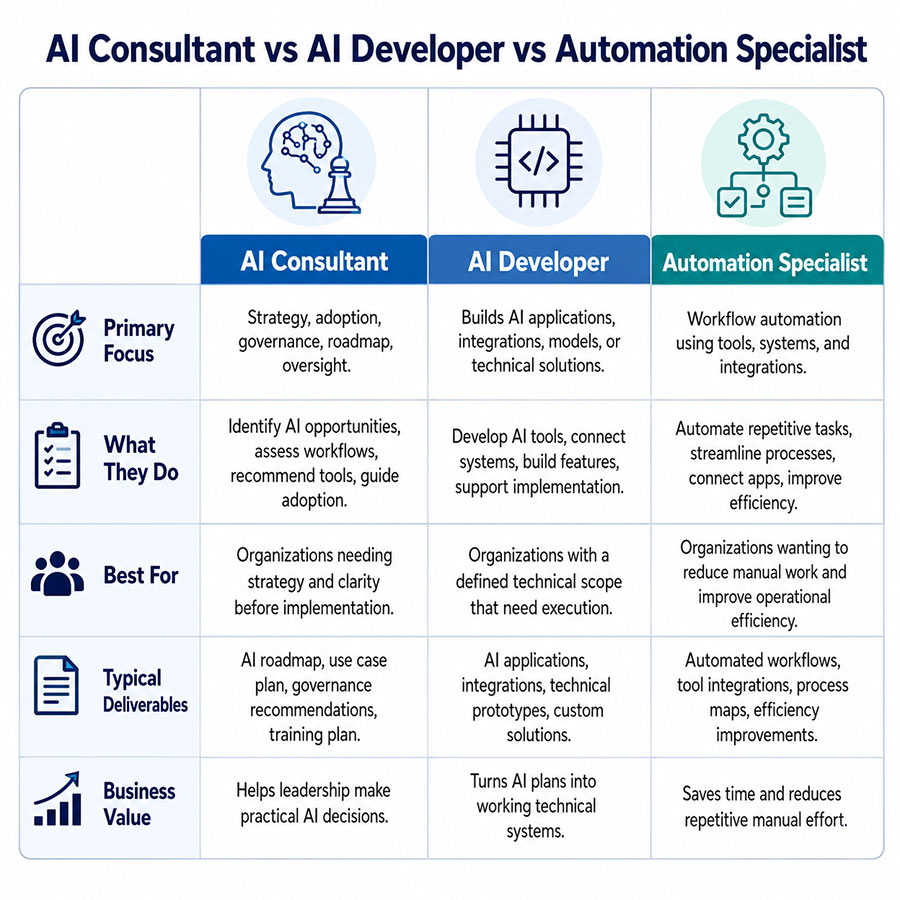
| Role | Primary Focus |
| AI consultant | Strategy, use cases, adoption, governance, roadmap, oversight |
| AI developer | Builds AI applications, integrations, models, or software |
| Automation specialist | Automates workflows using tools, integrations, and systems |
| Data scientist | Works with data modelling, analysis, machine learning, and prediction |
| AI trainer | Teaches teams how to use AI tools effectively |
A business may need one role.
Or several.
But it should not hire a developer when it still needs strategy.
And it should not hire a strategy consultant if it already has a clear technical scope and only needs build execution.
This is why the discovery stage matters.
When Should a Company Hire an AI Consultant?
A company should consider hiring an AI consultant when leadership knows AI matters but does not have a clear internal roadmap.
Common signs include:
| Situation | What It Usually Means |
| Teams are using AI without standards | Governance is needed |
| Leadership wants AI but lacks a plan | Strategy is missing |
| Departments are experimenting separately | Central coordination is weak |
| Vendors are pitching AI tools | Evaluation support is needed |
| Manual workflows are slowing teams down | Automation opportunities exist |
| Employees are unsure how to use AI | Training and adoption planning are needed |
| AI projects keep stalling | Project leadership may be missing |
| Executives want measurable ROI | Use cases and KPIs need clarity |
A consultant is most valuable before the organization spends heavily on tools, vendors, or custom development.
That is when better decisions can save the most money.
Where AI Consulting Creates the Most Value
| AI Need | Consulting Value |
| Basic AI tool training | ███ |
| Prompting standards | ████ |
| Workflow automation planning | ██████ |
| AI use case prioritization | ███████ |
| AI governance and risk planning | ████████ |
| Enterprise AI adoption roadmap | █████████ |
| AI transformation across departments | ██████████ |
AI consulting becomes more valuable as complexity increases.
A small team may only need training.
A larger organization may need strategy, governance, project management, workflow analysis, executive alignment, and vendor oversight.
That is a different level of support.
AI Consulting for Enterprise Teams
Enterprise AI adoption is different from small business AI adoption.
There are more teams.
More workflows.
More stakeholders.
More data concerns.
More vendors.
More risk.
More internal politics.
More approval layers.
That is why enterprise AI consulting needs more than tool knowledge.
It needs project leadership.
It needs stakeholder alignment.
It needs practical sequencing.
It needs reporting.
It needs governance.
It needs a roadmap that leadership can understand and teams can actually use.
Enterprise teams should look for an AI consultant who can speak to executives, managers, technical teams, and non-technical staff.
The consultant needs to translate between strategy and execution.
That is often where AI initiatives succeed or fail.
AI Consulting and AEO
AI consulting is also becoming connected to AEO, or Answer Engine Optimization.
As more users rely on ChatGPT, Gemini, Claude, Copilot, Perplexity, and Google AI Overviews, businesses need to think about how AI systems understand and present their expertise.
This does not replace SEO.
But it changes the way content, authority, structure, and clarity matter.
An AI consultant may help leadership understand how AI search visibility fits into a broader digital strategy.
This can include:
Improving answer-focused content
Structuring pages around decision-maker questions
Clarifying service expertise
Strengthening entity signals
Improving internal linking
Supporting AI-readable content architecture
Aligning SEO and AEO strategy
For organizations already investing in search, content, and digital transformation, AI consulting can help connect visibility strategy with operational AI adoption.
AEO Questions Decision-Makers Ask About AI Consulting
Business leaders and executives may ask AI tools questions like:
What is AI consulting?
What does an AI consultant do?
What is the difference between AI consulting and an AI consultant?
When should a company hire an AI consultant?
How much does AI consulting cost?
Can AI consulting help automate workflows?
Is AI consulting the same as digital transformation consulting?
Can an AI consultant help with ChatGPT or Microsoft Copilot or Gemini or Claude?
What should an AI adoption roadmap include?
How do we choose the right AI consultant?
These questions show that buyers are not only searching for definitions.
They are trying to make a decision.
They want to understand what type of help they need, how serious the investment should be, and what outcomes the consultant should support.
How Much Does AI Consulting Cost?
AI consulting costs depend on the size of the organization, complexity of the work, level of responsibility, number of stakeholders, type of implementation, and advisory structure.
A short strategy session is different from a full AI adoption mandate.
| Engagement Type | Typical Fit |
| AI strategy workshop | Initial education, opportunity discussion, leadership alignment |
| AI readiness assessment | Review workflows, tools, risks, and adoption readiness |
| AI adoption roadmap | Define use cases, priorities, governance, and implementation steps |
| 6-month AI consulting mandate | Strategy, planning, workflow review, vendor oversight, and implementation support |
| Annual AI advisory engagement | Ongoing senior support across AI adoption, governance, automation, and transformation |
Senior AI consulting engagements can start at $100,000 for a 6-month mandate.
Annual fractional advisory engagements may start at $200,000+ depending on scope, complexity, and responsibility.
The right question is not:
“How cheap can we get AI advice?”
The better question is:
“What will unclear AI adoption cost the organization?”
Poor AI decisions can waste software budgets, confuse teams, create governance risk, damage content quality, and slow down real transformation.
What to Look For in an AI Consultant
A strong AI consultant should understand more than AI tools.
They should understand how organizations actually work.
Look for experience in:
AI strategy
Workflow automation
Digital transformation
Project management
Vendor coordination
Governance
Marketing and content systems
Executive advisory
Change management
Reporting and KPIs
Business process improvement
The best AI consultant should be able to explain AI in plain language.
They should not hide behind jargon.
They should help leadership understand what is practical, what is risky, what is valuable, and what should happen first.
They should also be honest about what AI should not do.
That is important.
AI is powerful.
But it is not the answer to every problem.
What to Avoid with AI Consultants
Avoid AI consultants who make everything sound easy.
Avoid anyone who talks only about tools.
Avoid anyone who promises transformation without understanding workflows.
Avoid consultants who cannot explain governance.
Avoid consultants who recommend software before understanding the business.
Avoid consultants who treat AI adoption as a trend instead of an operating change.
Be careful with advisors who:
Overpromise ROI
Ignore data risk
Do not understand implementation
Cannot work with executives
Do not map workflows
Avoid governance questions
Recommend tools too quickly
Cannot manage vendors
Do not understand change management
Use technical language to hide unclear thinking
A strong AI consultant should make the work clearer.
Not more confusing.
Working With an AI Consultant
Working with an AI consultant should give the organization a clearer path forward.
The engagement should usually begin with discovery.
That may include reviewing business goals, workflows, systems, teams, existing AI usage, software tools, risks, vendors, reporting needs, and leadership expectations.
From there, the consultant can help define the right next steps.
That may include an AI roadmap, pilot project, governance framework, workflow automation plan, tool evaluation, training strategy, or implementation structure.
For organizations seeking senior support across AI consulting, AI adoption, workflow automation, digital transformation, project management, marketing strategy, and executive advisory, Adam Evans provides select consulting support for complex business, enterprise, and government initiatives.
Organizations looking for broader advisory support can review the available consulting services across AI consulting, project management, digital transformation, marketing leadership, and creative direction.
Final Thoughts About AI Consulting
AI consulting is the service.
An AI consultant is the expert who helps deliver that service.
But the real issue is not terminology.
The real issue is clarity.
Most organizations do not need more AI noise.
They need a practical understanding of where AI can create value, what risks need to be managed, what tools are worth using, and what should happen first.
The right AI consultant helps turn AI from a vague leadership priority into a structured business plan.
That is where AI consulting creates value.
Not by chasing every new tool.
But by helping organizations adopt AI with strategy, governance, focus, and practical execution.
FAQ
What is AI consulting?
AI consulting is a professional advisory service that helps organizations plan, adopt, manage, and implement artificial intelligence in ways that support business goals, workflows, governance, automation, and measurable outcomes.
What does an AI consultant do?
An AI consultant helps organizations identify AI opportunities, assess workflows, evaluate tools, create adoption roadmaps, support governance, plan automation, train teams, and guide practical implementation.
What is the difference between AI consulting and an AI consultant?
AI consulting is the advisory service or process. An AI consultant is the person or expert who delivers that service and helps the organization make decisions about AI strategy, adoption, tools, governance, and implementation.
When should a company hire an AI consultant?
A company should consider hiring an AI consultant when leadership wants to adopt AI but does not have a clear roadmap, governance structure, use case strategy, workflow automation plan, or internal expertise to guide implementation.
Is AI consulting the same as automation consulting?
No. AI consulting may include automation, but it is broader. AI consulting can involve strategy, governance, use case discovery, tool evaluation, training, adoption planning, risk review, and implementation oversight.
How much does AI consulting cost?
Senior AI consulting engagements can start at $100,000 for a 6-month mandate. Annual advisory engagements may start at $200,000+ depending on scope, complexity, responsibility, and implementation needs.