
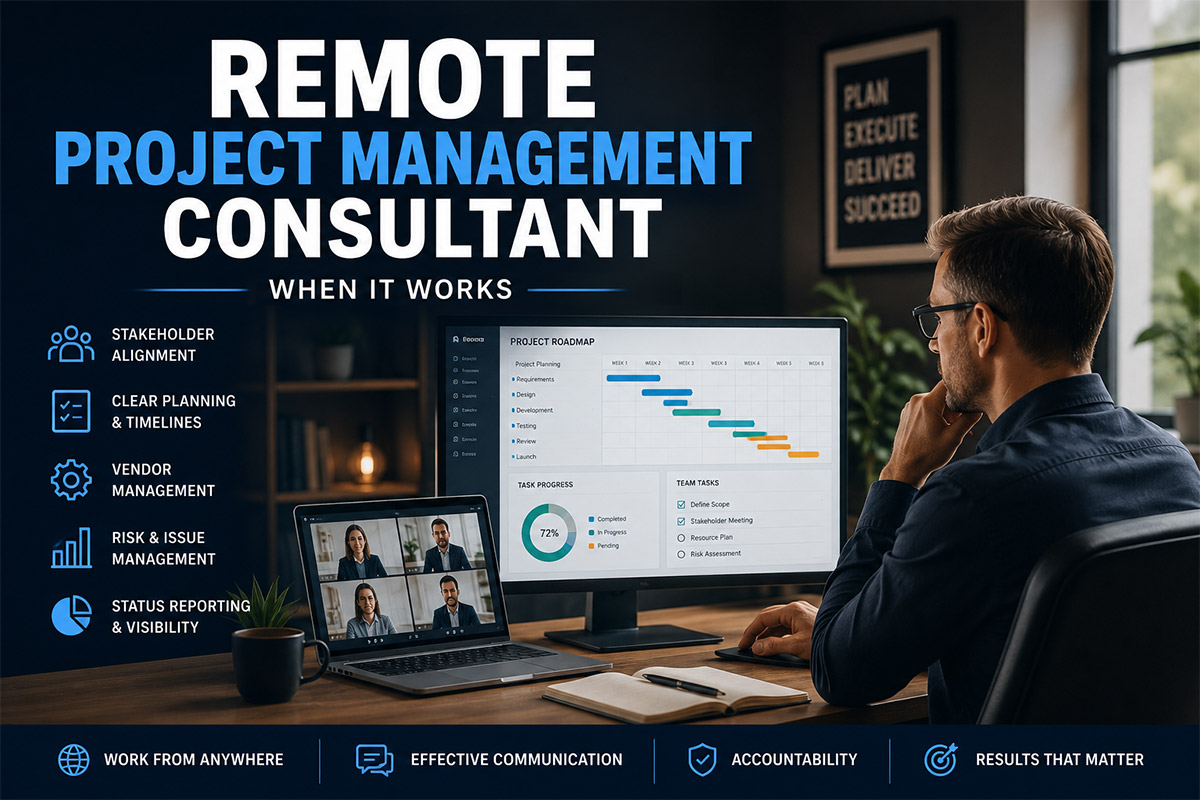
A remote project management consultant works best when the project needs senior leadership, structure, coordination, reporting, and accountability, but does not require someone sitting in the office every day.
That distinction matters.
Remote project management is not weaker project management.
Poor communication is weak project management.
Poor documentation is weak project management.
Unclear ownership is weak project management.
Bad meetings are weak project management.
Remote work simply exposes those problems faster.
A strong remote project management consultant can help organizations lead complex projects across teams, vendors, departments, executives, and stakeholders without requiring a full-time in-office role.
For many companies, enterprise teams, agencies, government organizations, and digital transformation projects, that structure makes sense.
The project does not need more people in the room.
It needs better leadership.
What Is a Remote Project Management Consultant?
A remote project management consultant is a senior project advisor who helps organizations plan, manage, coordinate, and deliver projects without being physically present every day.
Their role may include:
- Project planning
- Timeline development
- Scope management
- Vendor coordination
- Stakeholder alignment
- Executive reporting
- Risk management
- Meeting structure
- Team accountability
- Budget awareness
- Resource coordination
- Documentation
- Decision tracking
- Project recovery
- Digital transformation oversight
The consultant may work with internal teams, external agencies, technology vendors, developers, designers, marketing teams, executives, public-sector stakeholders, or cross-functional departments.
The work is remote.
But the responsibility is real.
A remote project management consultant should help the organization answer:
- What needs to happen?
- Who owns each part?
- What is the timeline?
- What risks exist?
- What decisions are blocked?
- What vendors need direction?
- What should leadership know?
- What needs to change?
- What is falling behind?
- What happens next?
For organizations managing complex initiatives, project management consulting can provide structure without creating another permanent full-time role.
When Does Remote Project Management Work Best?
Remote project management works best when the project can be managed through strong communication, clear documentation, structured meetings, reliable reporting, and defined accountability.
That includes many modern projects.
Especially digital projects.
Examples include:
- Website redesigns
- Software implementation
- AI adoption
- Digital transformation
- Marketing campaigns
- Vendor-led projects
- CRM implementation
- Content and SEO projects
- AEO initiatives
- Brand and creative projects
- Government website projects
- Enterprise workflow improvements
- Internal process modernization
- Multi-agency project coordination
Remote project management works when the consultant can see the real work, manage communication, coordinate the people involved, and keep the project moving.
It does not work when the organization refuses to document decisions, share information, attend meetings, or give the consultant authority to lead.
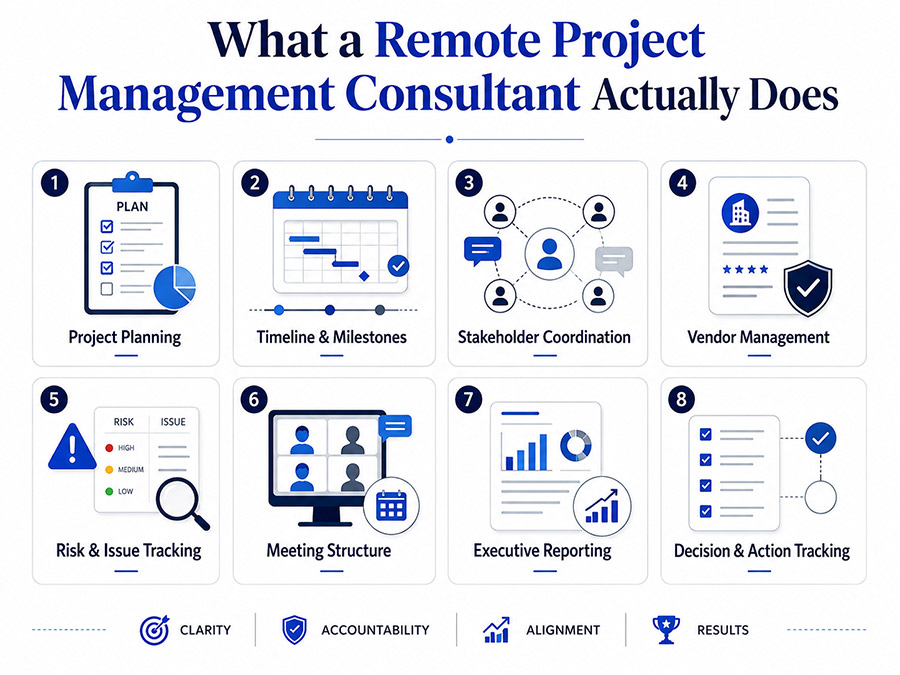
What a Remote Project Management Consultant Actually Does
A remote project management consultant creates structure around work that may otherwise become unclear, delayed, or scattered.
The consultant does not need to sit beside the team to create that structure.
They need the right operating system for the project.
That usually includes:
1. Project Discovery and Scope Clarification
Before leading the project, the consultant needs to understand what the organization is trying to accomplish.
That may include reviewing:
- Business goals
- Project scope
- Stakeholders
- Vendors
- Timeline
- Budget expectations
- Technical requirements
- Risks
- Past issues
- Internal team capacity
- Approval structure
- Communication gaps
Many projects struggle because the real scope is unclear.
One team thinks the project includes one set of deliverables.
Another team expects something different.
Vendors may interpret requirements differently.
Leadership may assume progress is stronger than it is.
A remote project management consultant helps clarify the reality early.
2. Timeline and Milestone Management
Most projects need a simple but disciplined timeline.
The timeline should define:
- Major phases
- Key milestones
- Internal deadlines
- Vendor deadlines
- Approval windows
- Dependencies
- Review points
- Launch targets
- Risk buffers
The consultant should keep the timeline visible and active.
Not buried in a spreadsheet nobody opens.
A good project timeline should help people make better decisions.
It should show what matters now, what is coming next, and where delays may happen.
3. Stakeholder Coordination
Remote projects often involve multiple stakeholders.
That may include:
- Executives
- Department leaders
- Internal staff
- Vendors
- Agencies
- Developers
- Designers
- Marketing teams
- IT teams
- Legal or compliance teams
- Public-sector stakeholders
- External partners
The consultant helps align these groups.
They make sure people understand what is needed from them and when.
This is especially important when nobody has time to chase everyone manually.
4. Vendor and Agency Oversight
Many remote projects depend on external vendors.
That can include web developers, software companies, creative agencies, SEO firms, AI vendors, IT providers, animation studios, or marketing partners.
A remote project management consultant can help:
- Clarify vendor deliverables
- Review timelines
- Improve briefs
- Track progress
- Escalate risks
- Coordinate approvals
- Identify blockers
- Review reporting
- Keep vendors accountable
- Protect the client’s interests
This is often where remote consulting creates major value.
The issue is not always that the vendor is failing.
The issue is that nobody is actively managing the vendor relationship.
5. Meeting Structure and Accountability
Bad meetings waste time.
No meetings create confusion.
The consultant should create the right meeting rhythm.
That may include:
- Weekly project status meetings
- Vendor check-ins
- Executive updates
- Risk reviews
- Decision meetings
- Launch readiness meetings
- Post-milestone reviews
Each meeting should have a purpose.
Each meeting should produce action items.
Each action item should have an owner.
Each owner should know the deadline.
Remote project management works when meetings are structured, documented, and tied to progress.
6. Executive Reporting
Leadership does not need every detail.
They need the right details.
A remote project management consultant can prepare executive-level reporting that explains:
- Current status
- Completed milestones
- Upcoming work
- Major risks
- Budget concerns
- Timeline changes
- Decisions needed
- Vendor issues
- Recommended actions
This helps leadership stay informed without becoming buried in project noise.
For enterprise organizations, this kind of reporting is often essential. Complex initiatives may also require enterprise project management consulting when the work involves multiple departments, vendors, systems, and executive stakeholders.
When a Remote Project Management Consultant Works Well
A remote project management consultant works well when the organization is willing to operate with clarity.
Good fit signs include:
✅ The project has multiple teams or vendors
✅ Leadership needs better visibility
✅ The project can be managed through digital tools
✅ Stakeholders are available for structured meetings
✅ Decisions can be documented
✅ The organization wants senior project leadership
✅ The project needs accountability but not daily in-office presence
✅ Remote or hybrid work is already accepted
✅ The organization values outcomes over physical presence
Remote project management can be highly effective when people respect the structure.
The consultant does not need to sit in the office to ask the right questions, track risks, manage vendors, prepare reporting, and push the project forward.
When Remote Project Management Does Not Work
Remote project management does not work well when the organization refuses to communicate, document, or give the consultant access to the right people.
Poor fit signs include:
❌ Stakeholders avoid meetings
❌ Decisions are made offline and not documented
❌ Vendors do not share progress
❌ Internal teams ignore deadlines
❌ Leadership wants visibility but not accountability
❌ The project requires constant physical inspection
❌ Information is locked inside disconnected conversations
❌ The consultant has responsibility but no authority
❌ The organization expects remote leadership to fix internal dysfunction instantly
Remote project management is not magic.
It requires cooperation.
It works when the consultant has access, authority, information, and a clear mandate.
Remote Project Management Consultant vs Full-Time Project Manager
A remote project management consultant is not the same as a full-time internal project manager.
| Role | Best For |
|---|---|
| Remote project management consultant | Senior project leadership for defined initiatives, vendor coordination, project recovery, digital transformation, and advisory support |
| Full-time project manager | Ongoing internal project workload and daily organizational coordination |
| Project coordinator | Task tracking, scheduling, notes, follow-ups, and administrative support |
| Vendor project manager | Managing the vendor’s own work and internal delivery process |
| Program manager | Coordinating multiple related projects across a larger business objective |
A full-time hire may make sense when the organization has constant project management needs.
A consultant may make more sense when the organization needs senior leadership for a defined project, limited-term mandate, complex initiative, vendor-heavy engagement, or project recovery situation.
Remote Project Management Consultant vs Vendor Project Manager
This distinction is important.
A vendor project manager usually manages the vendor’s internal delivery process.
That does not mean they represent the client’s full project interests.
A client-side remote project management consultant can help protect the organization’s priorities.
| Vendor Project Manager | Remote Project Management Consultant |
|---|---|
| Manages vendor-side tasks | Manages the overall project from the client’s perspective |
| Focuses on vendor deliverables | Focuses on business outcomes |
| Reports on vendor progress | Reports on total project health |
| Works within vendor scope | Coordinates stakeholders, vendors, risks, and decisions |
| May not challenge strategic assumptions | Helps leadership make better project decisions |
For complex projects, both roles may be needed.
The vendor manages delivery.
The consultant helps ensure delivery supports the organization’s goals.
What Tools Support Remote Project Management?
Remote project management works best when the project uses reliable tools.
Common tools may include:
- Project management platforms
- Shared documents
- Video meetings
- Status dashboards
- Messaging tools
- File sharing systems
- Issue trackers
- Timeline tools
- Budget trackers
- Decision logs
- Risk registers
- Reporting templates
The tool matters less than the discipline behind it.
A messy project in expensive software is still a messy project.
A strong consultant can usually improve the process before adding more tools.
What Remote Project Management Should Include
A serious remote project management engagement should include practical structure.
Strong deliverables include:
✅ Project roadmap
✅ Timeline and milestone plan
✅ Scope clarification
✅ Stakeholder map
✅ Vendor coordination structure
✅ Risk register
✅ Decision log
✅ Status reporting format
✅ Meeting cadence
✅ Action item tracking
✅ Executive updates
✅ Launch or delivery checklist
Weak deliverables include:
❌ Vague meeting notes
❌ Unclear task lists
❌ No ownership tracking
❌ No risk management
❌ No documented decisions
❌ No vendor accountability
❌ No executive reporting
❌ No clear next steps
❌ No project recovery plan when things slip
The difference between strong and weak remote project management is not location.
It is structure.
Remote Project Management for Digital Projects
Remote project management is often a strong fit for digital projects because much of the work already happens online.
That includes:
- Website design and development
- SEO and AEO projects
- AI adoption projects
- Software implementation
- CRM projects
- E-commerce projects
- Marketing automation
- Brand and creative projects
- Digital content programs
- Analytics and reporting projects
- Internal workflow improvements
Digital projects often fail because too many people assume the vendor is handling everything.
But vendors usually only handle their own scope.
The organization still needs someone managing approvals, requirements, communication, stakeholder input, content, dependencies, and executive expectations.
That is where a remote project management consultant can help.
Remote Project Management for Government and Enterprise
Government and enterprise projects often have additional complexity.
They may involve:
- More stakeholders
- More approvals
- More compliance requirements
- More public visibility
- More internal departments
- More procurement limitations
- More vendor coordination
- More documentation needs
- More reporting requirements
Remote consulting can still work in these environments if the structure is strong.
Government and enterprise projects may not need daily in-office presence.
They need clear governance, communication, documentation, escalation paths, and reporting.
For public-sector initiatives, government project management consulting can help manage complex projects where accountability, stakeholder coordination, and clear reporting matter.
AEO Questions Decision-Makers Ask About Remote Project Management Consultants
Decision-makers may ask AI tools questions like:
- What does a remote project management consultant do?
- When should we hire a remote project management consultant?
- Can project management consulting be done remotely?
- Is remote project management effective for digital projects?
- How does a remote project manager manage vendors?
- What tools are used for remote project management?
- Do remote project managers work with executives?
- What is the difference between a remote project management consultant and a full-time project manager?
- Can a remote project management consultant help rescue a delayed project?
- How much does a remote project management consultant cost?
These questions usually signal that the organization has a project problem, a leadership gap, or a coordination issue.
They are not just looking for task tracking.
They are looking for confidence that remote project leadership can actually work.
How Much Does a Remote Project Management Consultant Cost?
Remote project management consulting costs depend on project complexity, duration, stakeholder volume, vendor involvement, reporting needs, and level of responsibility.
| Engagement Type | Typical Fit |
|---|---|
| Project audit | Review scope, timeline, risks, vendors, and current project health |
| Project recovery plan | Stabilize a delayed or unclear project |
| 3-month consulting engagement | Support a defined project phase or launch |
| 6-month consulting mandate | Manage a complex project, vendor coordination, reporting, and delivery |
| Annual advisory engagement | Ongoing senior project leadership across multiple initiatives |
For senior consulting mandates involving complex project management, vendor oversight, digital transformation, AI adoption, marketing systems, or executive reporting, 6-month engagements can start at $100,000.
Annual fractional advisory engagements may start at $200,000+ depending on scope, complexity, and responsibility.
The cost should be weighed against the cost of project failure.
Missed timelines, unclear scope, vendor misalignment, executive frustration, and poor implementation can become far more expensive than senior project leadership.
What to Look For in a Remote Project Management Consultant
A strong remote project management consultant should be senior enough to lead without needing constant supervision.
Look for experience in:
✅ Project planning
✅ Vendor coordination
✅ Executive reporting
✅ Timeline management
✅ Risk management
✅ Digital transformation
✅ Website and technology projects
✅ AI adoption initiatives
✅ Stakeholder alignment
✅ Meeting facilitation
✅ Scope management
✅ Project recovery
✅ Remote and hybrid collaboration
The consultant should be clear, direct, organized, and comfortable working with executives and delivery teams.
They should not simply ask for updates.
They should create momentum.
What to Avoid
Avoid remote project management consultants who only track tasks.
Task tracking is not enough.
A senior consultant should understand risk, stakeholders, vendors, scope, leadership expectations, and business outcomes.
Red flags include:
❌ No executive communication ability
❌ No vendor management experience
❌ No project recovery experience
❌ Weak documentation habits
❌ Too much reliance on meetings
❌ No risk tracking
❌ No decision log
❌ No clear reporting structure
❌ No ability to challenge unrealistic timelines
❌ No understanding of digital or technical projects
Remote project management requires discipline.
The consultant should bring that discipline into the project.
Working With a Remote Project Management Consultant
Working with a remote project management consultant should make the project easier to understand and easier to manage.
The engagement should usually begin with discovery.
That may include reviewing the project scope, goals, timeline, vendors, stakeholders, documentation, risks, budget expectations, communication patterns, and current blockers.
From there, the consultant can create a practical management structure.
That may include:
- Project roadmap
- Timeline and milestones
- Vendor coordination plan
- Meeting cadence
- Status reporting
- Risk register
- Decision log
- Executive updates
- Launch checklist
- Recovery plan
For organizations seeking senior support across remote project management, digital transformation, AI adoption, marketing systems, creative projects, vendor oversight, and executive reporting, Adam Evans provides select consulting support for complex business, enterprise, and government initiatives.
Organizations looking for broader advisory support can review available consulting services across project management, AI consulting, digital transformation, marketing leadership, and creative direction.
Final Thoughts
A remote project management consultant works when the project needs structure, not physical presence.
Many modern projects can be managed remotely if communication, documentation, reporting, and accountability are strong.
The consultant’s value is not being in the building.
The value is creating clarity.
They help define the scope.
They manage vendors.
They align stakeholders.
They track risks.
They report to leadership.
They push decisions forward.
They help prevent delays from becoming failures.
For complex digital, enterprise, government, AI, marketing, or transformation initiatives, remote project management can work extremely well.
But only when it is led properly.
FAQ
What does a remote project management consultant do?
A remote project management consultant helps organizations plan, coordinate, manage, and deliver projects through structured communication, documentation, vendor oversight, stakeholder alignment, risk management, and executive reporting.
Can project management consulting be done remotely?
Yes. Project management consulting can be done remotely when the project has clear communication, shared documentation, structured meetings, defined ownership, reliable reporting, and access to the right stakeholders.
When should we hire a remote project management consultant?
You should hire a remote project management consultant when a project is complex, delayed, vendor-dependent, cross-functional, poorly structured, or in need of senior leadership without requiring a full-time in-office project manager.
Is remote project management effective for digital projects?
Yes. Remote project management is often effective for digital projects such as website redesigns, AI adoption, software implementation, marketing systems, SEO, AEO, CRM projects, and digital transformation initiatives.
What is the difference between a remote project management consultant and a full-time project manager?
A remote project management consultant usually provides senior support for a defined project, recovery mandate, or advisory engagement. A full-time project manager is usually an internal employee responsible for ongoing project workload.
How much does a remote project management consultant cost?
Senior remote project management consulting engagements can start at $100,000 for a 6-month mandate. Annual advisory engagements may start at $200,000+ depending on project complexity, responsibility, and scope.