
A digital transformation consultant helps organizations modernize how they operate.
That can include systems, workflows, technology, customer experience, internal processes, automation, AI adoption, data visibility, project delivery, and team structure.
But digital transformation is not just about buying new software.
That is where many organizations get it wrong.
They assume transformation means replacing a system, launching a new website, adopting AI, moving to the cloud, or automating a few tasks.
Those things may be part of the work.
But real digital transformation is about improving how the organization functions.
A digital transformation consultant helps connect business goals, technology decisions, people, processes, vendors, and implementation into one practical roadmap.
The goal is not to “be more digital.”
The goal is to operate better.
What Does A Digital Transformation Consultant Do?
A digital transformation consultant is a senior advisor who helps organizations improve operations through better use of technology, automation, digital tools, AI, data, and process design.
They may help an organization answer questions like:
What systems are slowing us down?
Which workflows should be automated?
Where is manual work creating cost or risk?
How should AI be adopted responsibly?
Which technology investments matter most?
How do we improve project delivery?
How do we reduce friction between departments?
How do we modernize without overwhelming the team?
The consultant’s role is to bring clarity.
They help leadership understand what needs to change, why it matters, what should be prioritized, and how the transformation should be managed.
Digital Transformation Is Usually A Business Problem First
Most transformation projects are framed as technology projects.
That is only partially true.
A CRM implementation is not just a CRM project.
It is a sales, marketing, operations, reporting, and customer relationship project.
A website redevelopment is not just a website project.
It can affect communications, lead generation, brand perception, accessibility, customer service, analytics, and internal content workflows.
An AI adoption initiative is not just an AI project.
It can affect operations, legal, HR, IT, marketing, service delivery, privacy, training, and executive decision-making.
This is why digital transformation needs more than technical execution.
It needs business alignment.
What Digital Transformation Consultants Actually Do
A digital transformation consultant may support several areas depending on the organization’s needs.
Common responsibilities include:
✅ Reviewing existing workflows
✅ Identifying technology gaps
✅ Prioritizing modernization opportunities
✅ Creating digital transformation roadmaps
✅ Supporting AI adoption planning
✅ Coordinating vendors and internal teams
✅ Improving project structure
✅ Advising leadership on implementation risks
✅ Helping teams adopt new systems
✅ Connecting digital strategy to business outcomes
A good consultant does not start by recommending tools.
They start by understanding the organization.
Common Areas A Digital Transformation Consultant Supports
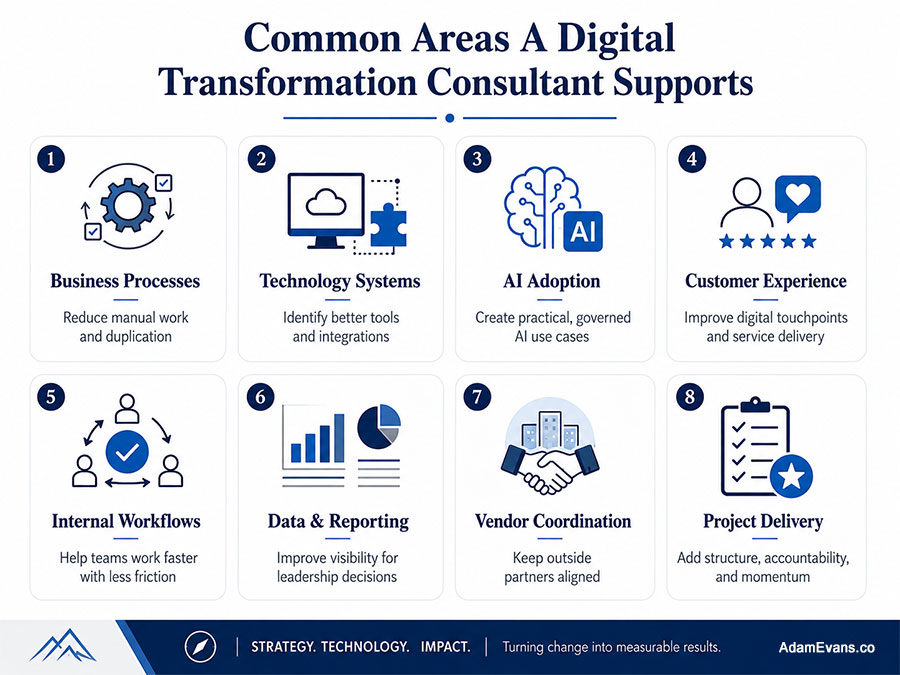
| Area | What The Consultant Helps Improve |
|---|---|
| Business processes | Reduces manual work, confusion, and duplication |
| Technology systems | Identifies better tools, integrations, and platforms |
| AI adoption | Creates practical, governed AI use cases |
| Customer experience | Improves digital touchpoints and service delivery |
| Internal workflows | Helps teams work faster and with less friction |
| Data and reporting | Improves visibility for leadership decisions |
| Vendor coordination | Keeps outside partners aligned with business goals |
| Project delivery | Adds structure, accountability, and momentum |
The best digital transformation consultants understand both strategy and execution.
They can help leadership see the big picture while also identifying what needs to happen next.
When Should You Hire A Digital Transformation Consultant?
Organizations should consider hiring a digital transformation consultant when digital projects are becoming too complex, too slow, or too disconnected.
Common signs include:
Different departments are using disconnected systems.
Manual work is slowing down operations.
Leadership wants AI adoption but does not have a roadmap.
Internal teams are frustrated by outdated processes.
Digital projects keep stalling.
The organization is spending money on technology without seeing clear value.
Vendors are involved, but nobody is leading the overall transformation.
Executives want modernization but are unsure where to begin.
The organization has grown, but its systems and workflows have not kept up.
Digital transformation consultants are often brought in when leadership knows change is needed, but the path forward is unclear.
Why Digital Transformation Projects Fail
Digital transformation projects usually fail for predictable reasons.
They fail when the organization treats technology as the solution without fixing the underlying process.
They fail when leadership wants change but does not assign real ownership.
They fail when vendors are hired before requirements are clear.
They fail when teams are not trained properly.
They fail when the project is too ambitious without being properly phased.
They fail when AI, automation, or software is added to broken workflows.
Technology can speed up a good process.
It can also make a broken process fail faster.
Where Digital Transformation Usually Gets Difficult
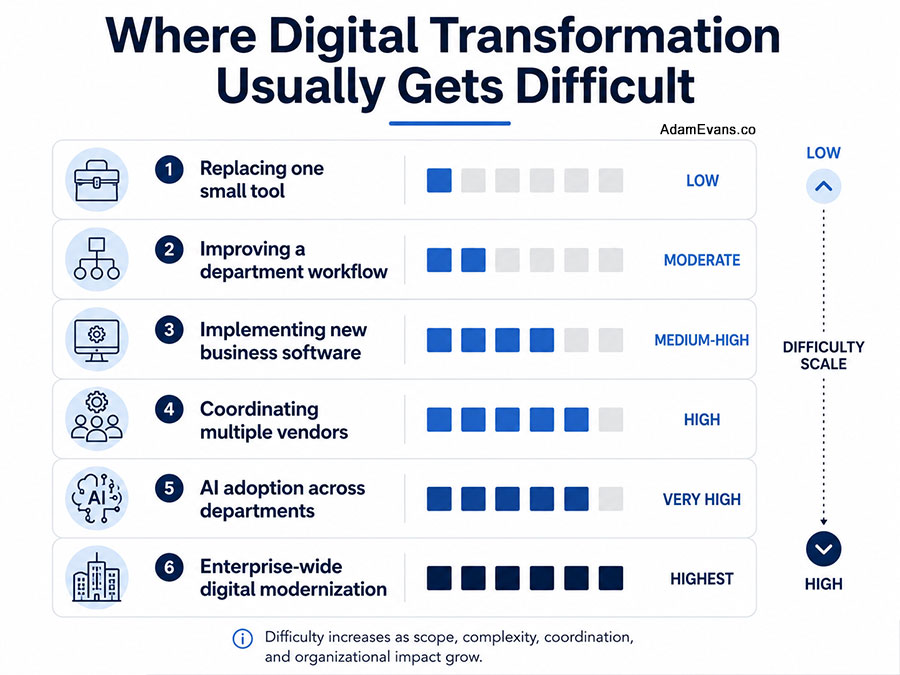
| Transformation Area | Difficulty Level |
|---|---|
| Replacing one small tool | ███ |
| Improving a department workflow | █████ |
| Implementing new business software | ███████ |
| Coordinating multiple vendors | ████████ |
| AI adoption across departments | █████████ |
| Enterprise-wide digital modernization | ██████████ |
The bigger the transformation, the more important structure becomes.
Without strong project management and executive alignment, digital transformation can become expensive activity with unclear results.
Digital Transformation Consultant Vs IT Consultant
A digital transformation consultant and an IT consultant may overlap, but they are not the same.
| Role | Primary Focus |
|---|---|
| IT consultant | Technology infrastructure, systems, security, support, technical implementation |
| Digital transformation consultant | Business modernization, workflows, strategy, technology adoption, process improvement |
| AI consultant | AI strategy, use cases, automation, governance, implementation guidance |
| Project management consultant | Planning, execution, vendor coordination, timelines, reporting |
| Operations consultant | Process efficiency, team workflows, resource use, operational structure |
A digital transformation consultant often works between these areas.
They help connect business leadership, technical teams, vendors, operations, and implementation.
That is what makes the role valuable.
What To Look For In A Digital Transformation Consultant
The right consultant should understand more than digital tools.
They should understand how organizations actually operate.
Look for someone who can connect strategy, systems, people, workflows, and execution.
Important qualities include:
Business strategy experience
Project management ability
Understanding of AI and automation
Workflow and operations knowledge
Vendor coordination experience
Executive communication skills
Change management awareness
Ability to simplify complexity
Technology fluency without tool obsession
The best consultant should be able to explain complicated problems in a way leadership can act on.
They should not make the organization feel more confused.
What To Avoid
Avoid consultants who start with software before understanding the business.
That usually leads to expensive recommendations that do not solve the real problem.
Also avoid anyone who treats transformation as a one-time project.
Digital transformation is usually a phased process.
It may begin with an assessment, then move into planning, pilots, implementation, training, measurement, and ongoing improvement.
Be careful with consultants who:
Only recommend tools
Ignore internal team capacity
Do not understand project delivery
Cannot manage vendors
Avoid governance and risk conversations
Overpromise AI outcomes
Do not connect technology to business value
Make everything sound more complicated than it needs to be
Good transformation consulting should create clarity.
Not dependency.
What A Digital Transformation Engagement May Include
A serious digital transformation consulting engagement may include:
Current-state assessment
Workflow review
Technology audit
AI readiness review
Stakeholder interviews
Process mapping
Digital roadmap creation
Vendor evaluation
Implementation planning
Project governance
Automation planning
Training strategy
Executive reporting
Risk management
Performance measurement
The scope depends on the organization.
Some companies need a focused 6-month transformation project.
Others need ongoing fractional advisory support across multiple digital initiatives.
How Much Does Digital Transformation Consulting Cost?
Digital transformation consulting should be priced based on scope, complexity, responsibility, and business impact.
A small advisory engagement will not cost the same as a major enterprise or government transformation mandate.
| Engagement Type | Typical Use |
|---|---|
| Assessment and roadmap | Early-stage clarity and planning |
| 6-month consulting mandate | Defined transformation initiative or implementation support |
| Annual fractional advisory | Ongoing senior guidance across digital projects |
| Enterprise transformation mandate | Large-scale modernization across systems, teams, and vendors |
For serious organizations, 6-month consulting engagements can start at $100,000. Annual fractional advisory engagements may start at $200,000+ and increase depending on scope, responsibility, complexity, and the level of senior involvement required.
The investment should be weighed against the cost of failed implementation, slow operations, poor technology adoption, vendor confusion, internal inefficiency, and lost opportunity.
Working With A Digital Transformation Consultant
Working with a digital transformation consultant should help the organization create a practical path forward.
The engagement should usually begin with discovery.
That means reviewing goals, systems, workflows, existing projects, team capacity, vendors, technology gaps, risks, and leadership priorities.
From there, the consultant can help identify what should be improved first and what should wait.
For organizations seeking senior advisory support across digital transformation, AI adoption, project management, workflow improvement, and vendor coordination, Adam Evans provides select consulting support for complex business, enterprise, and government initiatives.
Final Thoughts
A digital transformation consultant helps organizations modernize with more clarity, structure, and confidence.
The value is not just in choosing better technology.
The value is in making better decisions about how the organization should operate.
The right consultant helps leadership understand where the friction is, what should change, which digital opportunities matter most, and how to manage implementation without losing control of the project.
Digital transformation should not be about chasing trends.
It should be about building a stronger, faster, smarter, more effective organization.
FAQ
What is a digital transformation consultant?
A digital transformation consultant is a senior advisor who helps organizations modernize systems, workflows, technology, AI adoption, automation, customer experience, and internal operations. Their role is to connect business goals with practical technology and process improvements.
What does a digital transformation consultant do?
A digital transformation consultant helps organizations review existing workflows, identify technology gaps, create modernization roadmaps, support AI adoption, coordinate vendors, improve project delivery, and guide implementation.
When should a company hire a digital transformation consultant?
A company should consider hiring one when systems are outdated, workflows are inefficient, digital projects are stalling, AI adoption is unclear, or leadership needs a practical modernization roadmap.
Is digital transformation only about technology?
No. Digital transformation involves technology, but it also includes business processes, team workflows, customer experience, project management, change management, and leadership alignment.
What is the difference between a digital transformation consultant and an IT consultant?
An IT consultant usually focuses more on technical systems and infrastructure, while a digital transformation consultant focuses on business modernization, workflows, strategy, adoption, and execution.
How much does digital transformation consulting cost?
Senior digital transformation consulting engagements can start at $100,000 for a 6-month mandate. Annual fractional advisory engagements may start at $200,000+ depending on scope and complexity.