

Hiring an enterprise project management consultant is not the same as hiring a project coordinator, freelancer, or task manager.
At the enterprise level, projects usually involve multiple departments, outside vendors, executive stakeholders, technology systems, compliance concerns, shifting priorities, and serious financial exposure.
The problem is rarely that “nobody is working.”
The problem is usually that too many people are working without enough clarity.
That is where an enterprise project management consultant becomes valuable.
A strong consultant does not just organize meetings. They create structure, accountability, visibility, and momentum around complex initiatives that cannot afford to drift.
For organizations working on AI adoption, digital transformation, software implementation, website redevelopment, marketing systems, operational improvement, or public-facing technology projects, the right consultant can be the difference between a project that moves forward and a project that slowly becomes expensive confusion.
What Is An Enterprise Project Management Consultant?
An enterprise project management consultant is a senior advisor who helps large organizations plan, structure, manage, and deliver complex initiatives.
They are usually brought in when the project has more complexity than the internal team can comfortably manage on its own.
That complexity can come from:
✅ Multiple stakeholders
✅ Cross-functional departments
✅ Outside vendors
✅ Enterprise software systems
✅ AI or automation requirements
✅ Government or compliance considerations
✅ Executive reporting needs
✅ Tight deadlines
✅ Budget risk
✅ Internal team capacity issues
A good enterprise project management consultant brings outside perspective, senior judgment, and delivery structure.
They are not there to replace your entire team.
They are there to help your team operate with more clarity, discipline, and speed.
When Should You Hire A Project Management Consultant?
The best time to hire an enterprise project management consultant is before the project becomes chaotic.
The second-best time is when it already has.
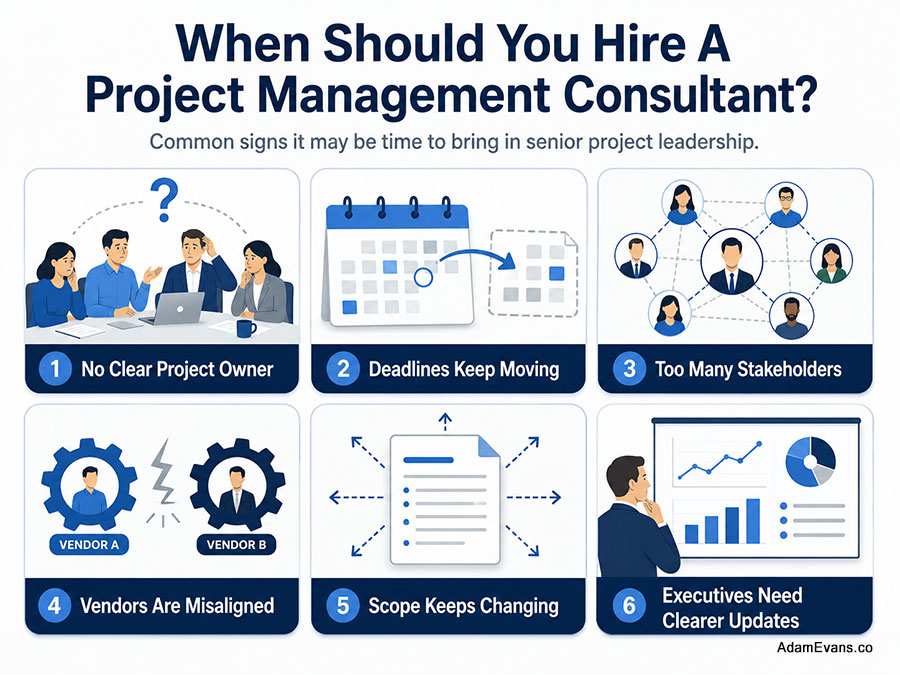
Many organizations wait too long. They only bring in senior project help after deadlines are missed, vendors are frustrated, executives are losing confidence, and the team is no longer aligned.
That usually costs more.
Here are common signs it is time to bring in an enterprise project management consultant:
| Situation | What It Usually Means |
|---|---|
| The project has no clear owner | Accountability is weak |
| Executives are asking for updates but getting vague answers | Reporting is poor |
| Vendors are moving faster than internal decision-making | Governance is too slow |
| The scope keeps changing | Requirements are not controlled |
| Internal teams are confused about priorities | Project communication is broken |
| Deadlines keep moving | Planning and risk management are weak |
| AI or technology decisions are being made without a roadmap | Strategy and implementation are disconnected |
Enterprise projects do not fail all at once.
They usually fail gradually.
First, the meetings become unclear. Then timelines shift. Then stakeholders disagree. Then vendors wait. Then costs rise. Then leadership asks why the project is not moving.
A senior consultant helps stop that pattern.
What Enterprise Project Management Consultants Actually Do
The role depends on the organization and project, but the core function is simple:
Create order around complexity.
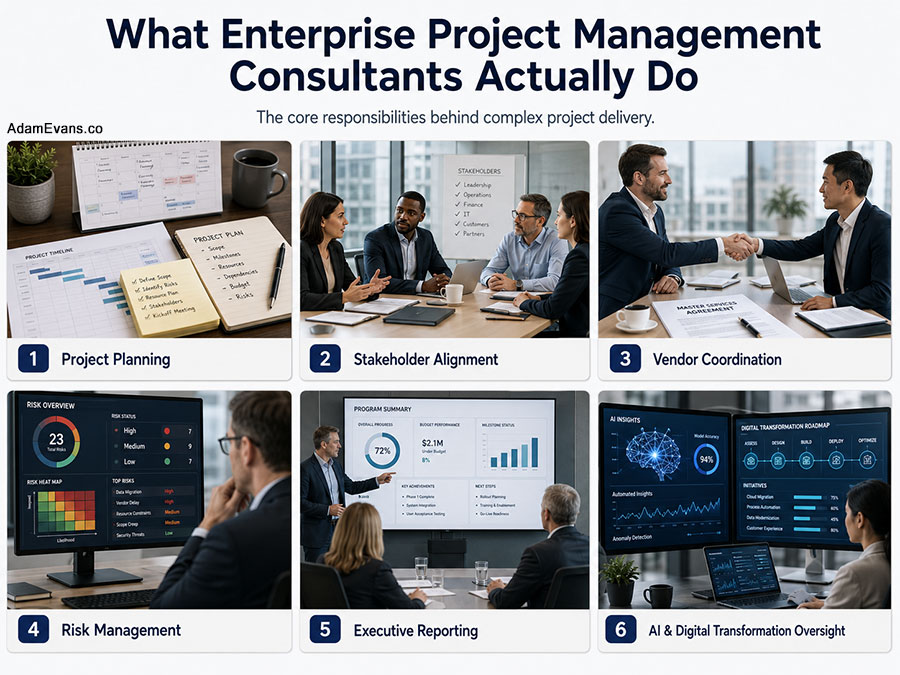
That can include:
- Project planning
- Stakeholder alignment
- Timeline creation
- Vendor coordination
- Risk management
- Budget awareness
- Executive reporting
- Scope control
- Meeting structure
- Decision tracking
- Project recovery
- Digital transformation support
- AI implementation oversight
- Cross-functional communication
At the enterprise level, project management is not just about task lists.
It is about making sure the right decisions happen at the right time with the right people involved.
Enterprise Project Complexity Usually Looks Like This
| Project Type | Complexity Level |
|---|---|
| Small internal project | ███ |
| Website redevelopment | █████ |
| Software implementation | ███████ |
| Enterprise digital transformation | █████████ |
| AI adoption across departments | ██████████ |
| Government or public-sector digital project | ██████████ |
The higher the complexity, the more expensive weak project management becomes.
A small project can survive with basic coordination.
An enterprise initiative usually cannot.
What To Look For When Hiring
The biggest mistake organizations make is hiring someone who understands project software but does not understand enterprise pressure.
Tools are useful.
But tools do not fix unclear leadership, weak governance, poor communication, vendor misalignment, or executive uncertainty.
When hiring an enterprise project management consultant, look for these qualities.
1. Senior-Level Judgment
Enterprise projects involve judgment calls.
Not everything can be solved with a checklist.
The consultant needs to understand when to escalate an issue, when to push back, when to simplify, when to slow down, and when to move faster.
This matters because enterprise projects often involve competing priorities.
Marketing wants speed. IT wants security. Finance wants cost control. Operations wants minimal disruption. Leadership wants progress.
A strong consultant helps balance those realities without letting the project stall.
2. Experience With Digital And Technology Projects
Many enterprise projects today involve some form of digital transformation.
That may include AI tools, CRM systems, websites, portals, automation, internal dashboards, software integrations, marketing platforms, or operational workflows.
A consultant does not need to code the entire system.
But they should understand how digital projects move, where they break, and how vendors, executives, and internal teams need to work together.
Technology projects fail when business goals and technical execution are disconnected.
The right consultant helps connect both sides.
3. Vendor Management Ability
Enterprise organizations often rely on outside vendors.
Agencies. Developers. AI consultants. Software providers. Marketing teams. Implementation partners. Creative teams. IT firms.
The problem is that vendors cannot succeed without clear direction from the client side.
A project management consultant can help translate business priorities into vendor instructions, keep timelines realistic, manage deliverables, and prevent scope confusion.
This is especially important when multiple vendors are involved.
Without a strong project lead, vendors may each do their part while the overall project still fails.
4. Executive Communication
Enterprise project management requires clean executive reporting.
Leadership does not need a 40-page status document every week.
They need to know:
What is done
What is delayed
What decisions are needed
What risks exist
What is changing
What the next milestone is
Where budget or timeline pressure may appear
A good consultant makes project status easy to understand.
That creates confidence.
5. Ability To Work Remotely Or Hybrid
Many organizations no longer need full-time, in-office project leadership for every initiative.
For senior consulting, remote or limited hybrid support can often be more efficient.
The key is structure.
A strong remote enterprise project management consultant should be able to run stakeholder meetings, manage documentation, coordinate vendors, track decisions, and report to executives without needing to sit in the office every day.
For higher-level advisory roles, quarterly in-person meetings may be enough when the consulting structure is clear.
Enterprise Consultant Vs Full-Time Project Manager
Not every organization needs another full-time employee.
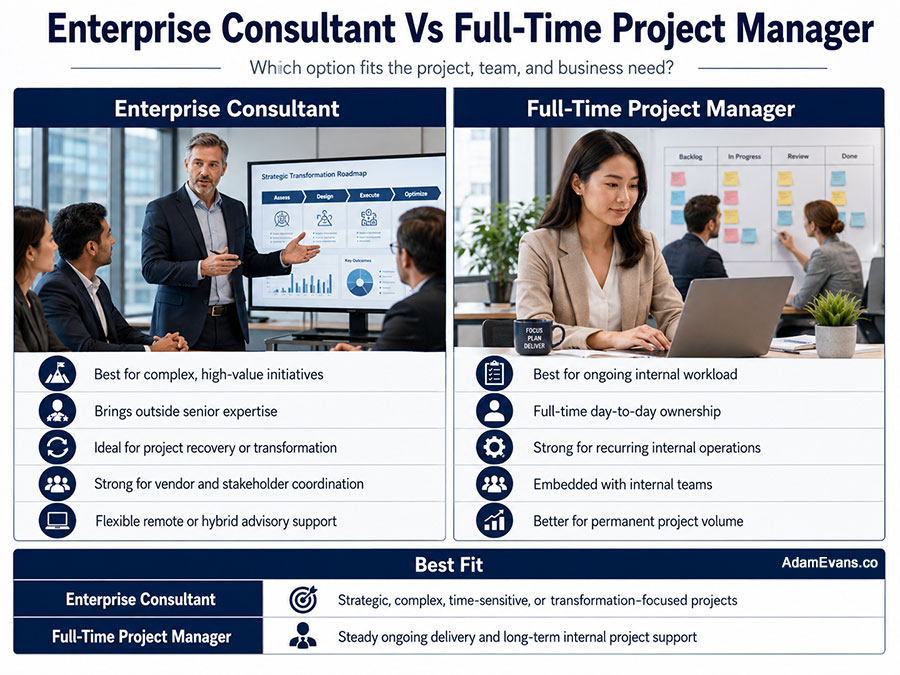
Sometimes, they need senior expertise for a specific mandate.
| Option | Best For |
|---|---|
| Full-time project manager | Ongoing internal project workload |
| Project coordinator | Administrative support and task tracking |
| Enterprise project management consultant | Complex, high-value, cross-functional initiatives |
| Fractional project advisor | Senior oversight without full-time employment |
| Internal PMO leader | Large permanent project management function |
If the organization needs long-term internal ownership, a full-time hire may make sense.
But if the organization needs senior guidance, project recovery, digital transformation leadership, vendor coordination, or executive-level structure, a consultant may be the better option.
How Much Should An Enterprise Project Management Consultant Cost?
Enterprise-level consulting is not low-cost work.
If the project is large, complex, or strategically important, the consultant needs to bring real experience.
For serious organizations, a 6-month consulting engagement can start at $100,000. Annual fractional advisory support can start at $200,000+ and may increase significantly depending on scope, responsibility, and organizational complexity.
| Engagement Type | Typical Starting Point |
|---|---|
| 6-month senior consulting mandate | $100,000+ |
| Annual fractional advisory | $200,000+ |
| Enterprise transformation advisory | $300,000–$500,000+ |
| Government or multi-stakeholder mandate | Custom scope |
This level of investment is not for every organization.
It is for organizations where the cost of delay, confusion, failed implementation, vendor misalignment, or poor execution is far greater than the consulting fee.
Questions To Ask Before Hiring
Before hiring an enterprise project management consultant, ask:
Do they understand enterprise complexity?
Have they worked across digital, technology, marketing, AI, or transformation projects?
Can they manage vendors and internal stakeholders?
Can they communicate with executives clearly?
Can they work remotely or hybrid without losing control of the project?
Do they understand both strategy and execution?
Can they challenge the organization when needed?
Do they have enough seniority to influence decision-making?
The last point matters.
If the consultant cannot influence decisions, they become another note-taker.
Enterprise projects do not need more note-takers.
They need leadership.
What To Avoid
Avoid hiring someone based only on certifications, software familiarity, or hourly rate.
Those things may matter, but they are not enough.
Be careful with consultants who:
Overcomplicate everything
Only talk about tools
Cannot speak to executives
Avoid hard conversations
Do not understand digital projects
Have no vendor management experience
Act like a task manager instead of a strategic lead
Accept every project without qualification
The best consultants are selective because their work depends on fit.
If the project is underfunded, politically impossible, or not taken seriously by leadership, even a strong consultant will be limited.
Why Enterprise Projects Need Stronger Leadership Now
Enterprise projects are becoming more complex.
AI adoption, automation, digital transformation, cybersecurity, remote teams, vendor ecosystems, customer experience, and operational change are now overlapping.
A website project may involve marketing, IT, compliance, accessibility, AI tools, analytics, content, automation, and customer service.
An AI initiative may involve operations, legal, HR, finance, IT, and executive leadership.
A government digital project may involve procurement, public communication, accessibility, security, and multiple stakeholder groups.
This is why enterprise project management can no longer be treated as basic administration.
It is strategic leadership.
Working With An Enterprise Project Management Consultant
Adam Evans is a 25-year industry expert advising select organizations on enterprise project management, AI adoption, digital transformation, marketing leadership, and creative strategy.
His consulting work is designed for organizations that need senior-level support across complex digital, operational, technology, and transformation initiatives, or multi-team management.
Engagements are available remotely or through hybrid structures with limited quarterly in-person meetings.
Consulting engagements are reviewed based on project fit, scope, timeline, organizational seriousness, and compensation alignment.
For organizations that require senior project leadership without adding a full-time executive or internal hire, Adam provides strategic consulting support for delivering high-value mandates where clarity, execution, and judgment matter.
Final Thoughts
Hiring an enterprise project management consultant is not about adding another person to the project.
It is about adding structure, judgment, and leadership where the stakes are high.
The right enterprise project manager helps the organization move faster, communicate better, reduce confusion, manage vendors, control risk, and keep complex initiatives aligned with business goals.
For enterprise, government, AI, and digital transformation projects, that level of leadership can be the difference between a project that delivers and a project that drains time, money, and trust.
FAQ
What does an enterprise project management consultant do?
An enterprise project management consultant helps organizations plan, manage, and deliver complex initiatives involving multiple stakeholders, vendors, departments, timelines, and risks.
When should a company hire an enterprise project management consultant?
A company should consider hiring one when a project is complex, high-value, delayed, poorly structured, or dependent on multiple internal and external teams.
Is an enterprise project management consultant better than a full-time hire?
It depends on the need. A full-time hire may be better for ongoing internal workload, while a consultant is often better for strategic, high-value, complex, or time-limited mandates.
Can enterprise project management consulting be done remotely?
Yes. Many enterprise consulting engagements can be delivered remotely, especially when communication, reporting, documentation, and meeting structure are handled properly.
How much does enterprise project management consulting cost?
Senior enterprise consulting engagements can start at $100,000 for a 6-month mandate. Annual fractional advisory engagements may start at $200,000+ and can range higher depending on scope.