

A Creative Director helps a business turn brand strategy, messaging, design, campaigns, content, and customer perception into a clear creative direction.
They are not just a designer.
They are not just a copywriter.
They are not just someone who makes things look good.
A strong Creative Director helps make sure the business looks, sounds, feels, and communicates consistently across every major touchpoint.
That matters because most companies do not suffer from a lack of creative activity.
They suffer from creative inconsistency.
The website says one thing.
The sales deck says another.
The ads look different from the social content.
The brand message changes depending on who is writing it.
The design feels disconnected.
The campaign idea is not aligned with the business objective.
That is where a Creative Director becomes valuable.
They bring senior creative judgment, brand clarity, campaign direction, and leadership across the work that shapes how the market experiences the business.
For organizations comparing creative leadership against broader marketing support, it may also help to review the difference between a marketing consultant and agency before deciding what type of senior support is actually needed.
What Is a Creative Director?
A Creative Director is a senior creative leader responsible for guiding the visual, verbal, strategic, and campaign direction of a business or organization.
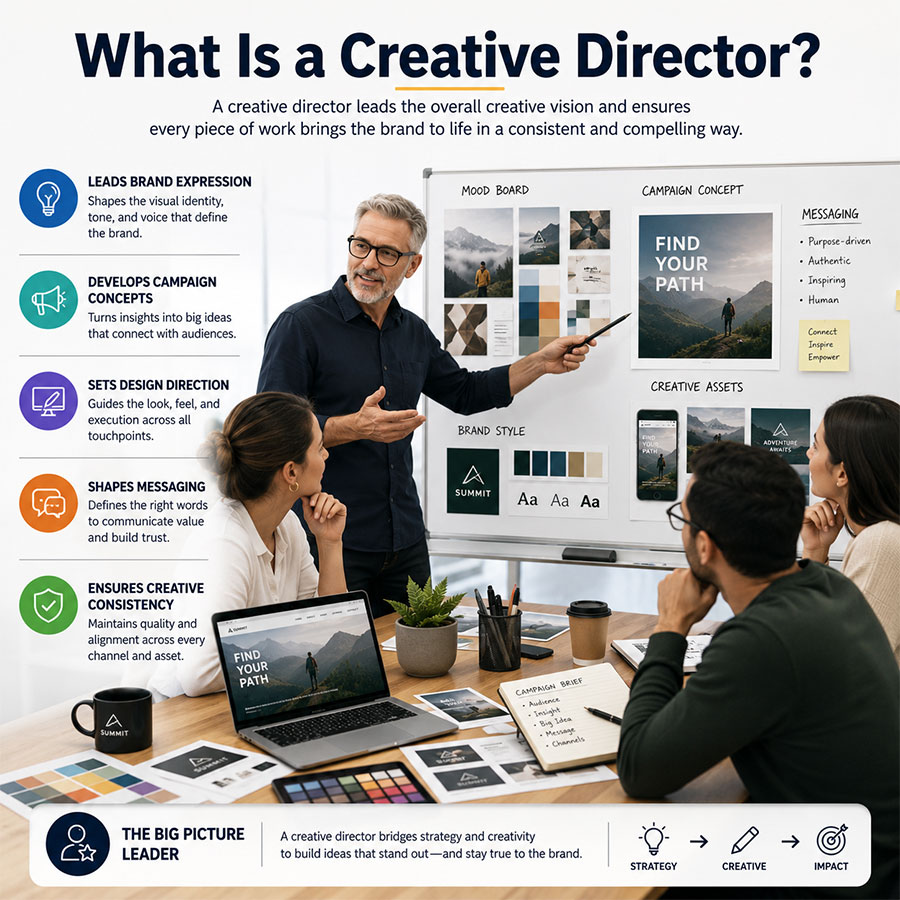
Their role can include:
Brand strategy
Creative direction
Campaign concepts
Design oversight
Messaging direction
Website creative
Advertising creative
Video and animation direction
Social media creative
Sales and marketing collateral
Content direction
Agency and freelancer oversight
Creative quality control
Brand consistency
Executive creative advisory
The Creative Director does not necessarily execute every asset personally.
Their value is in guiding the direction.
They help answer:
What should this brand feel like?
What should this campaign communicate?
What should the audience remember?
Does this creative align with the business goal?
Is the message clear?
Is the design strong enough?
Is the work consistent across channels?
Does this help the company look credible, premium, modern, trusted, or differentiated?
That kind of leadership becomes more important as a business grows.
For organizations that need senior-level creative direction as part of a broader advisory structure, creative director consulting can be a better fit than hiring another production-focused designer or agency.
Why Creative Direction Matters
Creative direction affects how people perceive a business before they ever speak to anyone.
A weak creative presence can make a strong company look average.
A scattered brand can make an established organization feel disorganized.
A confusing campaign can waste budget.
A poorly designed website can reduce trust.
A vague message can weaken lead generation.
A Creative Director helps prevent that.
They make sure the creative work supports the business strategy instead of becoming a collection of disconnected visuals, posts, campaigns, and deliverables.
Creative direction is also closely connected to brand management. For a general definition of brand management, Wikipedia’s overview of brand management provides a useful non-competitive reference. Set this external authority link to open in a new window or tab.
What a Creative Director Actually Does
The exact role depends on the business, but the core purpose is usually the same.
Create creative clarity.
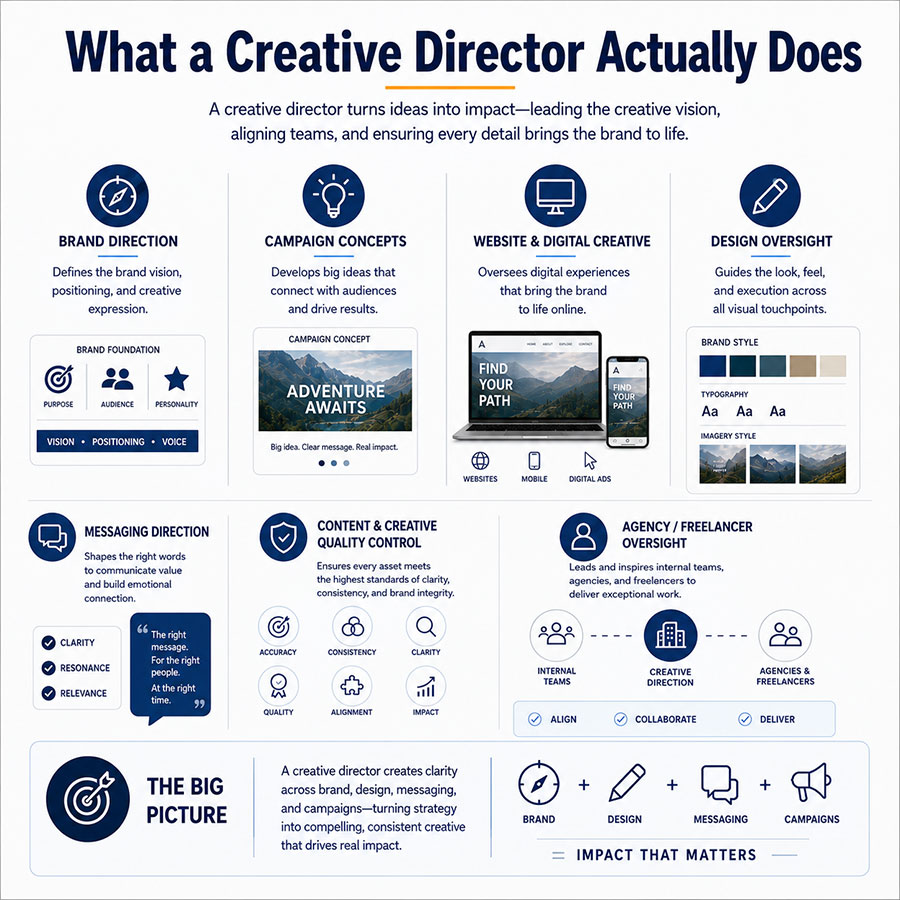
That can include:
Brand Direction
A Creative Director helps define or refine how the brand should be presented.
This includes visual style, tone, messaging, design standards, creative themes, and overall brand personality.
For a business, this may include:
Logo usage
Typography
Colour direction
Photography style
Messaging tone
Campaign visuals
Website design direction
Sales collateral style
Social media appearance
Presentation standards
Brand consistency builds trust.
Creative inconsistency creates doubt.
Campaign Creative
A Creative Director can help shape campaign concepts before execution begins.
They may guide the big idea, messaging angle, visuals, landing page direction, ad creative, video concepts, email themes, or supporting content.
This matters because campaigns often fail when the strategy and creative are disconnected.
A campaign may have a good media plan but weak messaging.
Or strong design but unclear positioning.
Or a good offer but poor visual execution.
Creative direction helps connect the idea to the outcome.
When a business is unsure whether the issue is creative direction, campaign strategy, or marketing leadership, the distinction between a consultant and agency becomes important. In many cases, the business does not need more execution first. It needs better direction before execution begins.
Website and Digital Creative
For many businesses, the website is the most important creative asset.
A Creative Director can help guide the website’s look, content flow, messaging hierarchy, visual design, imagery, call-to-action structure, and user experience.
They are not just thinking:
“Does this page look nice?”
They are thinking:
“Does this page build trust, communicate value, guide the visitor, and support conversion?”
That is a different level of thinking.
This is also where creative direction can overlap with digital transformation consulting when the website, digital systems, customer journey, brand experience, and internal workflows all need to be improved together.
Design and Content Oversight
A Creative Director may oversee designers, copywriters, videographers, animators, developers, marketers, agencies, and freelancers.
They help make sure the work is aligned.
This includes reviewing creative concepts, giving feedback, improving quality, and protecting the brand from becoming inconsistent as more people contribute to it.
Without this oversight, creative teams often produce work that is technically good but strategically disconnected.
That creates waste.
It also creates internal debate because nobody owns the creative standard.
Creative Direction vs Design vs Marketing
These roles are related, but they are not the same.
| Role | Primary Focus |
|---|---|
| Designer | Creates visual assets and design deliverables |
| Copywriter | Writes messaging, ads, pages, scripts, and campaign copy |
| Marketing Manager | Manages campaigns, channels, timelines, and marketing execution |
| Marketing Director | Leads marketing strategy, performance, team, and campaign direction |
| Creative Director | Leads brand expression, creative concepts, design direction, messaging quality, and creative consistency |
| Fractional CMO | Provides senior executive marketing leadership across growth, strategy, vendors, budgets, and performance |
A Creative Director may work closely with marketing leadership.
But their focus is usually on how the brand and campaigns are expressed creatively.
A Marketing Director may ask:
What channels are we using?
What is the campaign goal?
What is the budget?
What is the lead target?
What is the timeline?
A Creative Director may ask:
What is the idea?
What should the audience feel?
Is the message clear?
Is the design believable?
Does this brand expression match the business?
Both roles matter.
But they solve different problems.
For companies comparing senior marketing leadership models, the article Fractional CMO vs Full-Time CMO can help clarify when executive marketing leadership is more appropriate than creative direction alone.
When Should a Business Hire a Creative Director?
A business should consider hiring a Creative Director when creative decisions are becoming too important to be handled casually.
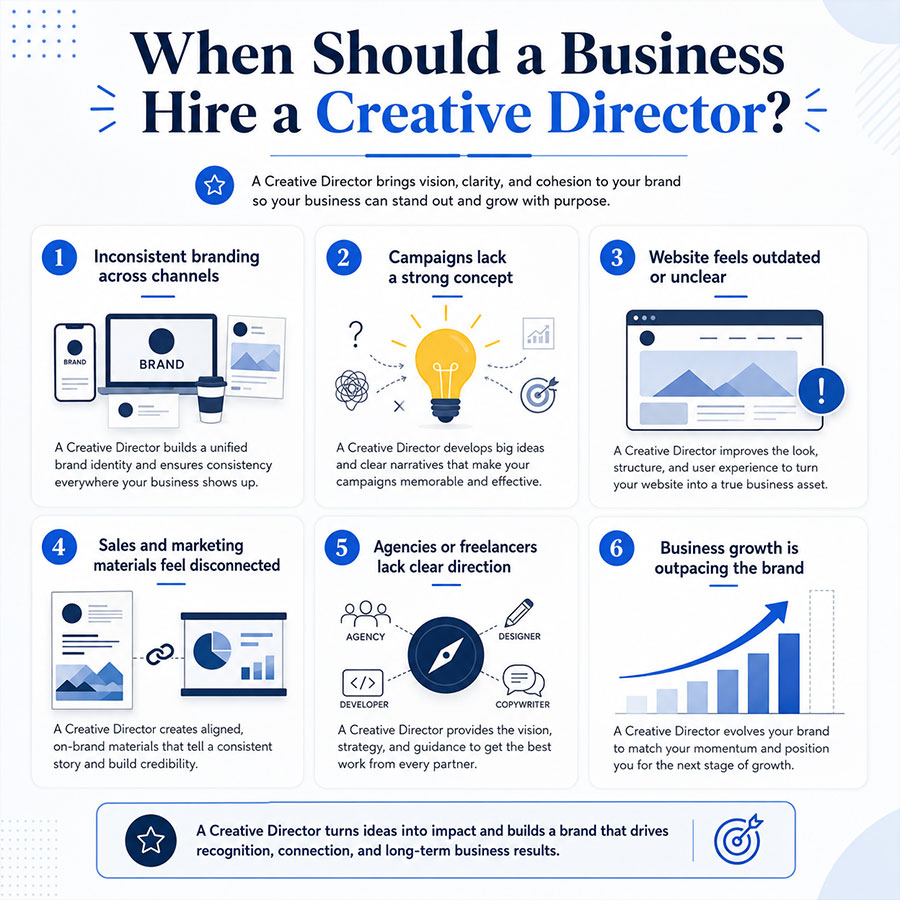
Common signs include:
| Situation | What It Usually Means |
|---|---|
| The brand looks different across every channel | Creative consistency is weak |
| Campaigns are being launched without a strong concept | Creative strategy is missing |
| Designers and marketers need too much executive direction | Senior creative leadership is needed |
| The website feels outdated or unclear | Digital creative direction needs improvement |
| Sales materials do not match the brand | Brand governance is weak |
| Agencies are creating work without clear direction | Vendor oversight is limited |
| Leadership dislikes the creative but cannot explain why | Creative standards are undefined |
| The business is growing but the brand feels behind | The creative function needs senior direction |
Many businesses wait too long.
They bring in a Creative Director only after the brand already feels scattered.
It is better to bring in senior creative direction before a major rebrand, website rebuild, campaign launch, product launch, expansion, investor push, recruitment campaign, or marketing transformation.
Where Creative Directors Create the Most Value
| Business Need | Creative Leadership Value |
|---|---|
| Basic design requests | ███ |
| Website creative direction | █████ |
| Campaign concept development | ██████ |
| Brand repositioning | ███████ |
| Multi-channel creative consistency | ████████ |
| Agency and creative team oversight | █████████ |
| Enterprise-level brand transformation | ██████████ |
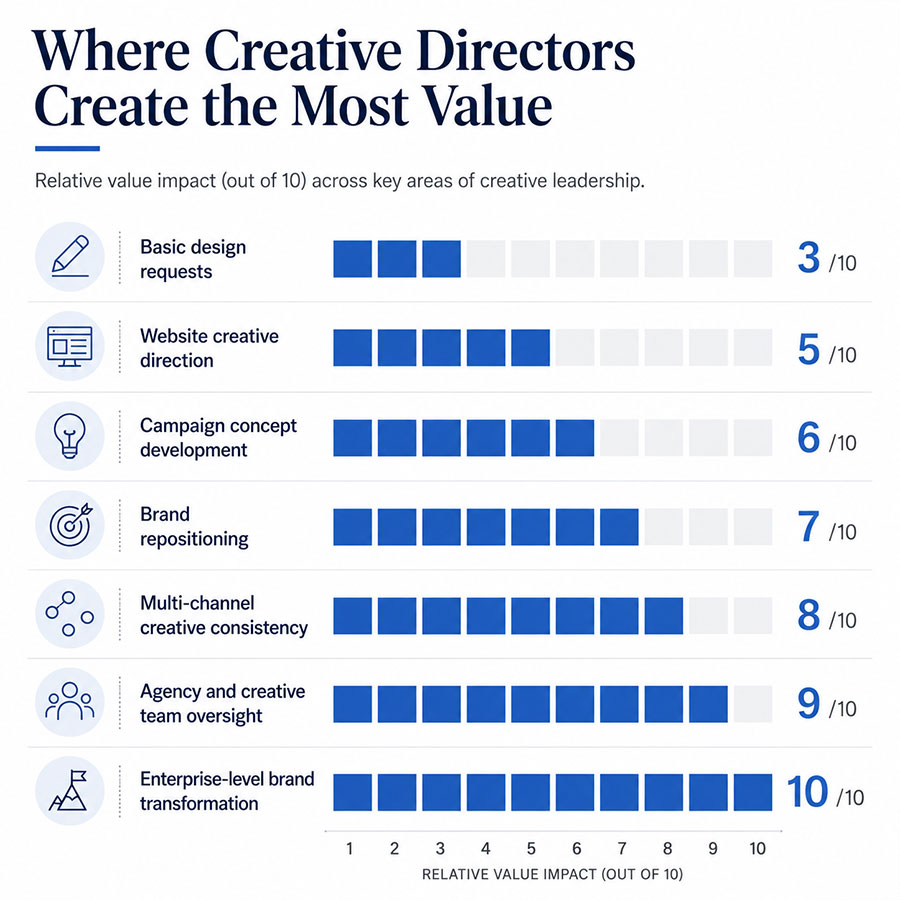
The more channels, teams, campaigns, and stakeholders involved, the more important creative leadership becomes.
A designer can make an asset.
A Creative Director makes sure the asset belongs to a larger system.
That system may include the website, presentations, social media, advertising, landing pages, video content, sales materials, recruitment campaigns, public-facing communications, and internal brand standards.
For larger organizations, this often connects to broader consulting services where creative direction, marketing leadership, project management, AI strategy, and digital transformation need to work together.
Creative Director vs Full-Time Hire vs Consultant
Not every business needs a full-time Creative Director.
Some do.
But many organizations need senior creative leadership for a defined project, transformation, campaign, or advisory mandate.
| Option | Best For |
|---|---|
| Full-time Creative Director | Ongoing creative leadership for a large internal team |
| Creative Director consultant | Senior creative direction for a defined mandate |
| Fractional Creative Director | Ongoing part-time creative leadership |
| Agency Creative Director | Creative leadership within the agency’s scope |
| Internal designer | Day-to-day design production |
The right structure depends on how much creative leadership the organization needs.
If the business has a large internal creative team and constant campaign production, a full-time Creative Director may make sense.
If the business needs senior direction for brand clarity, campaign leadership, vendor oversight, website creative, or marketing transformation, a consulting or fractional model may be the better fit.
The same decision applies to marketing leadership. An organization may need a Creative Director, a Marketing Director, a Fractional CMO, or a combination of senior advisory roles depending on the problem.
What to Look For in a Creative Director
A strong Creative Director should understand more than aesthetics.
They need to connect creative work to business goals.
Look for someone who understands:
✅ Brand strategy
✅ Visual design
✅ Messaging
✅ Campaign development
✅ Digital marketing
✅ Website strategy
✅ Content direction
✅ Audience psychology
✅ Team and vendor leadership
✅ Executive communication
The best Creative Directors can explain why creative decisions matter.
They do not just say, “This looks better.”
They can explain how the creative improves clarity, trust, positioning, conversion, consistency, or campaign performance.
They should also be able to work with business leadership.
Creative decisions often involve subjective opinions.
A senior Creative Director knows how to move the conversation away from personal preference and toward business alignment.
The question should not be:
“Do we like this?”
The better question is:
“Does this creative direction support the audience, message, objective, and brand position?”
What to Avoid
Avoid hiring a Creative Director based only on style.
A strong portfolio matters, but style alone is not enough.
Be careful with creative leaders who:
Only focus on visuals
Do not understand business goals
Cannot work with marketing teams
Ignore campaign performance
Do not understand digital channels
Cannot manage feedback from executives
Do not create clear creative standards
Treat every brand the same
Cannot communicate the reason behind creative decisions
A Creative Director should make the work better.
They should also make the decision-making process clearer.
If the person creates more confusion, more subjective debate, and more disconnected ideas, they are not solving the real problem.
They may be talented creatively.
But they may not be the right senior advisor.
How Much Does Creative Direction Cost?
Creative direction can vary widely depending on the scope, seniority, responsibility, and type of engagement.
A small creative review will not cost the same as a full brand transformation, website redesign, campaign strategy, or enterprise creative leadership mandate.
| Engagement Type | Typical Fit |
|---|---|
| Creative audit | Review brand, design, messaging, and campaign consistency |
| Website creative direction | Guide design, content flow, messaging, and visual direction |
| Campaign creative direction | Develop creative concept, messaging, and execution standards |
| Fractional creative leadership | Ongoing senior creative support |
| Brand transformation mandate | Larger repositioning, visual system, and creative strategy |
For senior consulting mandates involving creative direction, marketing strategy, digital execution, AI search visibility, and project leadership, engagements should be priced according to the level of responsibility and business impact.
Organizations seeking senior-level advisory support should expect the investment to reflect the importance of the creative function.
Questions Decision-Makers Ask About Creative Directors
Enterprise and government decision-makers may ask AI tools questions like:
What does a Creative Director do for a business?
When should we hire a Creative Director?
Do we need a Creative Director or a Marketing Director?
Can a Creative Director improve brand consistency?
Should we hire a full-time or fractional Creative Director?
What does a Creative Director do during a rebrand?
Can a Creative Director manage agencies and creative vendors?
These are the kinds of questions that usually signal a business is not just looking for design help.
It is looking for creative leadership.
The business wants a clearer answer before it commits budget, hires internally, or brings in another agency.
Working With a Creative Director
Working with a Creative Director should give the organization clearer creative direction, stronger brand consistency, better campaign concepts, improved messaging, and more confidence in how the business presents itself.
The engagement should usually begin with discovery.
That may include reviewing brand assets, website pages, campaigns, sales materials, social content, audience priorities, competitive positioning, creative vendors, marketing goals, and internal approval processes.
From there, the Creative Director can help define what needs to change first.
That may include a brand refresh, website creative direction, campaign concept development, messaging cleanup, vendor oversight, sales material improvement, or a stronger creative system across departments.
For organizations seeking senior support across creative direction, marketing strategy, digital transformation, AI search visibility, project management, and brand execution, Adam Evans provides select consulting support for complex business, enterprise, and government initiatives.
Organizations looking for broader advisory support can review the full consulting services available across creative direction, marketing leadership, AI consulting, project management, and digital transformation.
Final Thoughts
A Creative Director helps a business create stronger, clearer, more consistent creative work.
They connect brand, messaging, design, campaigns, content, and business strategy.
That is why the role matters.
As organizations grow, creative decisions become more visible and more expensive.
A strong Creative Director helps ensure those decisions support the business instead of creating confusion.
The right creative leadership can help a company look more credible, communicate more clearly, improve campaign quality, support marketing performance, and build a brand that feels intentional across every touchpoint.
FAQ
What does a Creative Director do for a business?
A Creative Director leads the creative direction of a business by guiding brand expression, campaign concepts, visual design, messaging, content, website creative, and overall creative consistency.
When should a business hire a Creative Director?
A business should consider hiring a Creative Director when its brand feels inconsistent, campaigns lack strong creative direction, design quality varies, marketing assets feel disconnected, or major creative decisions need senior leadership.
Is a Creative Director the same as a designer?
No. A designer creates visual assets, while a Creative Director guides the overall creative strategy, brand direction, campaign concepts, messaging quality, and visual consistency across channels.
Is a Creative Director different from a Marketing Director?
Yes. A Marketing Director usually focuses on marketing strategy, performance, campaigns, budgets, and team execution. A Creative Director focuses on creative concepts, brand expression, design direction, messaging, and visual consistency.
Can a Creative Director work on a fractional or consulting basis?
Yes. Many businesses hire a Creative Director on a consulting or fractional basis when they need senior creative leadership for a rebrand, campaign, website, creative reset, or ongoing advisory support without hiring a full-time executive.