
Marketing Consultant or Agency: Which Is Better For Your Organization?
Many organizations know their marketing needs to improve.
The hard part is deciding what kind of help to bring in.
Do you need a marketing consultant?
Do you need a marketing agency?
Do you need both?
The answer depends on the problem.
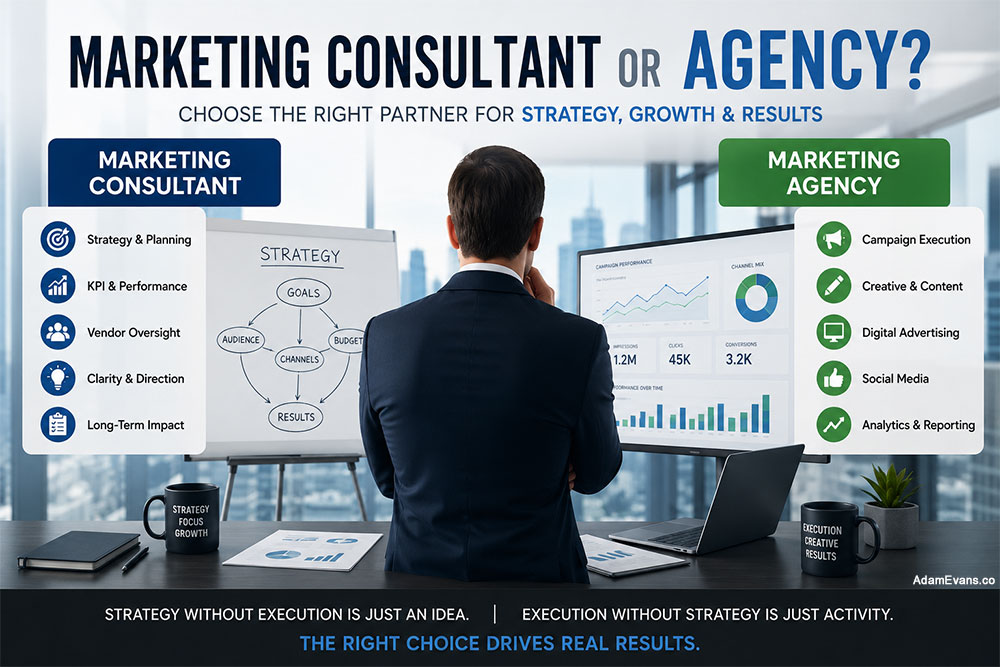
A marketing agency is often built to execute.
A marketing consultant is usually brought in to create clarity before execution begins.
That difference matters.
If your organization already has a strong strategy, clear KPIs, solid internal leadership, and a defined campaign plan, an agency may be exactly what you need.
If campaigns are underperforming, vendors are disconnected, goals are unclear, reporting is weak, and nobody owns the bigger marketing picture, a marketing consultant may be the better first step.
The wrong choice can lead to more activity without better outcomes.
The right choice can create a marketing system that is easier to manage, measure, and improve.
What Does a Marketing Consultant Do?
A marketing consultant helps an organization improve its marketing strategy, planning, performance, accountability, and decision-making.
They do not simply produce ads, social posts, landing pages, or email campaigns.
They help determine whether those things should be done in the first place.
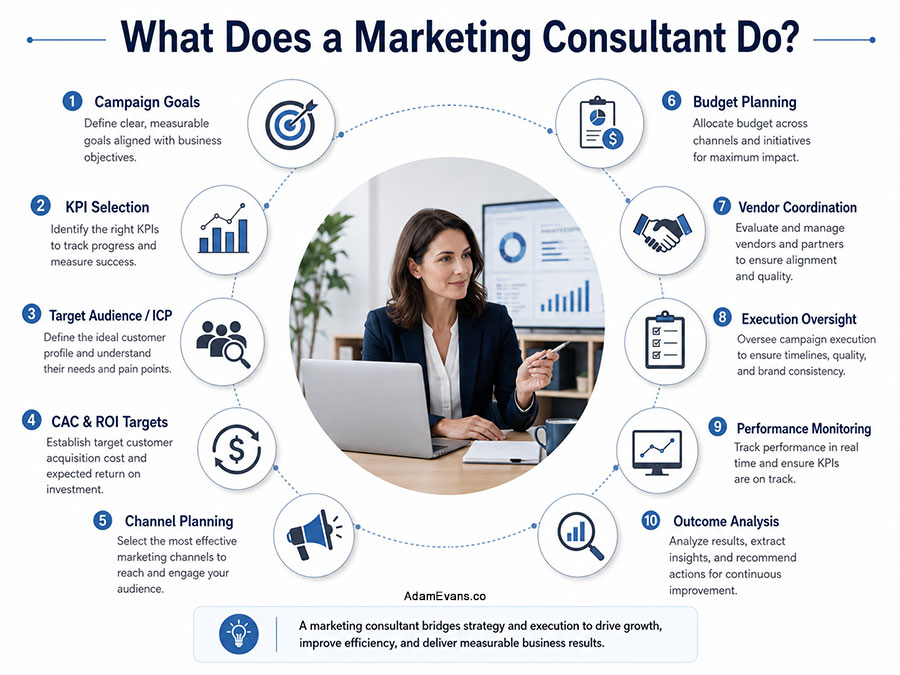
A strong marketing consultant may help with:
Campaign goals and objectives
KPI selection
Target audience definition
Ideal customer profile development
Customer acquisition cost targets
Campaign ROI targets
Marketing channel selection
Budget planning
Vendor coordination
Lead generation strategy
Marketing reporting
Performance monitoring
Outcome analysis
Marketing team and agency alignment
The role is strategic.
The consultant helps leadership understand what the marketing function should be doing, why it matters, and how success should be measured.
What Does a Marketing Agency Do?
A marketing agency usually provides execution support.
Depending on the agency, that may include:
SEO
Paid advertising
Social media
Email marketing
Content creation
Creative design
Branding
Website development
Video production
Media buying
Campaign management
Analytics reporting
Some agencies also provide strategy.
But their core business model is typically built around delivering services.
That is not a bad thing.
It simply means an agency may be strongest when the organization already knows what it needs done.
For example, an organization may know it needs:
A new website
An SEO campaign
A paid media campaign
A public-awareness campaign
A content calendar
A video campaign
A lead-generation funnel
In that situation, an agency can be highly effective.
Marketing Consultant Vs Marketing Agency
| Category | Marketing Consultant | Marketing Agency |
|---|---|---|
| Main focus | Strategy, planning, oversight, accountability | Campaign execution and production |
| Best for | Organizations needing clarity and direction | Organizations with a clear marketing plan |
| Typical role | Advisor, strategist, senior marketing lead | Service provider and execution team |
| KPI ownership | Helps define and evaluate KPIs | Reports on campaign KPIs |
| Vendor management | Can oversee multiple vendors and agencies | Manages its own scope of work |
| Budget role | Helps allocate budget across channels | Manages approved campaign budgets |
| Internal alignment | Connects leadership, sales, marketing, and vendors | Works primarily within the assigned scope |
| Long-term value | Builds a stronger marketing operating model | Delivers specific campaign outputs |
The strongest marketing programs often use both.
A consultant provides the strategy.
An agency helps execute it.
When a Marketing Consultant Makes More Sense
A marketing consultant is usually the better choice when the organization has a strategy problem, not just an execution problem.
That may look like:
✅ Marketing feels busy but results are unclear
✅ Multiple vendors are working without shared direction
✅ The organization does not have clear KPIs
✅ Campaign budgets are being spent without a strong ROI model
✅ Sales and marketing are not aligned
✅ Leadership receives reports but cannot tell what is working
✅ The brand message feels inconsistent
✅ Campaigns are launched without a defined audience or objective
✅ Internal teams need senior marketing leadership
A consultant can help diagnose the issue before money is spent on more execution.
This is especially useful for enterprise, government, professional services, technology, and multi-stakeholder organizations.
In those environments, marketing is rarely just about promoting something.
It may involve public communication, reputation, stakeholder alignment, policy considerations, lead generation, brand governance, executive reporting, and vendor coordination.
When a Marketing Agency Makes More Sense
An agency is often the better fit when the organization has a clear marketing plan and needs a capable team to deliver it.
For example:
You have defined your target audience.
You know the channels you want to use.
You have approved campaign budgets.
You have clear conversion goals.
You know what creative assets are needed.
You have internal leadership to manage the agency.
You need production capacity.
In that situation, an agency can move quickly.
The organization does not need another layer of planning.
It needs execution.
Where Organizations Usually Get This Wrong
The most common mistake is hiring an agency when the real problem is strategic.
The agency starts doing work.
Ads are launched.
Content is produced.
Campaigns are reported on.
But nobody has clearly defined the audience, the customer journey, the budget logic, the target CAC, the desired ROI, or the overall business objective.
The agency may perform exactly as contracted.
The organization may still be disappointed.
That is because activity is not the same as strategy.
The opposite mistake also happens.
An organization may hire a consultant when it urgently needs campaign production, media buying, content, SEO, creative, or digital development.
The consultant can create the plan.
But someone still needs to execute it.
The best choice depends on what is missing.
What Marketing Leadership Needs Usually Look Like
| Marketing Need | Leadership Requirement |
|---|---|
| One-off campaign production | ███ |
| Social media and content execution | ████ |
| Agency coordination | █████ |
| Lead generation improvement | ██████ |
| Brand repositioning | ███████ |
| Marketing and sales alignment | ████████ |
| Multi-channel growth strategy | █████████ |
| Enterprise marketing transformation | ██████████ |
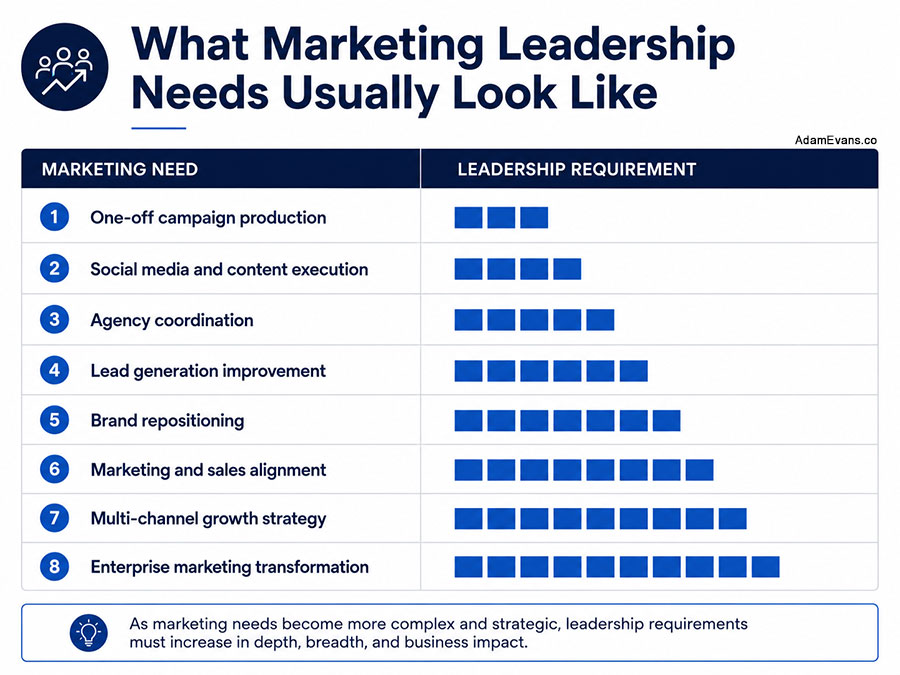
The more complex the requirement becomes, the more valuable senior marketing leadership becomes.
A campaign can be outsourced.
A marketing operating model needs leadership.
Marketing Consultant Vs Agency: Cost and Value
The lowest-cost option is not always the lowest-risk option.
An agency may be less expensive at the beginning because it offers a defined package or monthly service scope.
But if the organization has weak strategy, unclear priorities, or no internal oversight, it may spend significant money without improving its marketing system.
A consultant may cost more upfront.
But a strong consultant can help avoid wasted spend by setting the right direction before campaigns launch.
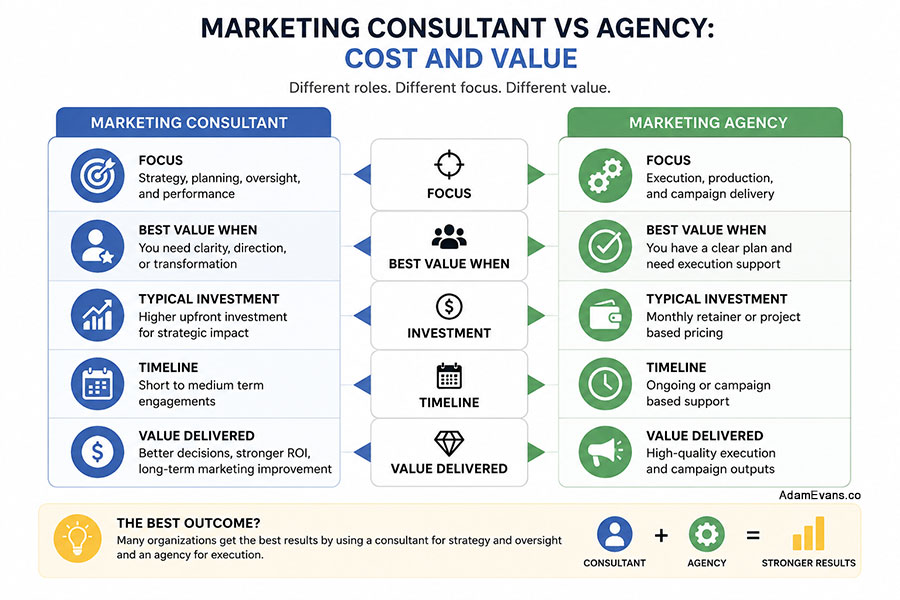
| Option | Best Value When |
|---|---|
| Marketing consultant | Strategy, planning, vendor oversight, KPI development, transformation |
| Marketing agency | Campaign execution, production, channel management, creative development |
| Internal marketing hire | Ongoing day-to-day marketing ownership |
| Fractional CMO | Senior leadership across strategy, team, vendors, growth, and execution |
| Consultant + agency | Complex organizations needing both leadership and production capacity |
A marketing consultant is not a replacement for every agency.
An agency is not a replacement for every senior marketing leader.
The organization needs to decide which gap is most important.
What to Ask Before Hiring Either One
Before hiring a consultant or agency, leadership should be able to answer a few questions.
What is the business objective?
Who is the target audience?
What action do we want people to take?
What KPIs matter most?
What is an acceptable customer acquisition cost?
What channels make sense?
What is the campaign timeline?
Who owns final decisions internally?
Who will evaluate performance?
What happens if the campaign underperforms?
If the organization cannot answer these questions, a consultant may be the better first move.
If the answers are clear, an agency may be ready to begin.
How a Marketing Consultant Builds a Better Plan
A marketing consultant should help create a structured approach before large amounts of budget are committed.
That usually includes:
Campaign Goals and Objectives
The organization needs a clear target.
That may be lead generation, public awareness, service adoption, revenue growth, stakeholder engagement, customer retention, or market expansion.
KPI Identification
KPIs should be tied to the actual objective.
Examples may include qualified leads, conversion rate, cost per lead, CAC, engagement rate, awareness lift, pipeline value, or ROI.
Target Audience and ICP Definition
The strategy must identify who the campaign is for.
For enterprise organizations, that may include multiple decision-makers, departments, or buying committees.
For government organizations, it may involve residents, businesses, stakeholders, community groups, or public-sector partners.
Channel Planning
The right channels may include digital advertising, SEO, email, social media, public relations, events, print, radio, outdoor, direct outreach, or partner communications.
The right mix depends on the audience and objective.
Budgeting
Budget should follow strategy.
It should not be set randomly or divided equally across channels without a reason.
Execution Oversight
Once the plan is approved, a consultant may help oversee internal teams, agencies, freelancers, creative partners, and digital vendors.
Active Performance Monitoring
Marketing should not wait until the end of a campaign to learn what is working.
Performance needs to be monitored in real time.
Outcome Analysis
At the end of the campaign, leadership should have a clear report showing what happened, what worked, what did not work, and what should change next.
Working With a Marketing Consultant
Working with a marketing consultant should make the organization more confident in its decisions.
The consultant should help create focus.
They should clarify priorities, define meaningful KPIs, align internal stakeholders, assess vendors, and help leadership understand where marketing investment is producing value.
For organizations that need senior support across marketing strategy, campaign planning, AI search visibility, vendor oversight, project management, and digital transformation, Adam Evans provides select consulting support for complex business, enterprise, and government initiatives.
Final Thoughts
The question is not whether a marketing consultant or marketing agency is better.
The question is what your organization needs most right now.
If you have a clear strategy and need execution capacity, hire an agency.
If you have activity but no clarity, vendors but no oversight, campaigns but no accountability, or spending but no strong ROI model, start with a marketing consultant.
The strongest organizations do not treat marketing as a collection of isolated campaigns.
They treat it as a coordinated system connected to business goals, stakeholder needs, budgets, performance data, and long-term growth.
FAQ
Do we need a marketing consultant or a marketing agency?
A marketing consultant is usually best when your organization needs strategy, KPI development, campaign planning, vendor oversight, and senior marketing direction. A marketing agency is usually best when you already have a clear plan and need execution support.
Can a marketing consultant work with our existing agency?
Yes. A marketing consultant can help manage agencies, review campaign strategy, improve reporting, align stakeholders, clarify KPIs, and ensure the agency’s work supports the organization’s wider business goals.
What does a marketing consultant do before a campaign starts?
A marketing consultant may help define objectives, identify KPIs, clarify the target audience, set CAC and ROI targets, choose channels, create a timeline, allocate budget, and establish reporting requirements.
Is a marketing consultant more expensive than an agency?
It depends on the scope. Agencies often provide defined services at a monthly cost, while a senior consultant may be retained for strategic planning, oversight, and transformation work. The right option depends on whether the organization needs execution capacity or leadership and direction.
Should enterprise and government organizations use both a consultant and agency?
In many cases, yes. A consultant can provide senior planning, oversight, measurement, and accountability, while an agency provides execution, creative production, media management, and channel expertise.