
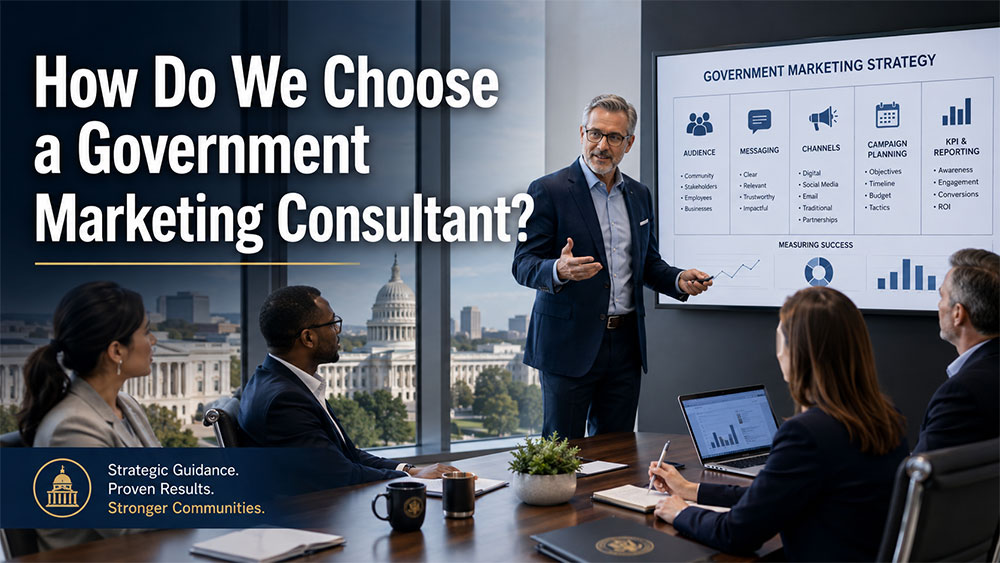
Choosing a government marketing consultant is not the same as hiring a general marketing freelancer or a campaign agency.
Government marketing has more complexity.
More stakeholders.
More public accountability.
More approvals.
More communications risk.
More accessibility requirements.
More reporting needs.
And often, more pressure to prove that public funds are being used responsibly.
A government organization may need help with a public awareness campaign, stakeholder engagement, municipal communications, public-facing digital initiatives, recruitment marketing, service adoption, economic development, tourism, community outreach, website modernization, or multi-channel campaign planning.
But the wrong consultant can make the work more complicated.
They may bring private-sector tactics without understanding public-sector realities.
They may focus on flashy creative instead of clear public communication.
They may recommend channels without understanding accessibility, procurement, approval processes, stakeholder expectations, or campaign accountability.
The right government marketing consultant brings clarity.
They help the organization define the audience, identify the real communication challenge, establish KPIs, coordinate vendors, improve reporting, and build a campaign plan that leadership can support.
What Is a Government Marketing Consultant?
Government marketing consultants are senior advisors who help public-sector organizations improve marketing strategy, communications planning, campaign performance, stakeholder alignment, public engagement, reporting, and digital visibility.
The role can include:
Public awareness campaign planning
Communications strategy
Audience research
Stakeholder mapping
Campaign goals and objectives
KPI development
Channel planning
Budget guidance
Agency and vendor oversight
Public engagement support
Website and digital strategy
SEO and AI search visibility
Reporting and performance analysis
Accessibility-aware marketing planning
Internal team alignment
The consultant is not there to replace the communications department.
They are there to help the department and leadership make stronger decisions.
Why Government Marketing Is Different
Private-sector marketing often focuses on revenue, customer acquisition, conversion, market share, and sales performance.
Government marketing may include some of those objectives.
But it often has additional responsibilities.
It may need to inform residents.
Encourage service adoption.
Build awareness.
Support public health.
Promote civic participation.
Explain policy changes.
Reach underserved communities.
Improve public trust.
Support local business growth.
Recruit talent.
Promote events or programs.
Government communications are often judged by more than clicks.
They may be judged by clarity, reach, accessibility, public response, stakeholder confidence, service uptake, and accountability.
That is why government marketing requires a different mindset.
When Should Government Hire a Marketing Consultant?
Government organizations should consider hiring a marketing consultant when a campaign is too important, too visible, too complex, or too cross-functional to manage casually.
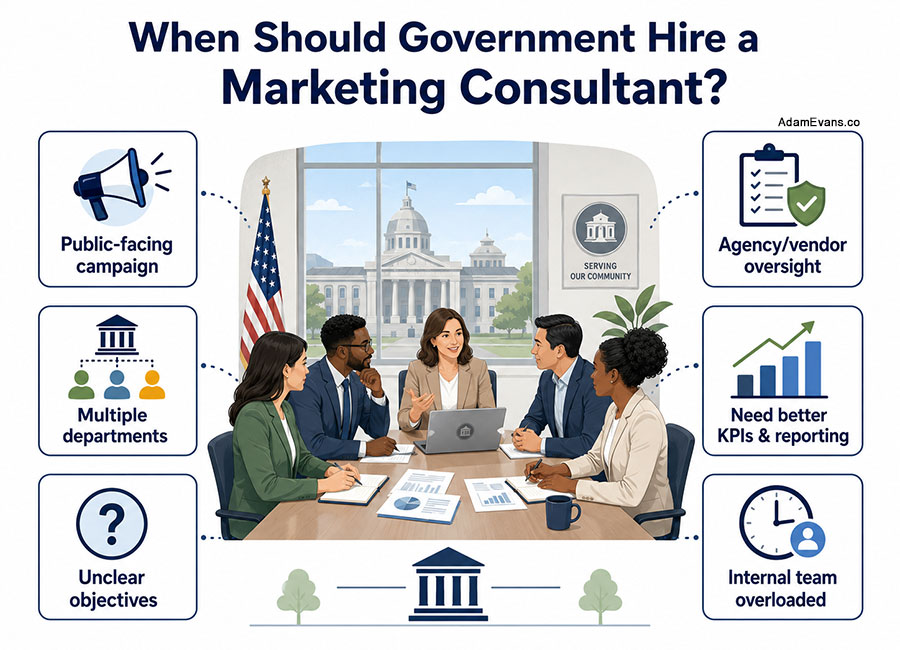
Common signs include:
| Situation | What It Usually Means |
|---|---|
| A public-facing campaign has multiple departments involved | Stakeholder alignment is weak |
| Campaign objectives are unclear | The organization needs strategy before execution |
| Agencies are producing work without a larger plan | Vendor direction is limited |
| Leadership wants better reporting | KPIs are not connected to outcomes |
| Public engagement is lower than expected | Audience or channel strategy may be weak |
| Messaging is inconsistent across departments | Brand and communications governance is unclear |
| A major public initiative is launching | Senior planning and oversight are needed |
| Internal communications teams are overloaded | Additional strategic capacity is required |
A consultant can help before a campaign launches.
That is often when the work creates the most value.
What a Government Marketing Consultant Actually Does
The role depends on the organization and the mandate.
But the core purpose is simple.
Create clarity around public-sector marketing and communications.
That may include:
Campaign strategy
Public awareness planning
Audience segmentation
Stakeholder engagement
Channel selection
Messaging direction
Public communications support
Digital campaign oversight
Agency coordination
Budget and timeline planning
Performance reporting
Outcome analysis
Internal communication structure
Executive and council-ready reporting
A strong consultant should make it easier for leadership to answer:
What are we trying to achieve?
Who needs to hear this?
What action should they take?
Which channels matter most?
How will we know the campaign worked?
What risks need to be managed?
Who approves what?
What happens if public response is low?
What to Look For in a Government Marketing Consultant
Government organizations should not choose a marketing consultant based only on creative work, social media followers, or general marketing claims.
The consultant should understand the context around public-sector work.
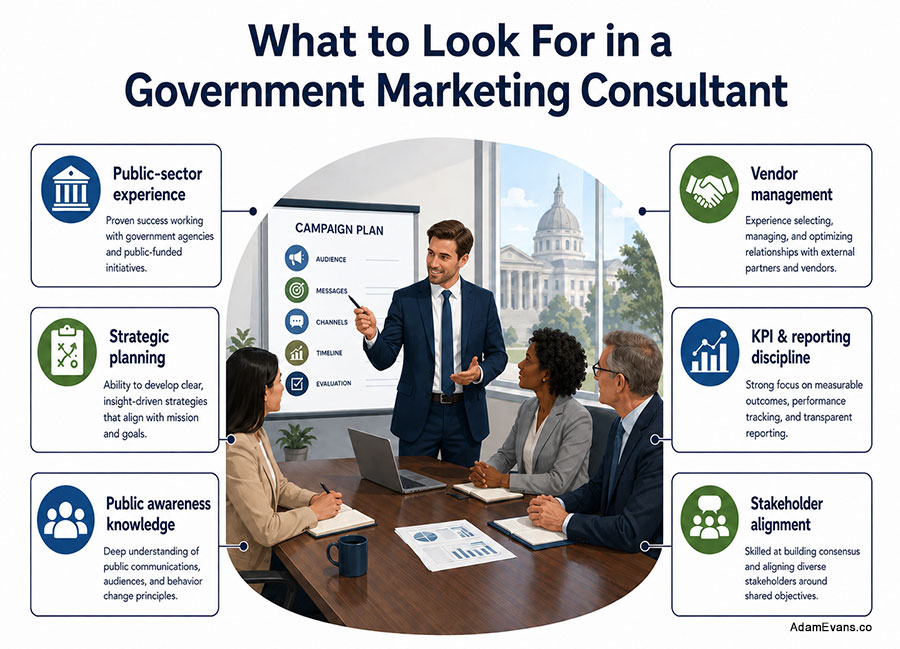
1. Public-Sector and Multi-Stakeholder Experience
Government campaigns often involve communications teams, department leaders, elected officials, legal, procurement, accessibility, IT, community groups, agencies, vendors, and the public.
The consultant needs to be able to work in that environment.
They should understand that decisions may take longer.
They should understand that many stakeholders need to be heard.
They should understand that public messaging has higher visibility and higher risk.
2. Strategic Planning Ability
The consultant should be able to move beyond creative ideas.
They should help define the campaign objective, audience, message, channels, budget, timeline, reporting structure, and success criteria.
A campaign should not start with “What should we post?”
It should start with:
“What public outcome are we trying to improve?”
3. Public Awareness and Engagement Knowledge
Government marketing is often about helping people understand something, access something, participate in something, or change a behavior.
That requires a different approach from direct-response advertising.
A consultant should understand how to plan campaigns for:
Public awareness
Community engagement
Service adoption
Program participation
Public health communication
Resident outreach
Economic development
Municipal events
Policy change communication
Recruitment and employer branding
4. Vendor and Agency Management Ability
Many government organizations work with agencies, media vendors, web developers, creative teams, video producers, public relations firms, and digital advertising providers.
The consultant should help ensure those partners are working toward the same goal.
They can help improve briefs, clarify deliverables, review performance, manage timelines, and identify gaps before they become larger problems.
5. KPI and Reporting Discipline
Government campaigns need reporting.
But not every campaign should be measured the same way.
A public awareness campaign may focus on reach, message recall, website visits, video views, public engagement, event registrations, service usage, or survey results.
A recruitment campaign may focus on applicant volume and quality.
An economic development campaign may focus on inquiries, partner engagement, leads, or event attendance.
The consultant should help identify KPIs that matter.
Not just metrics that look good on a dashboard.
Government Marketing Complexity Usually Looks Like This
| Campaign Type | Complexity Level |
|---|---|
| Single social media post or email notice | ███ |
| Local event promotion | ████ |
| Department-level awareness campaign | █████ |
| Multi-channel public education campaign | ███████ |
| City-wide public engagement initiative | █████████ |
| High-visibility policy or service transformation campaign | ██████████ |
As stakeholder involvement and public visibility increase, the need for strategy and oversight increases too.
Government Marketing Consultant vs Agency vs Internal Team
A government marketing consultant is not necessarily a replacement for an agency or internal communications team.
Each role can add value.
| Option | Best For |
|---|---|
| Internal communications team | Daily communications, organizational knowledge, ongoing public updates |
| Marketing agency | Creative production, media buying, digital ads, campaign execution |
| Government marketing consultant | Strategy, planning, KPI structure, stakeholder alignment, oversight |
| Fractional marketing executive | Ongoing senior leadership across communications, marketing, vendors, and growth initiatives |
The strongest model often combines all three.
The internal team understands the organization.
The consultant brings senior strategy and oversight.
The agency provides production capacity and specialist execution.
What Government Buyers Should Ask Before Hiring
Before choosing a government marketing consultant, ask:
Do they understand public-sector complexity?
Can they work with multiple departments and stakeholders?
Do they have experience planning public-facing campaigns?
Can they define measurable campaign outcomes?
Can they manage agencies and vendors?
Can they build a clear reporting structure?
Can they explain complex strategy in plain language?
Do they understand accessibility and public communication considerations?
Can they work with executive leadership, councils, boards, and department heads?
Can they create a practical campaign roadmap?
The best consultant should make the work easier to govern.
Not harder.
What to Avoid
Avoid consultants who only talk about channels.
Social media, paid media, SEO, content, events, and email are tools.
They are not the strategy.
Also avoid anyone who treats government marketing like a fast-moving consumer campaign.
Public-sector organizations require more care.
Be cautious with consultants who:
Overpromise campaign results
Ignore accessibility or public communications standards
Do not understand stakeholder approvals
Cannot manage vendors
Focus only on tactics
Cannot explain KPIs clearly
Treat every audience the same
Do not understand public accountability
Push a one-size-fits-all campaign template
A strong government marketing consultant should bring structure without adding bureaucracy.
How Much Does Government Marketing Consulting Cost?
Government marketing consulting should be priced based on campaign complexity, scope, stakeholder needs, public visibility, vendor involvement, reporting requirements, and strategic responsibility.
A focused campaign planning engagement may require limited support.
A city-wide campaign, multi-department communications plan, service transformation initiative, or long-term advisory mandate requires more senior involvement.
| Engagement Type | Typical Fit |
|---|---|
| Campaign strategy workshop | Clarify goals, audiences, channels, and KPIs |
| Communications or marketing audit | Review existing campaigns, vendors, reporting, and opportunities |
| 6-month consulting mandate | Campaign planning, oversight, vendor coordination, and reporting |
| Annual advisory engagement | Ongoing senior strategy and marketing leadership |
| Public-sector transformation mandate | Multi-team, multi-channel, high-visibility initiative |
For serious strategic consulting mandates, 6-month engagements can start at $100,000. Annual fractional advisory engagements may start at $200,000+ depending on scope, complexity, leadership responsibility, and organizational needs.
The investment should be weighed against the cost of unclear messaging, weak campaign performance, missed public engagement, vendor waste, internal confusion, and reputational risk.
Working With a Government Marketing Consultant
Working with a government marketing consultant should give the organization more control.
More clarity.
More confidence.
The engagement should usually begin with discovery.
That includes reviewing campaign goals, audiences, stakeholders, internal teams, agencies, past performance, communication risks, budgets, timelines, channel mix, reporting, and approval structure.
From there, the consultant can help create a practical roadmap.
For government organizations seeking senior support across marketing strategy, public awareness campaigns, digital visibility, vendor coordination, project management, AI adoption, and digital transformation, Adam Evans provides select consulting support for complex public-sector initiatives.
Final Thoughts
Government organizations should hire a marketing consultant when the work is too important to be handled as a collection of disconnected tactics.
The right consultant helps define the strategy before more budget is spent on execution.
They help clarify the audience.
They help align stakeholders.
They help choose the right channels.
They help establish KPIs.
They help improve vendor performance.
And they help leadership understand whether the campaign is actually working.
For public-sector organizations, that level of clarity matters.
Because public marketing is not just about getting attention.
It is about creating understanding, participation, trust, and measurable public value.
FAQ
What does a government marketing consultant do?
A government marketing consultant helps public-sector organizations improve campaign strategy, public awareness planning, audience research, stakeholder alignment, vendor oversight, KPI development, reporting, digital visibility, and marketing accountability.
When should a government organization hire a marketing consultant?
A government organization should consider hiring a marketing consultant when a campaign is high-visibility, cross-departmental, vendor-dependent, public-facing, underperforming, or in need of stronger strategic direction.
Is a government marketing consultant the same as a marketing agency?
No. A marketing agency usually focuses on campaign execution, creative production, media buying, and digital delivery. A government marketing consultant focuses on strategy, planning, KPIs, stakeholder alignment, vendor oversight, and accountability.
Can a government marketing consultant work with our internal communications team?
Yes. A consultant can support internal communications teams by improving campaign strategy, clarifying goals, strengthening reporting, coordinating vendors, and helping teams manage complex public-facing initiatives.
How much does government marketing consulting cost?
Senior government marketing consulting engagements can start at $100,000 for a 6-month mandate. Annual advisory engagements may start at $200,000+ depending on scope, complexity, and leadership responsibility.