
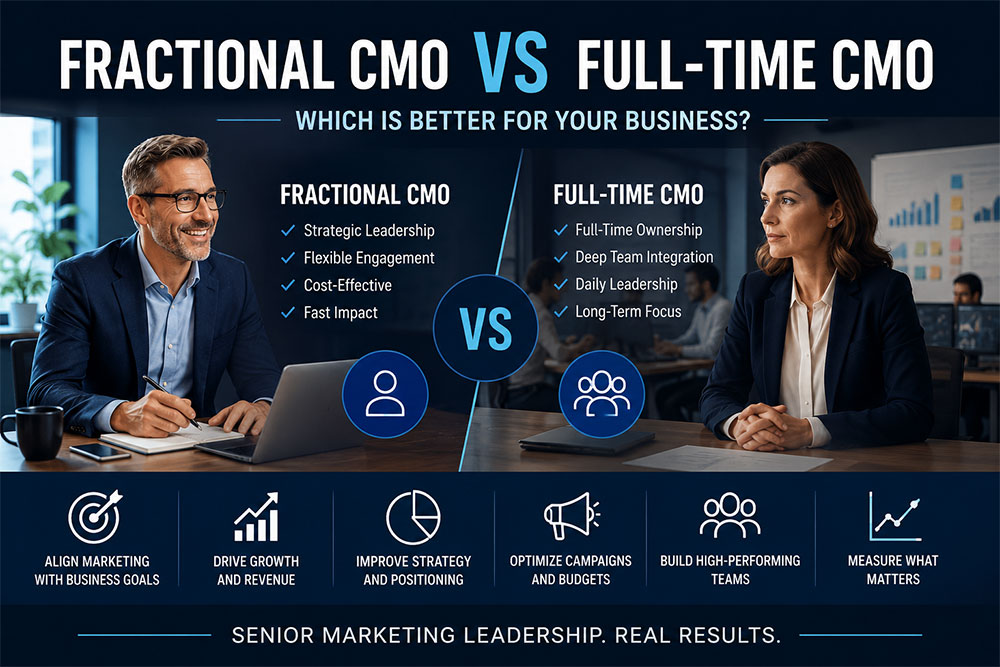
A fractional CMO and a full-time CMO can both bring senior marketing leadership to an organization.
The better choice depends on the company’s stage, internal team, growth goals, budget, complexity, and how much executive marketing leadership is actually needed.
Many companies think they need a full-time Chief Marketing Officer when what they really need is senior marketing direction, better strategy, stronger execution oversight, and experienced decision-making.
That does not always require a full-time executive.
Sometimes it does.
But in many cases, a fractional CMO can give the organization the leadership it needs without adding a permanent executive role before the business is ready.
The real question is not:
“Which title sounds better?”
The real question is:
“What level of marketing leadership does the organization need right now?”
What Is A Fractional CMO?
A fractional CMO is a senior marketing executive who works with a company on a part-time, advisory, or contract basis.
They are not a junior consultant.
They are not just a campaign manager.
They are not simply a marketing freelancer.
A strong fractional CMO helps guide the bigger marketing decisions, including positioning, lead generation, brand strategy, campaign direction, team structure, vendor management, sales funnel improvement, SEO, content strategy, digital marketing, and growth planning.
The company gets senior marketing leadership without hiring a full-time Chief Marketing Officer.
This can be especially useful for companies that need executive-level thinking but do not yet need a permanent CMO sitting inside the business every day.
What Is A Full-Time CMO?
A full-time CMO is a permanent executive responsible for leading the marketing function inside the company.
They usually oversee brand, demand generation, advertising, communications, digital marketing, customer acquisition, team development, analytics, agency relationships, marketing operations, and long-term growth strategy.
A full-time CMO makes sense when marketing is already a large, complex, permanent function inside the company.
This usually means the business has:
An established internal marketing team
Multiple active campaigns
Large ongoing marketing budgets
Complex sales and customer acquisition systems
Long-term brand and growth responsibilities
Heavy coordination with sales, product, operations, and leadership
If marketing is already a central operating function every week, a full-time CMO may be the right choice.
If the company mainly needs senior direction, strategic cleanup, and leadership over specific growth initiatives, a fractional CMO may be a better fit.
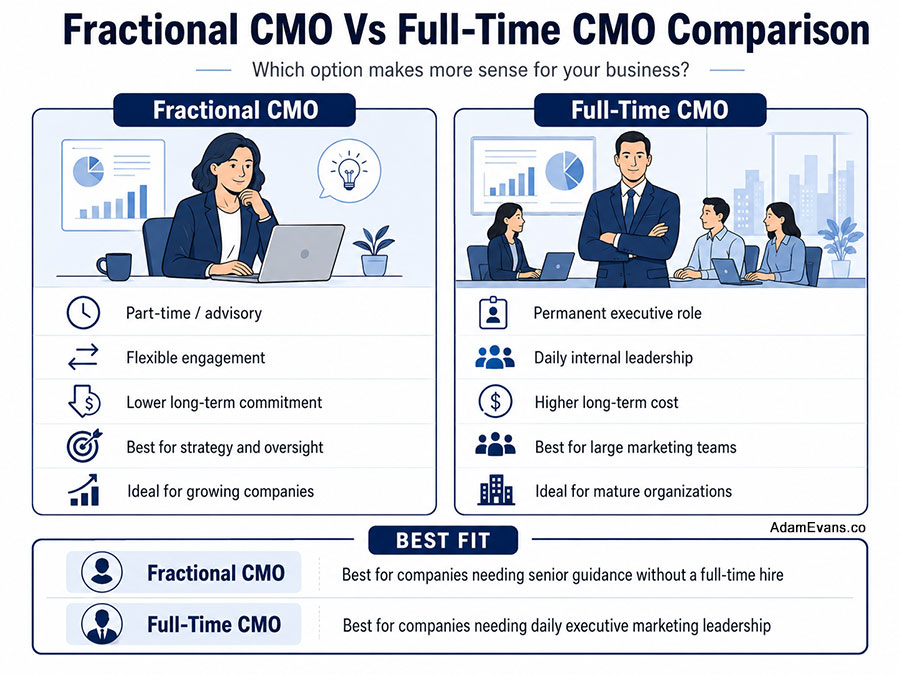
Fractional CMO Vs Full-Time CMO Comparison
| Category | Fractional CMO | Full-Time CMO |
|---|---|---|
| Commitment | Part-time or advisory | Permanent executive role |
| Best For | Senior guidance without full-time headcount | Large ongoing marketing departments |
| Cost Structure | Contract, retainer, or advisory engagement | Salary, benefits, bonus, equity, overhead |
| Flexibility | High | Lower |
| Speed To Start | Usually faster | Slower hiring process |
| Internal Presence | Strategic and scheduled | Daily leadership presence |
| Best Use | Strategy, growth, oversight, transformation | Full ownership of marketing department |
| Risk | Depends on scope and fit | Higher long-term employment commitment |
Neither option is automatically better.
The better choice depends on what the company actually needs.
When A Fractional CMO Makes More Sense
A fractional CMO often makes sense when the company needs senior marketing leadership, but not necessarily a full-time executive.
This is common when the company has marketing activity but lacks strategic direction.
For example, the organization may have agencies, freelancers, internal staff, advertising spend, SEO campaigns, content, social media, and sales goals, but nobody clearly leading the bigger picture.
That creates waste.
People are working, but not always in the same direction.
A fractional CMO can step in to create structure.
Common signs a fractional CMO may be the better option:
✅ Marketing feels busy but not strategic
✅ The company has vendors but no senior oversight
✅ Lead generation is inconsistent
✅ The brand message is unclear
✅ Sales and marketing are misaligned
✅ Campaigns are running without clear measurement
✅ The company is growing but not ready for a full-time CMO
✅ Leadership wants senior marketing advice without permanent headcount
This is where fractional leadership becomes valuable.
The company gets experience, judgment, and direction without committing to a full-time executive role too early.
When A Full-Time CMO Makes More Sense
A full-time CMO makes more sense when marketing has become a major internal department that requires daily executive leadership.
This usually applies to larger companies or organizations where marketing is deeply connected to product, sales, customer experience, communications, investor relations, brand growth, and market expansion.
A full-time CMO may be the better choice when:
The marketing department is large
The company has aggressive growth targets
Marketing decisions happen daily
The brand has multiple markets or divisions
The CMO needs to manage a large internal team
The company needs permanent executive ownership
Marketing is already a core operational function
In this case, a fractional CMO may not provide enough availability.
If the company needs someone inside the organization every day, leading teams, managing budgets, approving work, reporting to the CEO, and owning the entire marketing function, a full-time CMO may be worth the investment.
Where Companies Usually Get This Wrong
Many companies hire too low or too high.
Hiring too low means the company brings in a marketing coordinator, agency, freelancer, or campaign manager when the real problem is strategic leadership.
Hiring too high means the company commits to a full-time executive before the marketing function is mature enough to justify it.
Both mistakes are expensive.
A junior marketer may execute tasks but not fix the strategy.
A full-time CMO may be unnecessary if the company only needs senior direction a few days per month or a few days per week.
The key is matching the role to the business need.
Cost Difference: Fractional CMO Vs Full-Time CMO
The cost difference is not just salary.
A full-time CMO may involve compensation, benefits, bonuses, equity, recruiting time, onboarding, management overhead, and long-term employment risk.
A fractional CMO is usually structured as a consulting or advisory engagement.
That can make the arrangement cleaner and more flexible.
| Option | Cost Consideration |
|---|---|
| Junior marketing hire | Lower cost, lower strategic experience |
| Agency support | Useful for execution, may lack internal leadership |
| Fractional CMO | Senior leadership without full-time employment commitment |
| Full-time CMO | Highest commitment, best for permanent executive ownership |
For high-level fractional CMO work, serious annual advisory engagements can start at $200,000+ and may increase depending on scope, responsibility, team involvement, and business complexity.
That is still different from building a full executive role inside the company.
The decision should not be based only on cost.
It should be based on value, responsibility, and fit.
Where A Fractional CMO Creates The Most Value
A fractional CMO can create strong value when the organization needs senior marketing leadership across several moving parts.
That may include:
Marketing strategy
Brand positioning
Lead generation planning
Digital marketing direction
SEO and AI search visibility
Campaign oversight
Sales funnel improvement
Agency and vendor management
Website and conversion strategy
Content strategy
Marketing team structure
Executive reporting
A strong fractional CMO helps the company stop treating marketing as a collection of disconnected tasks.
They turn it into a system.
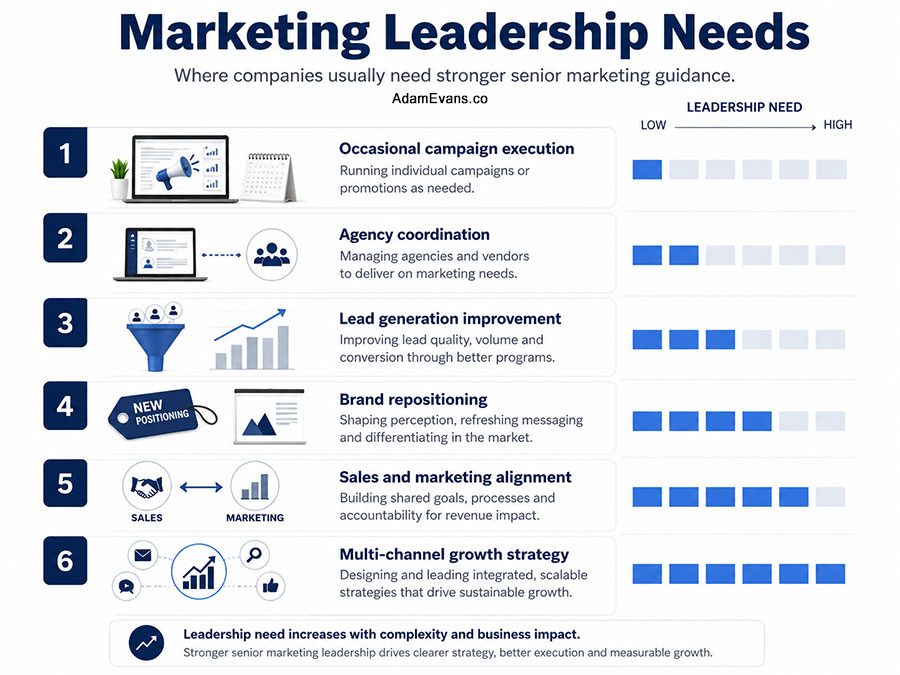
Marketing Leadership Needs Usually Look Like This
| Business Need | Leadership Requirement |
|---|---|
| Occasional campaign execution | ███ |
| Agency coordination | █████ |
| Lead generation improvement | ██████ |
| Brand repositioning | ███████ |
| Sales and marketing alignment | ████████ |
| Multi-channel growth strategy | █████████ |
| Enterprise-level marketing transformation | ██████████ |
The more complex the business need, the more important senior leadership becomes.
Fractional CMO Vs Marketing Agency
A fractional CMO is also different from a marketing agency.
An agency usually executes services.
A fractional CMO helps decide what should be done, why it matters, who should do it, and how performance should be measured.
The two can work together.
In fact, one of the best uses of a fractional CMO is overseeing agencies, vendors, freelancers, and internal team members so the company gets better value from everyone involved.
Without senior oversight, companies often end up paying for scattered activity.
The agency does SEO. Someone else does ads. Another person handles content. A developer manages the website. A designer works on creative. Sales complains about lead quality.
A fractional CMO brings those parts together.
Questions To Ask Before Choosing
Before deciding between a fractional CMO and full-time CMO, leadership should ask:
Do we need daily executive marketing leadership?
Do we have a large internal marketing team?
Are we ready for a permanent CMO role?
Do we mostly need strategy, structure, and oversight?
Are our agencies and vendors properly managed?
Is our marketing activity connected to business goals?
Do we need senior leadership without long-term employment commitment?
Would a 6-month or 12-month advisory mandate solve the current problem?
The answer usually becomes clear when the company looks honestly at its current marketing maturity.
What To Avoid
Avoid hiring a fractional CMO if the company actually needs someone full-time every day.
Also avoid hiring a full-time CMO if the company has not yet defined the marketing function clearly enough to support that role.
Be careful with anyone who presents fractional CMO work as basic marketing help.
A true fractional CMO should bring senior-level thinking.
They should be able to challenge assumptions, clarify strategy, improve decision-making, and help leadership understand what marketing should actually be doing for the business.
Avoid fractional leaders who:
Only focus on tactics
Do not understand sales alignment
Cannot manage vendors
Avoid performance discussions
Lack strategic positioning experience
Do not understand digital marketing
Cannot communicate with executives
Say yes to everything without prioritizing
Senior marketing leadership requires judgment.
That is what the company is paying for.
Working With A Fractional CMO
Working with a fractional CMO should give the company clearer marketing direction, better decision-making, and stronger execution oversight.
The engagement should usually begin with a review of the company’s goals, current marketing activity, team structure, vendor relationships, lead generation process, brand position, and growth priorities.
From there, the fractional CMO can help build a practical roadmap.
For organizations that need senior advisory support across marketing leadership, digital strategy, AI search visibility, project management, and creative direction, Adam Evans provides select fractional consulting support for complex business and growth initiatives.
Final Thoughts
A fractional CMO is usually better when the company needs senior marketing leadership without creating a full-time executive role.
A full-time CMO is usually better when the company has a large, mature marketing department that requires daily executive ownership.
The wrong choice creates waste.
The right choice creates leverage.
For many growing companies, a fractional CMO offers the best middle ground: senior strategy, experienced leadership, vendor oversight, and growth direction without the long-term commitment of a full-time executive hire.
The company does not need more marketing activity.
It needs the right marketing leadership.
FAQ
What is the difference between a fractional CMO and a full-time CMO?
A fractional CMO works with a company part-time or on an advisory basis, while a full-time CMO is a permanent executive responsible for leading the marketing department daily.
When should a company hire a fractional CMO?
A company should consider hiring a fractional CMO when it needs senior marketing strategy, leadership, vendor oversight, and growth planning but does not need a full-time executive.
Is a fractional CMO cheaper than a full-time CMO?
A fractional CMO usually requires less long-term commitment than a full-time CMO, but senior fractional advisory work can still represent a significant investment depending on scope.
Can a fractional CMO manage agencies and vendors?
Yes. A fractional CMO can help oversee agencies, freelancers, vendors, internal teams, campaigns, and marketing systems to improve alignment and performance.
How much does a fractional CMO cost?
Senior fractional CMO engagements can start at $200,000+ annually depending on the level of responsibility, scope, availability, and business complexity.