
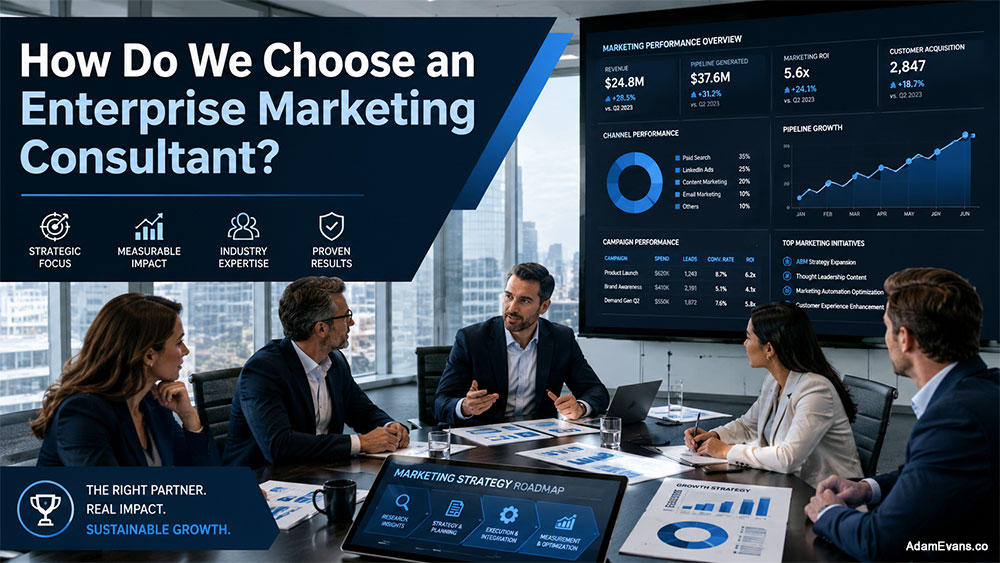
Choosing an enterprise marketing consultant is not the same as hiring a freelancer, campaign specialist, or agency.
An enterprise organization usually has more complexity.
More stakeholders.
More internal teams.
More vendors.
More channels.
More budget pressure.
More accountability.
The wrong consultant can create more slides, more meetings, and more marketing activity.
The right consultant creates clarity.
They help leadership understand what marketing should own, which audiences matter most, where budget should go, what KPIs should be tracked, which vendors are performing, and how marketing connects to business outcomes.
That is the real value.
An enterprise marketing consultant should not simply recommend more campaigns.
They should help the organization make better decisions before more money is spent.
What Is an Enterprise Marketing Consultant?
An enterprise marketing consultant is a senior advisor who helps large organizations improve marketing strategy, campaign performance, brand positioning, lead generation, vendor coordination, reporting, and organizational alignment.
They are usually brought in when the internal marketing function is active but not fully connected.
The organization may already have:
Internal marketers
Agencies
SEO vendors
Paid media providers
Creative teams
Website developers
Sales teams
Communications staff
CRM systems
Marketing dashboards
Brand guidelines
Campaign calendars
But those parts may not be working together.
An enterprise marketing consultant helps create a stronger operating model.
They can help align strategy, execution, measurement, and accountability.
When Should an Enterprise Hire a Marketing Consultant?
An enterprise should consider hiring a marketing consultant when marketing has become too important to manage without senior strategic oversight.
This does not mean the internal team is weak.
Often the opposite is true.
The team may be capable, busy, and working hard.
But the organization may still lack a clear senior-level structure around priorities, investment, performance, and decision-making.
Common signs include:
| Situation | What It Usually Means |
|---|---|
| Multiple agencies are working independently | No unified strategy or vendor governance |
| Marketing reports are detailed but not useful | KPIs are not connected to business outcomes |
| Sales and marketing disagree on lead quality | Funnel ownership and alignment are weak |
| Campaigns are active but ROI is unclear | Budget strategy or attribution is weak |
| Leadership is involved in every decision | Senior marketing ownership is missing |
| Brand messaging varies by channel | Positioning and governance are inconsistent |
| Marketing budgets grow without confidence | Investment priorities are unclear |
| Teams are busy but growth is flat | Activity is not translating into measurable value |
A consultant can help leadership see what is actually happening.
Not just what is being reported.
What an Enterprise Marketing Consultant Actually Does
The core role is simple.
Create order around marketing complexity.
That may include:
Marketing strategy
Audience and ICP definition
Campaign planning
Brand positioning
Vendor and agency oversight
KPI development
Budget guidance
Lead generation strategy
Sales and marketing alignment
Website and conversion strategy
SEO and AI search visibility
Marketing reporting
Performance analysis
Stakeholder alignment
Digital transformation support
The consultant is not there to replace every internal team or vendor.
They are there to help those people perform better together.
The Enterprise Marketing Consultant Hiring Checklist
When choosing a marketing consultant, enterprise organizations should look beyond a polished presentation or a list of tools.
The consultant needs to understand the business.
They need to understand how marketing connects to sales, operations, finance, leadership, technology, customer experience, and vendors.
1. Strategic Marketing Experience
The consultant should be able to think beyond channels.
Anyone can recommend paid ads, SEO, email, social media, content, or events.
The harder question is whether those activities are actually the right priority.
A strong enterprise marketing consultant should help answer:
What is the business objective?
Which audience matters most?
What should the organization be known for?
What should marketing own?
Which channels deserve more investment?
Which activities should stop?
How will leadership measure success?
This is strategic marketing.
Without it, campaigns become disconnected activity.
2. Enterprise and Multi-Stakeholder Experience
Enterprise marketing rarely involves one decision-maker.
It may involve executives, sales leaders, product teams, communications, regional teams, operations, legal, procurement, finance, agencies, and external vendors.
The consultant needs to be comfortable in that environment.
They need to know how to align people with different goals.
They also need to know when a decision needs executive attention and when the team can move forward independently.
That judgment matters.
3. Vendor and Agency Management Ability
A consultant should not only understand marketing.
They should understand how to manage outside partners.
Enterprise organizations may have agencies for media, SEO, creative, public relations, web development, branding, social media, video, email, and analytics.
Without strong oversight, these vendors can all do reasonable work while the overall marketing system still underperforms.
A strong consultant can help:
Set clearer scopes
Evaluate vendor performance
Improve briefs
Align timelines
Challenge weak recommendations
Reduce overlap
Create shared KPIs
Improve reporting
Support contract and budget discussions
This can create significant value before a new campaign is even launched.
4. KPI and Reporting Discipline
Enterprise marketing needs better reporting than “engagement went up.”
Leadership needs to understand what the marketing investment is producing.
Depending on the organization, that may include:
Qualified leads
Pipeline contribution
Conversion rate
Customer acquisition cost
Cost per lead
Revenue influenced
Brand awareness
Website conversion
Campaign ROI
Share of voice
Retention
Stakeholder engagement
The consultant should help decide which metrics matter.
Not every metric is equally important.
A good report should make leadership more confident.
Not more confused.
5. Sales and Marketing Alignment
One of the most common enterprise marketing issues is misalignment with sales.
Marketing says leads are being generated.
Sales says the leads are poor.
Leadership sees a dashboard but cannot tell where the breakdown is happening.
A strong consultant helps clarify the full journey.
Who is the target customer?
What is a qualified lead?
How is a lead handed off?
What happens after the handoff?
What feedback returns to marketing?
What should be measured together?
Marketing and sales do not need to agree on every detail.
But they need shared definitions and shared accountability.
What Enterprise Marketing Complexity Usually Looks Like
| Marketing Situation | Complexity Level |
|---|---|
| One campaign or channel | ███ |
| Managing a small agency relationship | ████ |
| Improving lead generation | ██████ |
| Repositioning a brand | ███████ |
| Coordinating multiple vendors | ████████ |
| Aligning sales and marketing | █████████ |
| Enterprise-wide marketing transformation | ██████████ |
As complexity increases, senior leadership becomes more important.
The organization may not need more people doing tasks.
It may need someone connecting the work.
Marketing Consultant vs Marketing Agency vs Fractional CMO
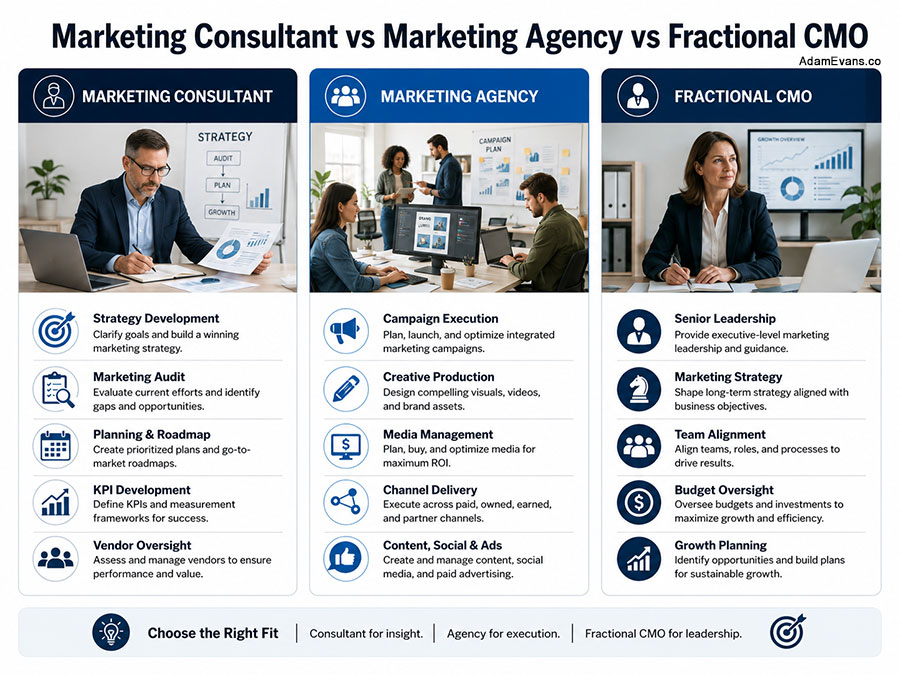
When comparing a marketing consultant vs marketing agency consider that an enterprise marketing consultant is not the same as a marketing agency or a fractional CMO.
| Option | Best For |
|---|---|
| Marketing agency | Campaign execution, creative production, media management, channel delivery |
| Marketing consultant | Strategy, audit, planning, vendor oversight, KPI development, targeted transformation |
| Fractional CMO | Ongoing executive leadership across teams, vendors, budgets, growth, and marketing function ownership |
| Internal marketing leader | Day-to-day organizational management and operational continuity |
A consultant may be right when the organization has a specific challenge.
For example:
A marketing audit.
A campaign performance issue.
An agency review.
A brand repositioning project.
A lead generation problem.
A new market strategy.
A marketing transformation initiative.
A fractional CMO may be better when the company needs ongoing senior leadership across the wider marketing function.
What to Ask Before Hiring
Before choosing an enterprise marketing consultant, leadership should ask:
Do they understand enterprise complexity?
Can they work across internal teams and external vendors?
Do they have strategic marketing experience?
Can they connect marketing activity to business goals?
Can they improve KPI reporting?
Can they challenge weak assumptions?
Can they help align sales and marketing?
Do they understand digital, brand, content, campaign, and technology considerations?
Can they communicate clearly with executives?
Can they create a practical roadmap?
The final question is important.
A consultant should leave the organization with more clarity than it had before.
What to Avoid
Avoid hiring a consultant based only on a large social following, flashy case-study claims, tool familiarity, or generic marketing language.
Be careful with consultants who:
Only recommend their preferred channels
Cannot explain how they measure success
Do not understand enterprise buying cycles
Avoid difficult stakeholder conversations
Cannot manage agencies or vendors
Treat every organization the same
Focus only on tactics
Cannot communicate with executives
Make broad promises without learning the business
The best consultants are selective.
They know that marketing transformation requires fit, leadership buy-in, internal capacity, and clear decision-making.
How Much Should an Enterprise Marketing Consultant Cost?
Enterprise marketing consulting should be priced based on the scope, complexity, level of responsibility, and business impact involved.
A focused marketing audit or planning engagement may be smaller.
A major enterprise transformation, agency consolidation, growth strategy, or multi-channel marketing reset requires more senior involvement.
| Engagement Type | Typical Fit |
|---|---|
| Strategy audit | Review current marketing, vendors, reporting, and opportunity areas |
| Campaign planning engagement | Define audience, KPIs, channels, budget, and roadmap |
| 6-month consulting mandate | Improve strategy, vendor coordination, reporting, and execution |
| Annual fractional advisory | Ongoing senior marketing leadership and strategic oversight |
| Enterprise marketing transformation | Complex, multi-team, multi-vendor modernization |
For serious organizations, 6-month consulting engagements can start at $100,000. Annual fractional advisory engagements may start at $200,000+ depending on scope, leadership responsibility, business complexity, vendor involvement, and organizational needs.
The investment should be compared against the cost of poor targeting, wasted campaign spend, weak vendor oversight, unclear reporting, missed growth opportunities, and internal misalignment.
Working With an Enterprise Marketing Consultant
Working with an enterprise marketing consultant should make marketing easier to manage.
The organization should gain clearer strategy, better governance, stronger reporting, more useful vendor relationships, and a stronger connection between marketing investment and business outcomes.
A strong engagement often begins with discovery.
That may include reviewing business goals, target audiences, current campaigns, vendors, internal teams, lead flow, sales alignment, technology, budgets, KPIs, and reporting.
From there, the consultant can help leadership prioritize what needs to change first.
For organizations seeking senior support across marketing strategy, campaign planning, growth, AI search visibility, vendor coordination, project management, and digital transformation, Adam Evans provides select consulting support for complex enterprise and government initiatives.
Final Thoughts
Choosing an enterprise marketing consultant is not about finding someone who can make marketing look better.
It is about finding someone who can help the organization make better marketing decisions.
The right consultant brings strategy, clarity, discipline, accountability, and senior judgment.
They help the organization stop treating marketing as a group of disconnected campaigns.
They help build a system that is connected to business goals.
For enterprise organizations, that can be the difference between more marketing activity and more measurable value.
FAQ
What does an enterprise marketing consultant do?
An enterprise marketing consultant helps large organizations improve marketing strategy, campaign planning, vendor oversight, KPI development, brand positioning, lead generation, sales alignment, reporting, and marketing accountability.
When should an enterprise hire a marketing consultant?
An enterprise should consider hiring a marketing consultant when marketing is complex, agencies are disconnected, ROI is unclear, reporting is weak, sales and marketing are misaligned, or leadership needs stronger strategic guidance.
Is an enterprise marketing consultant the same as a marketing agency?
No. A marketing agency usually focuses on execution, creative production, and campaign delivery. A marketing consultant focuses on strategy, planning, oversight, KPIs, vendor alignment, and decision-making.
Can an enterprise marketing consultant manage existing agencies?
Yes. A consultant can help evaluate agency performance, align vendors, improve briefs, clarify KPIs, review reporting, and ensure external work supports the organization’s overall business goals.
How much does an enterprise marketing consultant cost?
Senior enterprise marketing consulting engagements can start at $100,000 for a 6-month mandate. Annual fractional advisory engagements may start at $200,000+ depending on scope, complexity, and responsibility.