
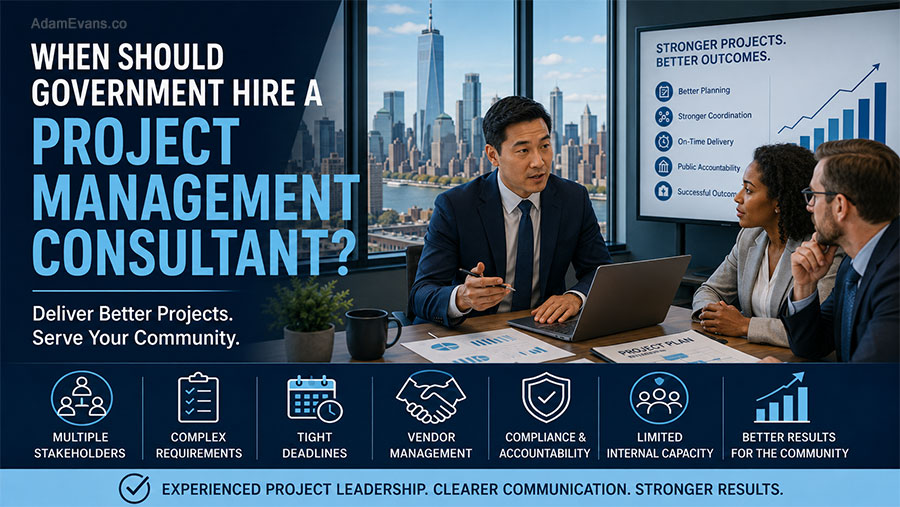
A highly experienced government project management consultant understands that government projects are different from private-sector projects.
They usually involve more stakeholders, more approvals, more public accountability, more documentation, more procurement requirements, and more visibility.
A private company can sometimes move quickly with a small leadership group.
Government organizations rarely have that luxury.
Municipalities, agencies, departments, boards, commissions, and public-sector teams often need to balance internal priorities, elected officials, public expectations, vendors, compliance requirements, accessibility standards, cybersecurity concerns, budgets, timelines, and long-term service delivery.
That is why government project management cannot be treated as basic administration.
When the project is important enough, complex enough, or visible enough, hiring a government project management consultant can make a major difference.
The right consultant helps create structure, reduce confusion, improve reporting, coordinate vendors, protect timelines, and keep the project moving without overwhelming internal teams.
What Is A Government Project Management Consultant?
A government project management consultant is a senior project advisor who helps public-sector organizations plan, manage, coordinate, and deliver complex initiatives.
This may include:
Digital transformation projects
AI adoption initiatives
Municipal website redevelopment
Software implementation
Internal workflow modernization
Public service delivery improvements
Vendor-led technology projects
Community-facing platforms
Operational improvement initiatives
Infrastructure-related digital projects
Cross-department transformation programs
The consultant’s role is to bring organization, clarity, and execution support to projects that have too many moving parts for the internal team to manage alone.
They do not replace government leadership.
They support it.
They help ensure that the project has a clear plan, clear ownership, clear communication, and clear reporting.
Why Government Projects Become Complicated
Government projects become complicated because they rarely involve only one group.
A project that looks simple on the surface may involve IT, communications, finance, procurement, legal, accessibility, department heads, service teams, elected officials, vendors, residents, and external stakeholders.
Even a website redevelopment can become complex.
It may involve:
Accessibility compliance
Content migration
Public communication
Citizen service requirements
Security standards
Internal approvals
Vendor selection
Departmental input
Budget control
Digital service improvements
Analytics and reporting
Long-term maintenance planning
This is why government projects can stall.
Not because people are not working.
Because the work is not always aligned.
When Should Government Hire A Project Management Consultant?
Government organizations should consider hiring a project management consultant when the project has strategic importance, multiple stakeholders, public visibility, vendor complexity, or internal capacity challenges.
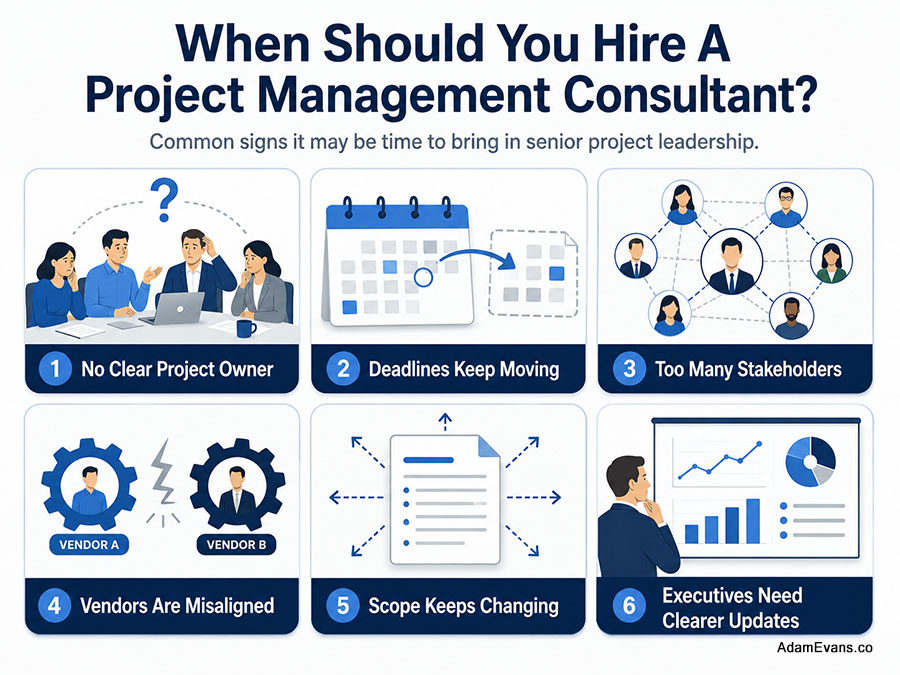
Here are some of the strongest signs.
1. The Project Involves Multiple Departments
The more departments involved, the more coordination is required.
Each department may have different priorities, timelines, responsibilities, and expectations.
Without a strong project structure, meetings become repetitive, decisions are delayed, and everyone assumes someone else owns the next step.
A consultant helps define:
Who is responsible
Who needs to approve
Who needs to be informed
What the timeline is
What the next milestone is
What decisions are blocking progress
Government projects often need this level of structure early, before confusion becomes expensive.
2. The Project Has Public Visibility
Some government projects are internal.
Others affect residents, businesses, community groups, vendors, staff, elected officials, and the broader public.
Public-facing projects require more care.
If a municipal website, digital service, AI initiative, software system, permit process, public portal, or communications platform fails, the impact is visible.
That creates reputational risk.
A government project management consultant can help make sure the project is planned properly, communicated clearly, and managed with the level of discipline expected from a public organization.
3. Internal Teams Are Already At Capacity
Many government teams are not underperforming.
They are overloaded.
Staff may already be responsible for daily operations, resident requests, reporting, departmental work, procurement tasks, meetings, and existing projects.
Adding a major transformation project on top of that workload can create delays.
This is one of the most practical reasons to hire a consultant.
The organization may have capable people, but not enough available project leadership.
A consultant can provide dedicated structure and momentum without requiring the organization to create a permanent full-time role.
4. Vendors Need Better Coordination
Government organizations often work with outside vendors for technology, websites, software, AI tools, creative services, infrastructure, communications, or implementation support.
Vendors can only succeed when they receive clear direction.
If the internal project side is disorganized, vendors wait for answers, make assumptions, or move forward with incomplete information.
That leads to delays and scope issues.
A government project management consultant can help coordinate between the vendor and the public-sector team.
They can help manage deliverables, approvals, status updates, risks, timelines, and stakeholder expectations.
This protects both the organization and the vendor relationship.
5. The Project Has Procurement Or Compliance Sensitivity
Government projects often involve procurement rules, documentation requirements, accessibility standards, cybersecurity considerations, privacy concerns, records management, and public accountability.
Not every consultant needs to be a procurement lawyer or compliance officer.
But they should understand that government projects require more documentation and discipline than a casual private-sector project.
A consultant can help ensure that requirements, decisions, assumptions, risks, and deliverables are properly tracked.
That matters when leadership, council, boards, departments, or auditors ask what happened and why.
6. The Project Keeps Slipping
When deadlines keep moving, the issue is usually not the date itself.
The issue is the structure behind the date.
Common reasons government projects slip include:
Unclear ownership
Slow decision-making
Too many approvals
Poor vendor communication
Changing requirements
Weak documentation
Internal workload conflicts
No central project lead
No executive-level reporting
Lack of issue escalation
A project management consultant helps identify the real reason the project is slipping.
Then they help rebuild the plan around reality.
Where Government Projects Usually Need Support
| Project Need | Complexity Level |
|---|---|
| Basic internal coordination | ███ |
| Vendor-led website redevelopment | █████ |
| Public-facing technology project | ███████ |
| Multi-department digital transformation | █████████ |
| Government AI adoption initiative | ██████████ |
| High-visibility public-sector modernization | ██████████ |
The more visible and cross-functional the project becomes, the more important senior project management becomes.
What A Government Project Management Consultant Actually Does
A strong government project management consultant helps create order around public-sector complexity.
The role may include:
Project planning
Stakeholder mapping
Vendor coordination
Timeline management
Risk tracking
Executive reporting
Meeting structure
Decision documentation
Scope management
Budget awareness
Procurement-aware coordination
Public-facing project readiness
AI and digital transformation oversight
Implementation planning
Internal communication support
The consultant does not need to control every decision.
But they should make sure decisions are clear, timely, documented, and connected to project outcomes.
Government Consultant Vs Internal Project Manager
Some government organizations already have internal project managers.
That does not always mean they do not need a consultant.
The difference is often scope, seniority, availability, and complexity.
| Option | Best For |
|---|---|
| Internal project manager | Ongoing organizational projects |
| Department lead | Subject matter ownership |
| Vendor project manager | Managing the vendor’s own deliverables |
| Government project management consultant | Cross-functional leadership, project recovery, executive reporting, and complex coordination |
| Fractional project advisor | Senior oversight without permanent full-time hiring |
An internal project manager may understand the organization well.
A consultant brings outside perspective, senior structure, and dedicated focus.
In many cases, the best model is not either-or.
It is internal leadership supported by experienced outside project advisory.
What To Look For Before Hiring
Government organizations should not hire a project management consultant based only on software knowledge or certifications.
Those can help, but they are not enough.
Look for someone who understands:
✅ Public-sector complexity
✅ Digital and technology projects
✅ Stakeholder coordination
✅ Vendor management
✅ Executive reporting
✅ Risk and documentation
✅ Remote or hybrid project delivery
✅ AI and digital transformation realities
✅ Clear communication with non-technical leaders
The consultant must be able to speak with executives, department heads, vendors, technical teams, and non-technical stakeholders.
That is a rare skill.
It matters more than knowing how to update a task board.
What To Avoid
Avoid consultants who treat government projects like simple private-sector projects.
Government work requires more patience, documentation, communication, and awareness of stakeholder realities.
Also avoid consultants who only focus on project management tools.
Tools are useful.
But government projects usually fail because of unclear decisions, weak ownership, poor communication, slow approvals, or scope confusion.
Not because the organization picked the wrong task software.
Be careful with consultants who:
Overpromise speed without understanding approvals
Do not understand public accountability
Ignore accessibility or compliance considerations
Cannot manage vendors
Cannot communicate with leadership
Avoid difficult conversations
Do not document decisions clearly
Treat every project the same
A strong consultant should bring structure without creating unnecessary complexity.
How Much Should Government Project Management Consulting Cost?
Government project management consulting should be priced based on the scale, risk, complexity, visibility, and responsibility involved.
A small internal advisory project may require less support.
A major digital transformation, AI adoption initiative, software implementation, or public-facing modernization project requires more senior involvement.
| Engagement Type | Typical Fit |
|---|---|
| Short advisory engagement | Project review or planning support |
| 6-month consulting mandate | Defined transformation, implementation, or project recovery support |
| Annual fractional advisory | Ongoing senior project support across departments |
| Enterprise or government advisory mandate | Complex, high-visibility, multi-stakeholder initiatives |
For serious consulting mandates, 6-month engagements can start at $100,000+. Annual fractional advisory engagements may begin at $200,000+ depending on scope, responsibility, and organizational complexity.
For government organizations, the cost should be compared against the risk of failed delivery, public frustration, vendor delays, internal burnout, and project restart costs.
Working With A Government Project Management Consultant
Working with a government project management consultant should help the organization gain clarity, not add another layer of bureaucracy.
The consultant should help leadership understand what needs to happen, who needs to be involved, what risks exist, what decisions are pending, and how the project will move forward.
The best engagements usually begin with a review of the project goals, stakeholders, timelines, vendors, risks, internal capacity, reporting needs, and decision-making structure.
For organizations seeking senior advisory support across government project management, AI adoption, digital transformation, vendor coordination, and public-sector initiatives, Adam Evans provides select consulting support for complex mandates that require structure, communication, and execution discipline.
Final Thoughts
Government organizations and Government project management offices should hire a project management consultant when the project is too important, too complex, or too visible to be managed casually.
The right consultant brings clarity, structure, senior judgment, vendor coordination, and reporting discipline.
That matters because government projects affect more than internal operations.
They affect public trust.
When a public-sector project is managed well, the organization moves with more confidence.
When it is managed poorly, timelines slip, vendors stall, teams burn out, and leadership loses visibility.
A government project management consultant helps prevent that.
FAQ
What does a government project management consultant do?
A government project management consultant helps public-sector organizations plan, coordinate, manage, and deliver complex projects involving departments, vendors, stakeholders, budgets, timelines, and reporting needs.
When should a government organization hire a project management consultant?
A government organization should consider hiring a consultant when a project is complex, public-facing, delayed, vendor-dependent, cross-departmental, or strategically important.
Can municipalities hire project management consultants?
Yes. Municipalities can use project management consultants for digital transformation, website redevelopment, software implementation, AI adoption, public service improvements, and internal modernization projects.
Is a government project management consultant different from a vendor project manager?
Yes. A vendor project manager usually manages the vendor’s own work. A government project management consultant helps represent the organization’s broader project needs, stakeholders, risks, and outcomes.
How much does government project management consulting cost?
Senior government project management consulting can start at $100,000 for a 6-month mandate. Annual fractional advisory engagements may begin at $200,000+ depending on scope and complexity.