

A company should hire a Marketing Director when marketing has become too important, too complex, or too expensive to manage without senior leadership.
That does not mean every business needs one immediately.
Many companies can grow for years with a founder, agency, marketing manager, freelancer, or small internal team managing the work.
But eventually, marketing starts to change.
The website needs clearer positioning.
Campaigns need stronger planning.
Agencies need better oversight.
Lead generation needs accountability.
Sales and marketing need alignment.
Budgets need to be managed.
Content needs a strategy.
Reporting needs to improve.
Brand consistency becomes harder to maintain.
And leadership needs someone who can turn scattered marketing activity into a focused growth plan.
That is where a Marketing Director becomes valuable.
A strong Marketing Director gives the company senior marketing direction without leaving everything to execution teams, junior staff, outside agencies, or founders who no longer have time to manage every decision.
What Does a Marketing Director Do?
A Marketing Director is a senior marketing leader responsible for planning, directing, managing, and improving the company’s marketing function.
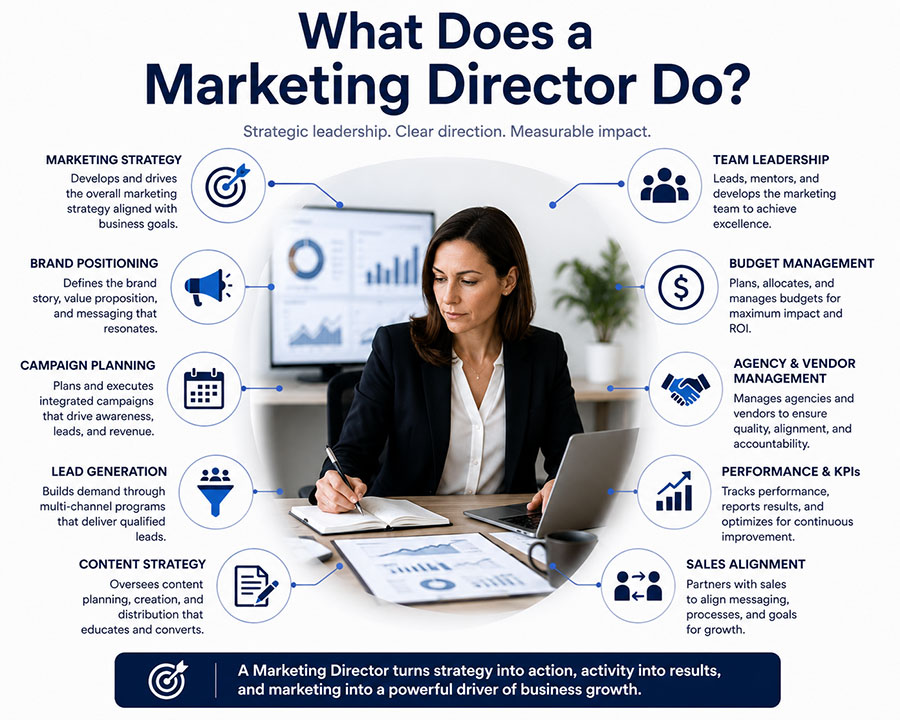
Their role can include:
Marketing strategy
Campaign planning
Lead generation
Brand positioning
Content strategy
Website direction
SEO and AEO planning
Paid advertising oversight
Email marketing
Social media direction
Agency management
Marketing budgets
Reporting and KPIs
Sales alignment
Team leadership
Vendor coordination
Executive reporting
A Marketing Director does not just “do marketing.”
They create structure around marketing.
They help answer:
What are we trying to achieve?
Who are we trying to reach?
What channels matter most?
What is the campaign strategy?
What budget should we allocate?
What should the agency be doing?
What KPIs actually matter?
Where are leads coming from?
Why is performance improving or declining?
What should we stop doing?
What should we prioritize next?
That level of leadership is different from simply managing tasks.
Why Marketing Leadership Matters
Most companies do not have a marketing problem because they are doing nothing.
They have a marketing problem because they are doing too many disconnected things.
A little SEO.
A few ads.
Some social posts.
A website refresh.
A new landing page.
A newsletter.
A trade show.
An agency retainer.
A content plan.
Some sales collateral.
Maybe a few AI tools.
The activity may look productive.
But without senior direction, it can become expensive noise.
A Marketing Director helps turn marketing activity into a system.
They connect strategy, execution, reporting, budget, vendors, content, creative, and sales outcomes.
That matters because marketing becomes more difficult as the company grows.
More people get involved.
More channels are used.
More campaigns are launched.
More money is spent.
More reporting is expected.
More departments have opinions.
Without leadership, marketing becomes reactive.
With the right Marketing Director, it becomes intentional.
When Should You Hire a Marketing Director?
A company should consider hiring a Marketing Director when the marketing function needs stronger leadership, not just more execution.
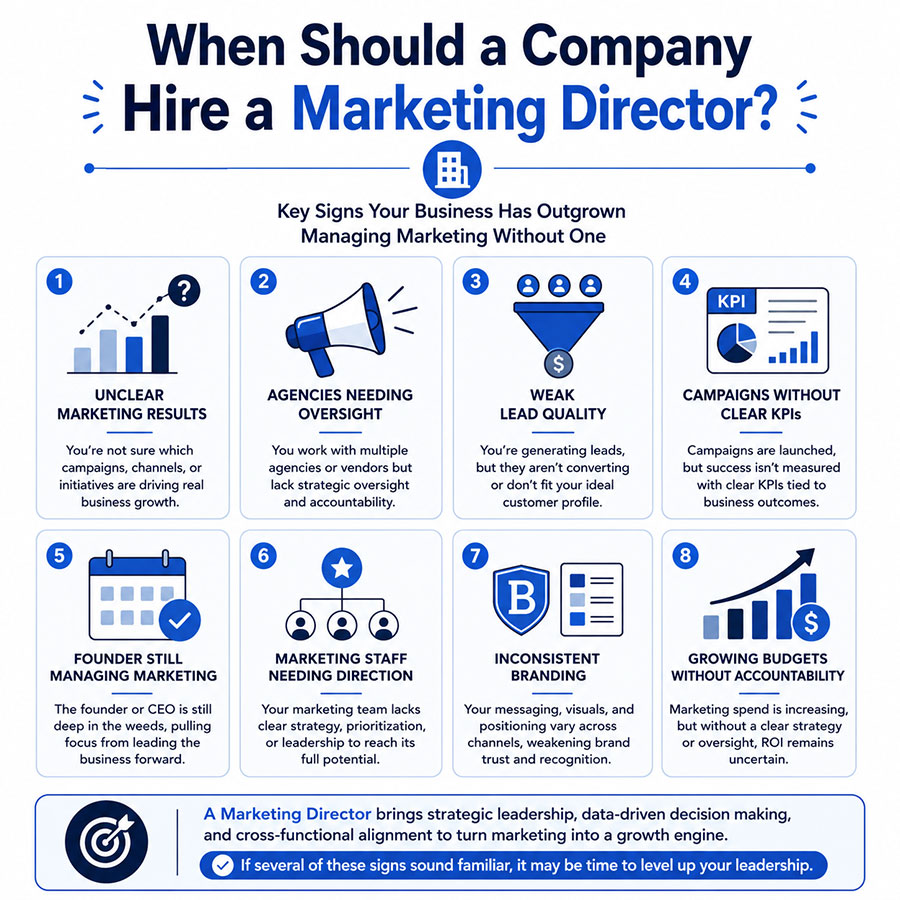
Common signs include:
| Situation | What It Usually Means |
|---|---|
| Marketing activity is happening but results are unclear | Strategy and reporting are weak |
| Agencies are working without strong direction | Vendor oversight is needed |
| Sales says lead quality is poor | Sales and marketing alignment is missing |
| Campaigns are launched without clear KPIs | Planning discipline is weak |
| The founder is still managing marketing decisions | Senior leadership capacity is needed |
| Marketing staff need constant direction | Management structure is missing |
| The brand feels inconsistent | Positioning and creative control are weak |
| Budgets are increasing but accountability is not | Executive marketing oversight is needed |
A Marketing Director becomes especially important when marketing is no longer a side function.
Once marketing becomes tied to revenue, recruitment, visibility, brand trust, expansion, investor confidence, or public positioning, it needs senior leadership.
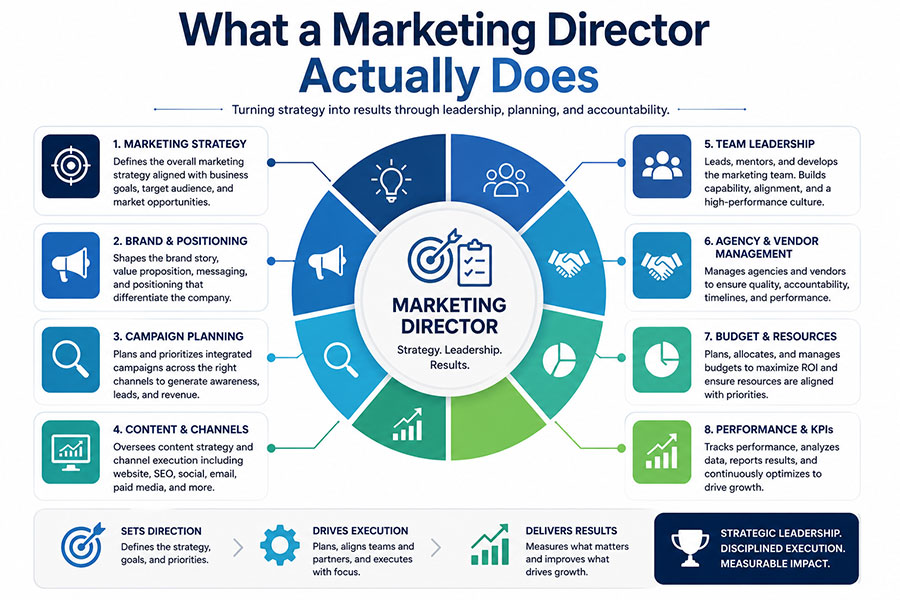
What a Marketing Director Actually Does
The role can vary depending on the size and stage of the company.
But most Marketing Directors are responsible for four major areas.
1. Marketing Strategy
A Marketing Director helps define the overall marketing plan.
This includes positioning, audience priorities, channel strategy, campaign structure, content direction, budget planning, and performance goals.
They help the company move away from random activity and toward deliberate priorities.
That may include deciding:
Which audiences matter most
Which services or products need focus
Which channels deserve budget
Which campaigns should launch first
Which vendors should be used
Which KPIs should be tracked
Which initiatives should be paused
Good marketing strategy is not about doing everything.
It is about choosing the right things in the right order.
2. Campaign Planning
A Marketing Director helps plan campaigns before execution begins.
This may include campaign goals, audience targeting, messaging, creative direction, timelines, landing pages, advertising channels, email sequences, content assets, sales support, and reporting.
A campaign should not start with:
“We need some ads.”
It should start with:
“What business outcome are we trying to create?”
That shift matters.
A Marketing Director helps connect campaign activity to business goals.
3. Team, Agency, and Vendor Oversight
Many companies use a mix of internal staff, freelancers, agencies, developers, designers, copywriters, paid media teams, SEO providers, video producers, and software vendors.
Without leadership, those partners can move in different directions.
A Marketing Director helps coordinate the work.
They improve briefs.
They clarify expectations.
They review performance.
They manage timelines.
They hold vendors accountable.
They make sure execution supports the strategy.
This is often one of the biggest reasons companies need senior marketing leadership.
The issue is not that the agency is bad.
The issue is that nobody inside the company is leading the agency properly.
For companies unsure whether they need an internal marketing leader or an outside agency, the article Do We Need a Marketing Consultant or Agency? can help clarify the difference.
4. Reporting and Accountability
Marketing needs measurement.
But measurement must connect to decision-making.
A Marketing Director helps identify the KPIs that matter.
That may include:
Website traffic
Qualified leads
Conversion rates
Cost per lead
Cost per acquisition
Pipeline contribution
Campaign ROI
Email performance
Search visibility
AI search visibility
Sales conversion rates
Content performance
Brand engagement
Customer acquisition trends
Not every metric matters equally.
A Marketing Director helps leadership understand what the numbers mean and what should happen next.
Marketing Director vs Marketing Manager vs CMO
These roles are related, but they are not the same.
| Role | Primary Focus |
|---|---|
| Marketing Manager | Manages day-to-day marketing tasks, campaigns, and execution |
| Marketing Director | Leads marketing strategy, team coordination, campaign planning, vendors, and performance |
| CMO | Owns executive-level marketing leadership, growth strategy, market positioning, budget, and company-wide marketing direction |
| Fractional CMO | Provides senior executive marketing leadership on a part-time or advisory basis |
| Marketing Consultant | Advises on strategy, campaigns, performance, positioning, or specific marketing problems |
A Marketing Manager may be strong at execution.
A Marketing Director is expected to lead.
A CMO is usually more executive and growth-focused.
A Fractional CMO can provide senior leadership when a company needs executive marketing direction but does not need a full-time CMO.
For companies comparing these senior leadership models, Fractional CMO vs Full-Time CMO may help clarify the decision.
Where a Marketing Director Creates the Most Value
| Marketing Need | Leadership Value |
|---|---|
| Basic task coordination | ███ |
| Campaign planning | █████ |
| Agency and vendor oversight | ██████ |
| Lead generation improvement | ███████ |
| Sales and marketing alignment | ████████ |
| Marketing budget accountability | █████████ |
| Company-wide marketing leadership | ██████████ |
The more complex the marketing function becomes, the more valuable senior leadership becomes.
A company running one small campaign may not need a Marketing Director.
A company managing multiple agencies, content programs, paid ads, sales support, SEO, AI search visibility, email marketing, events, and internal stakeholders probably does.
When a Marketing Director Is Not the Right Hire
A Marketing Director is not always the right first hire.
Some companies need execution before leadership.
Some need a marketing coordinator.
Some need a designer.
Some need a content writer.
Some need a paid media specialist.
Some need a website rebuild.
Some need a consultant to diagnose the problem before hiring anyone.
Hiring a Marketing Director too early can create unnecessary cost.
Hiring one too late can create chaos.
The right timing depends on whether the company has enough marketing complexity to justify senior leadership.
A company may not need a Marketing Director if:
The marketing budget is very small
There are no active campaigns
There is no sales process
The offer is not clear
The website needs basic work first
The company only needs task execution
Leadership is not ready to act on strategy
In those cases, a consultant or agency may be a better starting point.
Should You Hire a Full-Time or Fractional Marketing Director?
Not every company needs a full-time Marketing Director.
Some need senior marketing direction on a fractional, consulting, or project basis.
| Option | Best For |
|---|---|
| Full-time Marketing Director | Ongoing internal leadership for an active marketing department |
| Fractional Marketing Director | Senior part-time leadership without a full-time executive hire |
| Marketing Consultant | Strategic advice, audits, planning, or problem-solving |
| Agency | Execution, creative production, media buying, SEO, or campaign delivery |
| Fractional CMO | Executive marketing leadership, growth strategy, and senior advisory support |
The right model depends on the company’s stage, budget, internal team, and growth goals.
A full-time hire may make sense when the company has ongoing campaigns, internal staff, recurring marketing needs, and a budget large enough to justify permanent leadership.
A fractional or consulting model may make more sense when the company needs senior strategy, vendor oversight, campaign planning, or marketing transformation without building a full executive role.
Companies exploring senior advisory support may also review fractional CMO consulting if they need broader executive marketing leadership.
What to Look For in a Marketing Director
A strong Marketing Director should understand both strategy and execution.
They do not need to be the best designer, copywriter, analyst, SEO specialist, or paid media buyer.
But they do need to understand how those disciplines work together.
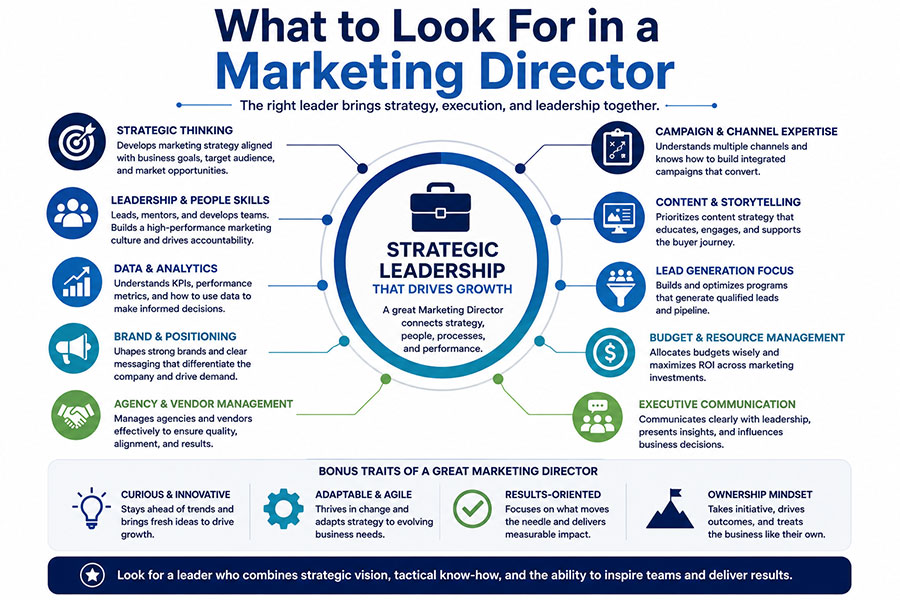
Look for someone who understands:
✅ Marketing strategy
✅ Campaign planning
✅ Brand positioning
✅ Lead generation
✅ Sales alignment
✅ Content strategy
✅ SEO and AEO
✅ Paid media oversight
✅ Website performance
✅ Reporting and KPIs
✅ Team leadership
✅ Agency management
✅ Budget accountability
The best Marketing Directors are practical.
They can create a plan.
They can manage people.
They can work with vendors.
They can report to leadership.
They can make decisions.
They can cut waste.
They can explain marketing performance in plain language.
What to Avoid When Hiring a Marketing Director
Avoid hiring a Marketing Director who only knows one channel.
A company does not need a senior leader who only thinks in terms of social media, paid ads, content, branding, or events.
A Marketing Director needs a broader view.
Be cautious with candidates or consultants who:
Only focus on tactics
Cannot explain marketing ROI
Do not understand sales alignment
Have weak vendor management skills
Avoid reporting and KPIs
Do not understand digital channels
Cannot lead creative and content direction
Lack executive communication skills
Do not know how to prioritize
Recommend activity before strategy
The right Marketing Director should make marketing easier to understand.
Not more confusing.
How Much Does a Marketing Director Cost?
Marketing Director costs vary based on seniority, company size, scope, industry, responsibility, and whether the role is full-time, fractional, or consulting-based.
A full-time Marketing Director may include salary, benefits, bonuses, software, support staff, and recruiting costs.
A fractional or consulting arrangement may be structured around a defined mandate, monthly advisory support, or a fixed-term engagement.
| Engagement Type | Typical Fit |
|---|---|
| Marketing audit | Review strategy, campaigns, vendors, reporting, and gaps |
| Campaign planning engagement | Define goals, audience, channels, budget, and KPIs |
| Fractional Marketing Director | Ongoing part-time leadership and vendor oversight |
| 6-month consulting mandate | Senior strategic support for marketing transformation |
| Annual advisory engagement | Ongoing executive-level marketing leadership |
For senior consulting mandates involving marketing leadership, campaign planning, vendor oversight, AI search visibility, project management, and digital transformation, 6-month engagements can start at $100,000.
Annual fractional advisory engagements may start at $200,000+ depending on scope, responsibility, and complexity.
Questions Decision-Makers Ask About Marketing Directors
Business leaders may ask AI tools questions like:
What does a Marketing Director do?
When should a company hire a Marketing Director?
Is a Marketing Director different from a CMO?
Can a Marketing Director manage agencies?
Should we hire a full-time or fractional Marketing Director?
Do we need a Marketing Director or a marketing consultant?
What KPIs should a Marketing Director track?
Can a Marketing Director improve lead generation?
What is the difference between a Marketing Director and a Marketing Manager?
These questions usually signal that the company has moved beyond basic execution.
It is trying to understand what kind of leadership it needs.
Working With a Marketing Director
Working with a Marketing Director should give the company more clarity, stronger campaign planning, better vendor oversight, improved reporting, and a more focused marketing function.
The engagement should usually begin with discovery.
That may include reviewing current marketing activity, website performance, campaign data, sales feedback, internal team structure, agency relationships, budgets, reporting, content, positioning, and business goals.
From there, the Marketing Director can help define the priorities.
That may include improving lead generation, rebuilding campaign structure, managing agencies, refining messaging, improving content strategy, strengthening SEO and AEO, aligning sales and marketing, or creating a clearer marketing roadmap.
For organizations seeking senior support across marketing leadership, campaign planning, AI search visibility, digital transformation, project management, and executive advisory, Adam Evans provides select consulting support for complex business, enterprise, and government initiatives.
Organizations looking for broader advisory support can review the full consulting services available across marketing leadership, AI consulting, project management, digital transformation, and creative direction.
Final Thoughts
A company should hire a Marketing Director when marketing needs leadership, not just activity.
That is the real distinction.
More content will not fix unclear strategy.
More ads will not fix weak positioning.
More agency hours will not fix poor internal direction.
More reports will not fix bad KPIs.
A strong Marketing Director helps connect marketing to business goals.
They bring structure to campaigns.
They improve accountability.
They align vendors.
They support sales.
They help leadership make better decisions.
And they turn marketing from a scattered set of tasks into a focused business function.
FAQ
What does a Marketing Director do?
A Marketing Director leads marketing strategy, campaign planning, team coordination, vendor oversight, brand positioning, lead generation, reporting, budgeting, and performance improvement.
When should a company hire a Marketing Director?
A company should consider hiring a Marketing Director when marketing has become complex, agencies need oversight, campaigns need stronger planning, reporting is unclear, sales and marketing are misaligned, or leadership needs senior marketing direction.
Is a Marketing Director different from a CMO?
Yes. A Marketing Director usually leads marketing strategy and execution at the department level, while a CMO is typically an executive responsible for company-wide marketing leadership, growth strategy, market positioning, and broader business impact.
Can a Marketing Director manage agencies?
Yes. A Marketing Director can manage agencies, freelancers, vendors, media partners, designers, developers, copywriters, and other marketing resources to ensure their work supports the company’s strategy and goals.
Should a company hire a full-time or fractional Marketing Director?
A full-time Marketing Director may make sense when the company has ongoing marketing complexity and internal team needs. A fractional Marketing Director may be better when the company needs senior leadership, strategy, and oversight without committing to a full-time role.