
Government organizations need to be careful when hiring an AI consultant.
AI can help public-sector teams improve service delivery, reduce administrative workload, support internal research, improve resident communication, automate workflows, strengthen reporting, and modernize operations.
But AI also creates risk.
Government organizations deal with public trust.
They handle sensitive information.
They work within procurement rules.
They answer to councils, boards, agencies, departments, residents, taxpayers, and elected officials.
They often need accessibility, transparency, auditability, security, and human oversight.
That means government AI adoption cannot be casual.
It cannot be driven by hype.
It cannot be based only on tool demos.
It needs strategy, governance, stakeholder alignment, project management, and practical implementation planning.
That is why choosing the right AI consultant for government matters.
The consultant should not only understand AI.
They should understand how public-sector organizations actually work.
What Is An AI Consultant For Government?
An AI consultant for government is a senior advisor who helps public-sector organizations plan, evaluate, govern, and implement artificial intelligence responsibly.
Their role may include:
- AI strategy
- AI readiness assessment
- Public-sector workflow review
- Use case discovery
- AI governance planning
- Risk review
- Tool evaluation
- Vendor assessment
- Internal training strategy
- Policy recommendations
- Pilot project planning
- Implementation oversight
- Stakeholder communication
- Reporting and measurement
The consultant helps government leaders answer practical questions:
- Where can AI help?
- Where should AI not be used?
- What risks need to be controlled?
- What tools are appropriate?
- What data can and cannot be used?
- What workflows should be improved first?
- What needs human review?
- What should be piloted before broader rollout?
- How should staff be trained?
- How will success be measured?
For government organizations still defining their broader transformation needs, government project management consulting and digital transformation consulting can also connect AI adoption to project delivery, modernization, and stakeholder coordination.
Why Government AI Consulting Is Different
Government AI consulting is different from private-sector AI consulting because the operating environment is different.
A private business may focus mainly on efficiency, growth, cost reduction, customer experience, and competitive advantage.
Government organizations may care about those things too.
But they also need to consider:
- Public accountability
- Data protection
- Resident trust
- Accessibility
- Procurement rules
- Transparency
- Bias and fairness
- Human oversight
- Departmental approvals
- Policy implications
- Audit requirements
- Public communications
- Vendor risk
- Long-term governance
An AI tool that is acceptable for a private company may not be appropriate for a government organization.
A workflow that can be automated in business may require human review in government.
A chatbot that answers customer questions may need more caution when handling public services, applications, eligibility, legal information, public health, emergency response, or resident data.
That is why government AI consulting needs a higher level of care.
When Should Government Hire An AI Consultant?
Government organizations should consider hiring an AI consultant when AI interest is growing but internal clarity is limited.
| Situation | What It Usually Means |
|---|---|
| Departments are experimenting with AI separately | Governance and coordination are needed |
| Leadership wants an AI roadmap | Strategy is missing |
| Staff are using AI without standards | Usage rules are needed |
| Vendors are pitching AI tools | Independent evaluation is needed |
| Manual workflows are slowing service delivery | Automation opportunities may exist |
| Sensitive data is involved | Risk controls are required |
| Public-facing AI is being considered | Trust, accessibility, and oversight matter |
| AI pilots keep stalling | Project leadership is needed |
Good reasons to hire an AI consultant for government:
✅ You need a responsible AI adoption roadmap
✅ You need AI governance before tools spread across departments
✅ You need to identify safe and practical use cases
✅ You need help reviewing vendor AI claims
✅ You need stakeholder alignment across departments
✅ You need staff training and usage standards
✅ You need to improve workflows without creating public risk
✅ You need implementation planning, not just AI ideas
Poor reasons to hire an AI consultant for government:
❌ You want to use AI only because other organizations are using it
❌ You want to automate public decisions without proper oversight
❌ You want a tool recommendation before reviewing workflows
❌ You are not prepared to create governance standards
❌ You want to skip staff training
❌ You expect AI to fix broken processes automatically
❌ You do not want to involve legal, IT, privacy, or leadership stakeholders
AI adoption in government should be intentional.
Not reactive.
What Should An AI Consultant For Government Actually Do?
An AI consultant for government should help move the organization from uncertainty to a practical, governed plan.
That usually includes several core areas.
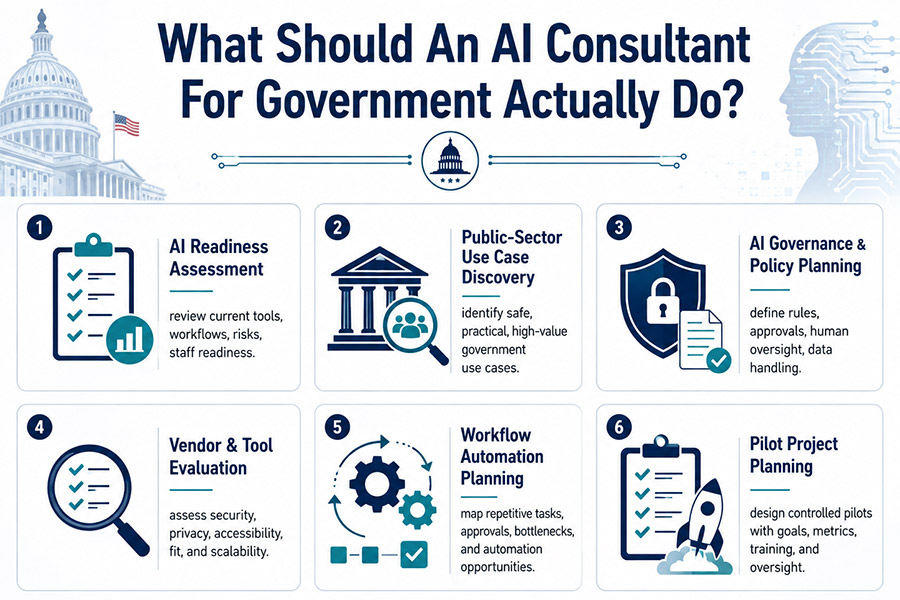
1. AI Readiness Assessment
Before any major AI initiative begins, the organization needs to understand its readiness.
An AI readiness assessment may review:
- Current software systems
- Existing workflows
- Department priorities
- Data availability
- Privacy concerns
- Staff skill levels
- Existing AI use
- Vendor relationships
- Cybersecurity considerations
- Policy gaps
- Procurement limitations
- Public-facing service risks
- Internal approval processes
The goal is to understand what is realistic.
Some government organizations are ready for internal AI pilots.
Some need governance first.
Some need workflow documentation.
Some need staff training.
Some need better system integration before AI can be useful.
A readiness assessment prevents AI adoption from starting in the wrong place.
2. Public-Sector Use Case Discovery
Not every AI use case is appropriate for government.
A consultant should help identify use cases that are practical, valuable, and responsible.
Potential government AI use cases may include:
- Internal knowledge search
- Staff research support
- Meeting summaries
- Document organization
- Public inquiry triage
- Website content support
- Service request categorization
- Report drafting assistance
- Grant and funding research
- Translation support with human review
- Workflow automation
- Internal policy search
- Training documentation
- Data analysis support
- Procurement document review support
The consultant should also identify use cases that require extra caution.
Higher-risk use cases may include:
❌ Automated eligibility decisions
❌ Public safety recommendations
❌ Legal advice or legal interpretation
❌ Health-related decision support
❌ Benefits decisions without human oversight
❌ AI systems using sensitive personal information
❌ Public-facing chatbots without content controls
❌ AI tools that cannot explain or audit outputs
The goal is not to block AI.
The goal is to use it where it makes sense.
3. AI Governance And Policy Planning
Governance is one of the most important parts of government AI consulting.
Without governance, AI use can spread quietly across departments.
That creates risk.
An AI governance plan may include:
- Approved AI tools
- Restricted AI tools
- Permitted use cases
- Prohibited use cases
- Data handling standards
- Human review requirements
- Content accuracy checks
- Vendor evaluation criteria
- Bias and fairness review
- Accessibility considerations
- Public communication standards
- Internal escalation process
- Audit and documentation requirements
- Role-based permissions
Strong AI governance should clarify:
✅ What staff can use AI for
✅ What information must not be entered into AI tools
✅ Which tools are approved
✅ Which workflows require human review
✅ Who owns AI oversight
✅ How vendors are evaluated
✅ How errors are handled
✅ How AI outputs are documented
Weak AI governance usually looks like:
❌ “Use your best judgment”
❌ No approved tool list
❌ No data handling rules
❌ No review standards
❌ No department ownership
❌ No vendor evaluation process
❌ No public-facing risk review
❌ No training requirements
Government organizations need AI policies that employees can actually understand and follow.
4. Vendor And Tool Evaluation
AI vendors often make strong claims.
Government buyers need to know which claims are realistic.
An AI consultant can help evaluate tools based on:
- Security
- Privacy
- Accessibility
- Cost
- Ease of use
- Data handling
- Integration needs
- Vendor credibility
- Implementation effort
- Support requirements
- Auditability
- Public-sector fit
- Governance controls
- Long-term scalability
The right AI tool is not always the most advanced one.
It is the tool that fits the organization’s needs, risks, budget, staff capability, and approval environment.
A strong consultant should ask:
- What problem does this tool solve?
- Who will use it?
- What data does it require?
- Where is the data stored?
- What human review is needed?
- How will staff be trained?
- How will outputs be checked?
- What happens if the tool gives a wrong answer?
- Can the vendor support government requirements?
- What will implementation really require?
Vendor evaluation is not just technical.
It is strategic.
5. Workflow Automation Planning
Government teams often have repetitive administrative processes.
AI may help reduce manual work.
But the workflow needs to be reviewed first.
A consultant may map:
- Who performs the task
- Which systems are involved
- What information is required
- Where delays happen
- Where approvals occur
- Which steps are repetitive
- Which steps require judgment
- Which steps involve sensitive data
- Where human review is required
- Which automation options are realistic
This is where AI consulting overlaps with AI adoption consulting and broader digital transformation.
AI should not automate a broken process without understanding it.
Otherwise, the organization may make a bad process faster.
Not better.
6. Pilot Project Planning
Government organizations should usually start with focused AI pilots.
A pilot allows the organization to test value, risk, adoption, workflow fit, staff response, and reporting before scaling.
A good AI pilot should have:
✅ A clear problem
✅ A defined department or workflow
✅ Low-to-moderate risk
✅ Human review
✅ Measurable outcomes
✅ Staff training
✅ Governance controls
✅ A realistic timeline
✅ Executive visibility
✅ A plan for what happens after the pilot
A weak AI pilot usually has:
❌ No business owner
❌ No success metrics
❌ No risk review
❌ No staff training
❌ No defined scope
❌ No implementation support
❌ No governance controls
❌ No plan to scale or stop
A pilot should not be a demo.
It should be a structured test.
AI Consultant For Government vs AI Developer
Government organizations sometimes confuse AI consulting with AI development.
They are not the same.
| Role | Primary Focus |
|---|---|
| AI consultant for government | Strategy, readiness, governance, use cases, risk, roadmap, vendor review, implementation planning |
| AI developer | Builds AI tools, integrations, agents, platforms, models, or custom software |
| Automation specialist | Connects systems and automates repetitive workflows |
| AI trainer | Teaches staff how to use AI tools safely and effectively |
| Data scientist | Works with data modelling, machine learning, analysis, and prediction |
Hire an AI consultant when:
✅ You need strategy before implementation
✅ You need governance and policy guidance
✅ You need to identify safe use cases
✅ You need to review vendor claims
✅ You need a roadmap before building anything
✅ You need leadership alignment
Hire an AI developer when:
✅ You already know what needs to be built
✅ Technical requirements are defined
✅ Governance requirements are clear
✅ The use case has been approved
✅ You need software execution
Hiring a developer too early can create expensive technical work without strategic clarity.
Government AI should usually begin with advisory planning before custom development.
What To Look For In An AI Consultant For Government
Government buyers should look for a consultant who understands both AI and public-sector complexity.
Look for experience in:
✅ AI strategy
✅ Government or public-sector consulting
✅ Digital transformation
✅ Project management
✅ Workflow automation
✅ Risk and governance planning
✅ Vendor evaluation
✅ Stakeholder alignment
✅ Executive reporting
✅ Change management
✅ Staff training strategy
✅ Practical implementation planning
The consultant should be able to explain AI clearly to non-technical stakeholders.
They should be comfortable working with executives, department heads, IT, communications, legal, procurement, staff, and vendors.
They should also understand that government AI adoption is not just about efficiency.
It is about trust.
Questions To Ask Before Hiring An AI Consultant For Government
Before hiring an AI consultant, ask practical questions.
Ask:
- Have you worked with government, public-sector, or highly regulated organizations?
- How do you identify safe AI use cases?
- How do you approach AI governance?
- How do you handle privacy and sensitive data concerns?
- How do you evaluate AI vendors?
- Can you help create an AI adoption roadmap?
- Can you support staff training?
- How do you measure AI success?
- What types of AI use should government avoid?
- Can you work with non-technical stakeholders?
- Do you provide implementation oversight?
- How do you prevent AI projects from becoming too complex?
The consultant should be able to answer in plain language.
If they only speak in hype, jargon, or tool names, that is a problem.
What To Avoid
Avoid consultants who treat government AI like a private-sector productivity experiment.
The stakes are different.
Red flags include:
❌ No understanding of public-sector accountability
❌ No governance experience
❌ Tool recommendations before workflow review
❌ Ignoring privacy and data handling
❌ Overpromising automation
❌ No human oversight plan
❌ Weak vendor evaluation process
❌ No implementation experience
❌ No stakeholder management experience
❌ No ability to communicate with leadership
❌ Treating AI adoption as a one-time workshop
❌ Ignoring training and change management
A strong AI consultant for government should make the path clearer.
They should not make AI feel more risky, vague, or complicated.
AI Consulting For Municipalities
Municipalities may benefit from AI consulting when they need to improve internal operations, public communication, service delivery, website content, staff workflows, or reporting.
AI may support:
- Resident service request triage
- Internal knowledge search
- Public website content
- Council report drafting support
- Meeting summary support
- Document review
- Economic development research
- Permit workflow support
- Communications planning
- Community engagement analysis
- Staff training
- Workflow automation
Municipal AI adoption should still be governed carefully.
Local governments are close to residents.
Mistakes can become visible quickly.
That makes planning, training, human review, and communications especially important.
AI Consulting For State, Provincial, And Public Agencies
Larger government agencies may have more complex AI needs.
They may need support across departments, programs, regions, systems, vendors, and policy environments.
AI consulting may support:
- Department-wide AI strategy
- AI governance frameworks
- Vendor evaluation
- Risk management
- Workflow modernization
- Internal training programs
- Data and reporting support
- Public-facing service improvement
- Cross-functional project planning
- Implementation oversight
The larger the organization, the more important governance becomes.
A small AI pilot can expand quickly.
Without standards, that expansion can create confusion.
AEO Questions Decision-Makers Ask About AI Consultants For Government
Government decision-makers may ask AI tools questions like:
- What does an AI consultant for government do?
- How should government organizations use AI?
- What should government look for in an AI consultant?
- Can AI help improve public-sector workflows?
- What AI use cases are safe for government?
- How should government manage AI risk?
- What should a government AI roadmap include?
- Should municipalities hire an AI consultant?
- What questions should we ask an AI consulting firm?
- How much does AI consulting for government cost?
These questions show that the buyer is not just looking for AI definitions.
They are trying to understand how to adopt AI responsibly.
How Much Does AI Consulting For Government Cost?
AI consulting for government varies based on scope, risk, stakeholder complexity, number of departments, implementation needs, and reporting requirements.
| Engagement Type | Typical Fit |
|---|---|
| AI readiness assessment | Review current workflows, risks, tools, and readiness |
| AI governance engagement | Create responsible AI standards, policies, and review requirements |
| AI use case discovery | Identify and prioritize practical AI opportunities |
| AI pilot planning | Design a focused AI pilot with controls and success metrics |
| 6-month AI consulting mandate | Strategy, governance, vendor review, roadmap, and implementation oversight |
| Annual AI advisory engagement | Ongoing senior support across AI adoption, transformation, and governance |
For senior government AI consulting mandates involving strategy, governance, workflow automation, vendor review, project leadership, and implementation planning, 6-month engagements can start at $100,000.
Annual advisory engagements may start at $200,000+ depending on scope, complexity, and responsibility.
The cost should be weighed against the cost of poor AI adoption.
Poor AI adoption can create public trust issues, staff confusion, tool waste, data risk, failed pilots, and vendor dependency.
Working With An AI Consultant For Government
Working with an AI consultant for government should create clarity.
The engagement should usually begin with discovery.
That may include reviewing departments, workflows, tools, risks, staff needs, existing AI use, vendor proposals, policy concerns, procurement limitations, and leadership priorities.
From there, the consultant can help create:
- AI readiness assessment
- AI governance framework
- Use case priority list
- Vendor evaluation criteria
- Pilot project plan
- Staff training strategy
- Workflow automation roadmap
- Executive reporting structure
- Implementation plan
For government organizations seeking senior advisory support across AI consulting, responsible AI adoption, workflow automation, digital transformation, project management, vendor oversight, and executive reporting, Adam Evans provides select consulting support for complex public-sector initiatives.
Organizations looking for broader support can review available consulting services across AI consulting, project management, digital transformation, marketing leadership, and creative direction.
Final Thoughts
Government organizations should look for an AI consultant who brings more than AI knowledge.
They need someone who understands strategy, governance, risk, workflows, public accountability, stakeholder alignment, and implementation.
AI can help government teams work better.
But only if it is adopted responsibly.
The right consultant helps identify safe opportunities.
They help create governance.
They help evaluate vendors.
They help train teams.
They help plan pilots.
They help manage implementation.
And they help government leaders make better decisions before AI spreads across the organization without structure.
That is the real value.
Not AI hype.
Responsible AI adoption.
FAQ
What does an AI consultant for government do?
An AI consultant for government helps public-sector organizations plan responsible AI adoption by identifying use cases, reviewing workflows, creating governance standards, evaluating tools, planning pilots, training staff, and supporting implementation.
How should government organizations use AI?
Government organizations should use AI carefully for practical use cases such as internal knowledge search, workflow automation, document support, reporting, public inquiry triage, and staff productivity, while maintaining human oversight and governance.
What should government look for in an AI consultant?
Government organizations should look for an AI consultant with experience in AI strategy, governance, public-sector complexity, workflow automation, vendor evaluation, stakeholder alignment, project management, and responsible implementation planning.
Can municipalities hire an AI consultant?
Yes. Municipalities can hire an AI consultant to support AI readiness assessments, responsible AI policy, staff training, workflow automation, public-facing service improvements, and practical AI adoption planning.
What AI use cases are risky for government?
Riskier government AI use cases may include automated eligibility decisions, public safety recommendations, legal or health advice, benefits decisions, public-facing chatbots without controls, and systems that use sensitive personal data without clear governance.
How much does AI consulting for government cost?
Senior AI consulting for government can start at $100,000 for a 6-month mandate. Annual advisory engagements may start at $200,000+ depending on scope, complexity, stakeholder needs, and implementation responsibility.