
AI adoption consultants understand that companies do not need AI because it is trending.
They need AI when it can improve how the business works.
That is the difference.
Many organizations are now experimenting with ChatGPT, Microsoft Copilot, Gemini, Claude, Perplexity, AI writing tools, automation platforms, internal knowledge tools, and custom AI systems.
But experimentation is not the same as adoption.
A few employees using AI quietly is not an AI strategy.
A software subscription is not an implementation plan.
A leadership discussion is not a roadmap.
A vendor demo is not transformation.
That is why companies need an AI adoption consultant.
An AI adoption consultant helps a business move from scattered AI interest to structured AI adoption.
They help identify where AI can create real value, what should be implemented first, which workflows should change, what risks need to be managed, and how teams should be trained.
The goal is not to chase every AI tool.
The goal is to make AI useful, safe, measurable, and practical.
What Is an AI Adoption Consultant?
An AI adoption consultant is a senior advisor who helps organizations plan, manage, and implement artificial intelligence across people, processes, tools, workflows, and governance.
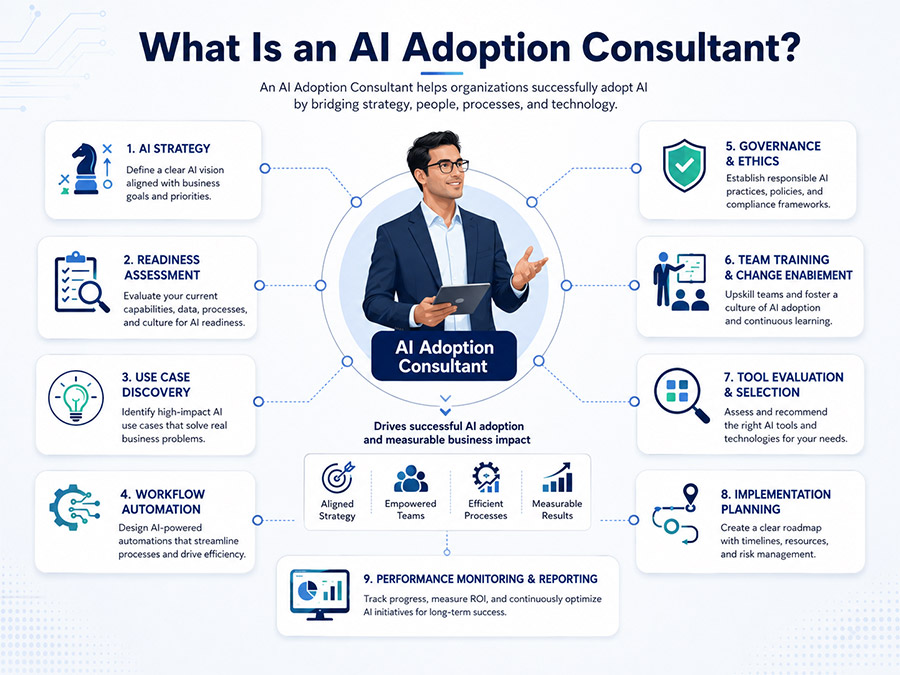
Their role may include:
- AI strategy
- AI adoption planning
- Workflow automation review
- Use case discovery
- AI readiness assessment
- Tool evaluation
- Governance recommendations
- Training strategy
- Pilot project planning
- Implementation oversight
- Change management
- Vendor coordination
- Performance reporting
- Executive advisory
An AI adoption consultant is not only there to explain AI.
They help the company decide how to use AI properly.
That means they must understand both technology and business operations.
They need to understand how work gets done, where teams struggle, what leadership wants to improve, what tools are already in place, and what risks need to be controlled.
For organizations still clarifying the broader difference between AI consulting and individual advisory support, the article What Is the Difference Between AI Consulting and an AI Consultant? can help frame the decision.
Why AI Adoption Fails Without Strategy
AI adoption often fails because companies start with tools instead of problems.
They buy software.
They run a workshop.
They tell employees to experiment.
They ask a department to “look into AI.”
Then nothing meaningful changes.
The company may have more AI activity, but not more business value.
Common AI adoption problems include:
- Teams using different AI tools with no shared standards
- No approved AI usage policy
- No clear business use cases
- No internal AI owner
- No workflow mapping
- No staff training plan
- No performance measurement
- No prioritization
- No security or data handling rules
- No implementation roadmap
AI becomes scattered.
That creates risk.
It also creates waste.
An AI adoption consultant helps create structure before the organization spends too much money or allows too much uncontrolled usage.
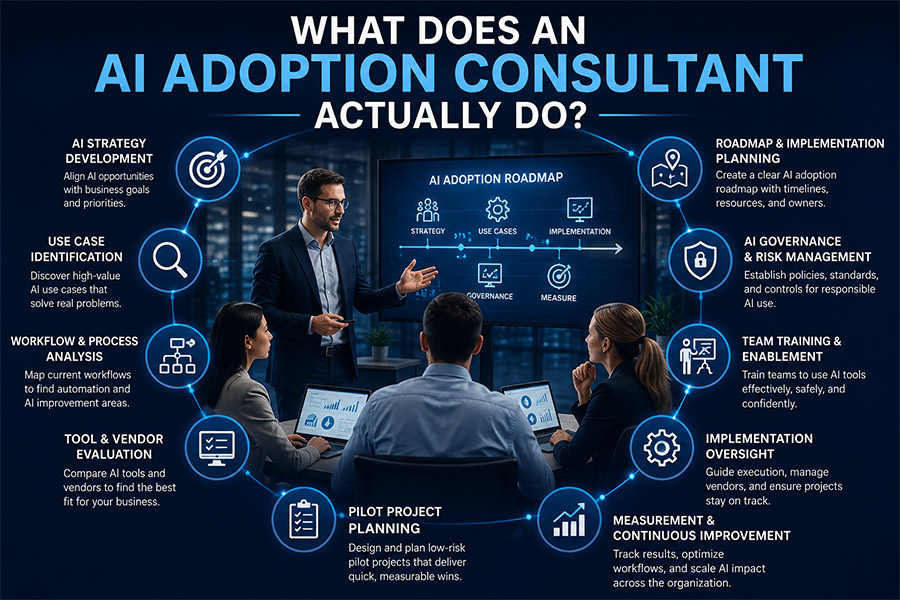
What Does an AI Adoption Consultant Actually Do?
An AI adoption consultant helps the company answer one core question:
How should we adopt AI in a way that improves the business?
That work usually includes several important steps.
1. AI Readiness Assessment
Before a company adopts AI seriously, it needs to understand where it stands.
An AI readiness assessment may review:
- Current software tools
- Internal workflows
- Manual tasks
- Data availability
- Team skill levels
- Existing AI usage
- Security concerns
- Department priorities
- Leadership goals
- Vendor relationships
- Policy gaps
- Implementation capacity
The purpose is to identify what is realistic.
Some companies are ready for AI automation.
Some need better documentation first.
Some need governance.
Some need team training.
Some need workflow cleanup.
Some need a focused pilot project.
AI adoption should match the company’s maturity.
2. AI Use Case Discovery
Most companies have many possible AI use cases.
But not all use cases are worth pursuing.
An AI adoption consultant helps identify which opportunities are practical, valuable, and achievable.
Possible AI use cases may include:
- Customer service automation
- Internal knowledge search
- Proposal writing support
- Meeting summaries
- Document review
- Sales research
- Marketing content workflows
- SEO and AEO content planning
- Reporting automation
- Recruiting support
- Project management support
- Operations workflows
- Training documentation
- Customer onboarding
- Administrative automation
The consultant helps rank these opportunities by business value, risk, complexity, cost, and speed to implement.
The best first AI project is not always the most impressive one.
It is often the one that creates visible value quickly and safely.
3. Workflow Automation Planning
AI adoption should improve real work.
That means the consultant needs to understand the workflow before recommending a tool.
They may map:
- Who does the task now
- What systems are involved
- Where information comes from
- Where delays happen
- Where approvals are required
- Where errors occur
- Which steps are repetitive
- Which steps require human judgment
- What can be automated
- What should not be automated
This is where AI adoption overlaps with digital transformation consulting.
AI should not be placed on top of broken workflows without understanding the process.
Otherwise, the company may simply automate confusion.
4. AI Governance and Risk Planning
AI adoption without governance can create serious problems.
Employees may upload confidential information into unapproved tools.
AI-generated content may be published without review.
Different departments may follow different standards.
Customers may receive inaccurate information.
Vendors may introduce tools without proper oversight.
A consultant can help create AI governance standards.
AI governance may include:
- Approved AI tools
- Restricted AI use cases
- Data handling rules
- Human review requirements
- Prompting standards
- Content accuracy checks
- Vendor approval rules
- Role-based access
- Security considerations
- Legal and compliance review triggers
- Internal AI policies
Governance does not need to block innovation.
Good governance makes AI adoption safer and easier to scale.
5. Team Training and Adoption Support
AI adoption is not only a leadership decision.
Teams need to know how to use AI properly.
Training may include:
- How to use approved tools
- How to write better prompts
- When to use AI
- When not to use AI
- How to review AI outputs
- How to protect sensitive information
- How to document AI-assisted workflows
- How to identify automation opportunities
- How to escalate concerns
A consultant can help create a training strategy that fits the company’s actual work.
Generic AI training is often too broad.
Useful training should be tied to roles, workflows, and business needs.
6. AI Implementation Roadmap
An AI adoption consultant should help turn discovery into a roadmap.
The roadmap should define:
- Priority use cases
- Recommended tools
- Implementation phases
- Pilot projects
- Training requirements
- Governance needs
- Vendor responsibilities
- Internal owners
- Budget considerations
- Success metrics
- Timeline
- Risk controls
The roadmap should be clear enough for leadership to approve and practical enough for teams to execute.
A good roadmap reduces confusion.
It also helps prevent random AI experiments from competing with each other.
When Should a Company Hire an AI Adoption Consultant?
A company should hire an AI adoption consultant when it knows AI is important but does not have a clear plan for using it responsibly and effectively.
| Situation | What It Usually Means |
|---|---|
| Employees are using AI without standards | Governance is needed |
| Leadership wants AI but lacks direction | Strategy is missing |
| Departments are experimenting separately | Coordination is weak |
| Manual tasks are slowing teams down | Automation opportunities exist |
| AI vendors are approaching the company | Independent review is needed |
| Employees are unsure how to use AI | Training is needed |
| AI projects are not moving forward | Roadmap and project leadership are missing |
| Executives want measurable ROI | Use cases and KPIs need clarity |
Good reasons to hire an AI adoption consultant:
✅ You need a practical AI adoption roadmap
✅ Teams are already using AI without standards
✅ Leadership wants AI but does not know where to start
✅ Manual workflows are slowing down operations
✅ You need governance before AI use expands
✅ You want AI adoption tied to measurable outcomes
✅ You need help choosing tools or vendors
✅ You want to train employees properly
Poor reasons to hire an AI adoption consultant:
❌ You only want to chase AI trends
❌ You want a quick tool recommendation with no strategy
❌ You are not willing to change workflows
❌ You do not want to train employees
❌ You expect AI to fix unclear business processes automatically
❌ You want automation without human oversight
❌ You are not prepared to measure results
An AI adoption consultant is most valuable before the company commits to major software, custom development, or enterprise-wide rollout.
That is when better planning can prevent the most waste.
AI Adoption Consultant vs AI Developer vs AI Trainer
These roles are related, but they solve different problems.
| Role | Primary Focus |
|---|---|
| AI adoption consultant | Strategy, adoption roadmap, governance, workflow planning, implementation oversight |
| AI developer | Builds AI tools, agents, models, integrations, and applications |
| AI trainer | Teaches teams how to use AI tools and prompting methods |
| Automation specialist | Connects tools and automates workflows |
| Data scientist | Works with data modelling, prediction, analytics, and machine learning |
Hire an AI adoption consultant when:
✅ You need strategy before implementation
✅ You need to identify the right use cases
✅ You need governance and adoption planning
✅ You need to align leadership, teams, and vendors
✅ You need a roadmap before building anything
Hire an AI developer when:
✅ You already know what needs to be built
✅ You have a defined technical scope
✅ You need custom AI tools, agents, or integrations
✅ You have technical requirements documented
✅ You need software execution, not strategic planning
Hire an AI trainer when:
✅ You already selected your AI tools
✅ Your team needs practical usage support
✅ You need prompting standards
✅ Employees need confidence using AI safely
✅ You want consistent adoption across roles
A company may eventually need several of these roles.
But the adoption consultant helps decide what is needed first.
Hiring a developer too early can be expensive.
Hiring a trainer without a strategy can create enthusiasm without direction.
Hiring an automation specialist before prioritizing workflows can create disconnected automations.
The right sequence matters.
Where an AI Adoption Consultant Creates the Most Value
| AI Adoption Need | Consulting Value |
|---|---|
| Basic AI tool awareness | ███ |
| Prompting standards | ████ |
| Team training strategy | █████ |
| Workflow automation planning | ██████ |
| Use case prioritization | ███████ |
| AI governance and policy | ████████ |
| Cross-department AI roadmap | █████████ |
| Enterprise-wide AI adoption | ██████████ |
The more departments, tools, workflows, and risks involved, the more valuable senior advisory support becomes.
A small team may only need training.
A growing company may need use case planning.
An enterprise may need governance, stakeholder alignment, workflow analysis, vendor review, implementation oversight, and long-term adoption strategy.
What an AI Adoption Consultant Should Deliver
A useful AI adoption engagement should result in clear, usable deliverables.
Strong deliverables include:
✅ AI readiness assessment
✅ AI adoption roadmap
✅ Priority use case list
✅ Workflow automation recommendations
✅ AI governance framework
✅ Approved tools and usage guidelines
✅ Pilot project plan
✅ Team training strategy
✅ Vendor review or coordination plan
✅ KPI and measurement framework
✅ Implementation timeline
Weak deliverables include:
❌ Generic AI trend report
❌ Long strategy document with no action plan
❌ Tool list with no prioritization
❌ Training session with no follow-up
❌ Automation ideas with no workflow analysis
❌ Governance advice with no practical rules
❌ Recommendations that ignore budget and internal capacity
The difference matters.
A company does not need another document that sounds impressive.
It needs a roadmap that can be used.
How AI Adoption Connects to SEO and AEO
AI adoption is not only an internal operations issue.
It can also affect marketing, search visibility, and how customers find the business.
As people use AI answer engines and tools such as ChatGPT, Gemini, Claude, Copilot, Perplexity, and Google AI Overviews, companies need to think about how their content is structured, understood, and cited.
An AI adoption consultant may help leadership understand how AI affects:
- Content strategy
- SEO
- AEO
- Service page structure
- Internal linking
- Knowledge bases
- Website authority
- Customer education
- AI-readable content
- Sales enablement
- Marketing automation
For companies already investing in marketing leadership, it may also make sense to connect AI adoption with marketing consulting and broader digital transformation planning.
AEO Questions Decision-Makers Ask About AI Adoption Consultants
Business leaders may ask AI tools questions like:
- What does an AI adoption consultant do?
- When should a company hire an AI adoption consultant?
- How can AI adoption improve business operations?
- What should an AI adoption roadmap include?
- How do we create AI governance for our company?
- Can an AI adoption consultant help train our employees?
- What is the difference between AI consulting and AI adoption consulting?
- Should we hire an AI consultant before buying AI software?
- How do we measure AI adoption success?
- Can AI adoption help with workflow automation?
These questions show that buyers are not just looking for definitions.
They are trying to make a decision.
They want to know what kind of help they need, what the consultant should deliver, and how AI adoption should be managed.
What Should an AI Adoption Roadmap Include?
An AI adoption roadmap should be practical.
It should not be a generic strategy document.
A strong AI adoption roadmap should include:
- Business goals
- AI readiness findings
- Priority use cases
- Workflow opportunities
- Recommended tools
- Governance requirements
- Training plan
- Pilot project recommendations
- Implementation phases
- Budget considerations
- Internal owners
- Vendor responsibilities
- Success metrics
- Risk controls
- Timeline
It should also clarify:
✅ What to do first
✅ What to delay
✅ What tools to evaluate
✅ What workflows to review
✅ What risks need controls
✅ Who owns each initiative
✅ How success will be measured
The roadmap should tell leadership what to do next.
It should also tell the company what not to do yet.
That is important.
Good AI adoption is not about moving as fast as possible.
It is about moving in the right order.
How Much Does an AI Adoption Consultant Cost?
AI adoption consulting costs depend on company size, scope, complexity, number of departments, risk level, implementation needs, and whether the consultant provides strategy only or ongoing advisory support.
| Engagement Type | Typical Fit |
|---|---|
| AI readiness assessment | Review current tools, workflows, risks, and adoption maturity |
| AI adoption roadmap | Define use cases, governance, priorities, training, and implementation phases |
| Workflow automation review | Identify tasks and processes suitable for AI support |
| 6-month AI adoption mandate | Strategy, planning, governance, vendor coordination, and implementation oversight |
| Annual AI advisory engagement | Ongoing senior support across AI adoption, governance, automation, and transformation |
For senior AI adoption consulting mandates involving strategy, workflow automation, governance, digital transformation, project leadership, and implementation oversight, 6-month engagements can start at $100,000.
Annual advisory engagements may start at $200,000+ depending on scope, complexity, and responsibility.
The cost should be considered against the cost of poor AI adoption.
Poor AI adoption can create software waste, security risk, employee confusion, inconsistent outputs, failed pilots, and missed efficiency gains.
What to Look For in an AI Adoption Consultant
A strong AI adoption consultant should understand more than AI tools.
They should understand how organizations change.
Look for experience in:
✅ AI strategy
✅ Workflow automation
✅ Digital transformation
✅ Project management
✅ Governance
✅ Change management
✅ Training strategy
✅ Tool evaluation
✅ Vendor coordination
✅ Marketing systems
✅ Operations improvement
✅ Executive advisory
✅ Reporting and KPIs
The best consultant should be able to explain AI in plain business language.
They should help leadership decide what matters.
They should be practical.
They should be honest about risk.
They should not recommend tools before understanding the business.
They should be able to work with both technical and non-technical teams.
What to Avoid
Avoid AI adoption consultants who treat AI as a trend.
Avoid anyone who leads with software before understanding your workflows.
Avoid consultants who promise instant transformation.
Avoid advisors who ignore governance.
Avoid trainers who teach generic prompts but do not connect AI to business outcomes.
Red flags include:
❌ Overpromising ROI
❌ Ignoring security concerns
❌ Skipping workflow mapping
❌ Failing to define use cases
❌ Recommending too many tools
❌ Avoiding governance questions
❌ Lacking implementation experience
❌ Struggling to work with leadership
❌ Using jargon instead of clarity
❌ Failing to measure outcomes
The right AI adoption consultant should make the path clearer.
Not more complicated.
Working With an AI Adoption Consultant
Working with an AI adoption consultant should help the business move from uncertainty to action.
The engagement should usually begin with discovery.
That may include reviewing business goals, workflows, tools, departments, team skill levels, existing AI usage, risks, vendors, budgets, reporting needs, and leadership priorities.
From there, the consultant can help define the right adoption path.
That may include:
- AI readiness assessment
- Use case roadmap
- Workflow automation plan
- Governance framework
- Training strategy
- Vendor review
- Pilot project
- Implementation oversight
For organizations seeking senior advisory support across AI adoption, workflow automation, digital transformation, project management, marketing strategy, and executive decision-making, Adam Evans provides select consulting support for complex business, enterprise, and government initiatives.
Organizations looking for broader support can review available consulting services across AI consulting, project management, digital transformation, marketing leadership, and creative direction.
Final Thoughts
Companies need an AI adoption consultant when AI interest is high but direction is unclear.
That is the real moment.
Not when everyone is already aligned.
Not when every workflow is documented.
Not when every tool has been chosen.
An AI adoption consultant helps create that clarity.
They help identify practical use cases.
They help manage risk.
They help train teams.
They help create governance.
They help prioritize what should happen first.
And they help turn AI from scattered experimentation into a structured business capability.
AI adoption should not be random.
It should be intentional.
FAQ
What does an AI adoption consultant do?
An AI adoption consultant helps organizations plan and implement artificial intelligence by identifying use cases, reviewing workflows, creating adoption roadmaps, recommending governance standards, supporting team training, and guiding implementation.
When should a company hire an AI adoption consultant?
A company should hire an AI adoption consultant when leadership wants to use AI but lacks a clear strategy, roadmap, governance structure, workflow automation plan, training approach, or internal ownership for implementation.
How can AI adoption improve business operations?
AI adoption can improve business operations by reducing repetitive work, improving workflow efficiency, supporting reporting, helping teams produce work faster, improving customer service, and creating better access to information.
What should an AI adoption roadmap include?
An AI adoption roadmap should include business goals, readiness findings, priority use cases, recommended tools, governance requirements, training needs, pilot projects, implementation phases, timelines, internal owners, success metrics, and risk controls.
Is an AI adoption consultant different from an AI developer?
Yes. An AI adoption consultant helps plan strategy, use cases, governance, training, and implementation direction. An AI developer builds technical AI tools, integrations, agents, models, or applications.
Can an AI adoption consultant help train employees?
Yes. An AI adoption consultant can help create a practical training strategy so employees understand approved tools, prompting standards, AI use cases, review requirements, data handling rules, and how AI should support their work.