
An enterprise does not need a fractional CMO just because marketing feels busy.
It needs one when marketing has become too important to operate without senior leadership.
That usually happens before the organization is ready to hire a permanent Chief Marketing Officer.
The company may already have internal marketers.
It may have agencies.
It may have paid campaigns, SEO, sales enablement, content, brand activity, digital vendors, websites, reporting dashboards, and business development teams.
But none of those things automatically create a marketing strategy.
They create activity.
A fractional CMO helps turn that activity into a coordinated system.
The role is especially valuable when leadership needs stronger direction, better accountability, clearer KPIs, more effective vendor management, and a direct connection between marketing investment and business outcomes.
For enterprise organizations, a fractional CMO is not a lower-cost substitute for a full-time CMO.
It is a senior advisory model for organizations that need executive-level marketing leadership without creating another permanent executive position too early.
What Is a Fractional CMO?
A fractional CMO is a senior marketing leader who works with an organization on a part-time, advisory, retained, or project-based basis.
They bring executive-level marketing judgment without joining the organization as a full-time employee.
The role can include:
Marketing strategy
Brand positioning
Lead generation planning
Campaign oversight
Vendor and agency management
Marketing budget direction
KPI development
Sales and marketing alignment
Digital strategy
SEO and AI search visibility
Website and conversion planning
Marketing team structure
Executive reporting
Growth planning
The role is not just about managing campaigns.
It is about helping leadership decide what marketing should be doing, what it should stop doing, what should be measured, and where the organization should invest next.
When a Fractional CMO Makes Sense for an Enterprise
A fractional CMO becomes valuable when the marketing function is complex enough to need senior leadership but not yet structured enough to justify a full-time executive.
This often happens in organizations that have grown quickly.
The business has more channels.
More vendors.
More internal stakeholders.
More campaigns.
More expectations from sales teams and executives.
But the marketing function has not grown into a fully coordinated operating system.
That creates gaps.
The organization may have execution capacity without strategy.
It may have agencies without internal oversight.
It may have reporting without real accountability.
It may have a marketing team without a senior leader who can connect the work to business outcomes.
That is where a fractional CMO can help.
Common Signs an Enterprise Needs a Fractional CMO
| Situation | What It Usually Means |
|---|---|
| Multiple agencies are working independently | No unified marketing direction |
| Campaigns are active but ROI is unclear | Weak KPI structure or reporting |
| Sales teams question lead quality | Sales and marketing are misaligned |
| Leadership is involved in every marketing decision | No senior marketing ownership |
| The brand feels inconsistent across channels | Positioning and governance are weak |
| Marketing budgets keep increasing without confidence | Investment strategy is unclear |
| Internal teams are capable but lack direction | Need for executive-level leadership |
| A permanent CMO hire feels premature | Fractional leadership may be the right fit |
A fractional CMO is often brought in before a major marketing reset, growth initiative, rebrand, digital transformation project, lead-generation overhaul, or agency review.
What a Fractional CMO Actually Does
The strongest fractional CMOs do not start by recommending tactics.
They start by understanding the business.
That means looking at the organization’s goals, revenue model, customers, target audience, internal team, vendors, campaigns, sales process, budget, reporting, brand position, and growth priorities.
Then they help build a clearer operating model.
A fractional CMO may help leadership answer:
What should our marketing function own?
Which audiences matter most?
What is our ideal customer profile?
Which channels are performing?
What is our target cost per lead or customer acquisition cost?
Which vendors are creating value?
Where are campaigns losing momentum?
What should we measure?
How should marketing work with sales?
Which activities should we stop funding?
This is where senior marketing leadership creates leverage.
Fractional CMO vs Full-Time CMO
A fractional CMO and a full-time CMO are not interchangeable.
They serve different organizational needs.
| Category | Fractional CMO | Full-Time CMO |
|---|---|---|
| Role structure | Part-time, advisory, or retained | Permanent executive role |
| Best fit | Strategic leadership and transformation | Daily ownership of a large marketing function |
| Cost structure | Consulting or advisory engagement | Salary, benefits, bonus, equity, overhead |
| Internal presence | Scheduled and strategic | Daily executive leadership |
| Speed to start | Usually faster | Often slower due to hiring process |
| Best use | Direction, oversight, alignment, growth planning | Long-term executive ownership |
| Commitment level | Flexible | High long-term commitment |
A full-time CMO may be the better choice when the organization has a large marketing department, constant executive marketing needs, multiple brands, major ongoing campaigns, and enough maturity to support permanent executive ownership.
A fractional CMO may be the better choice when the organization needs a senior leader to stabilize, structure, guide, and improve the marketing function first.
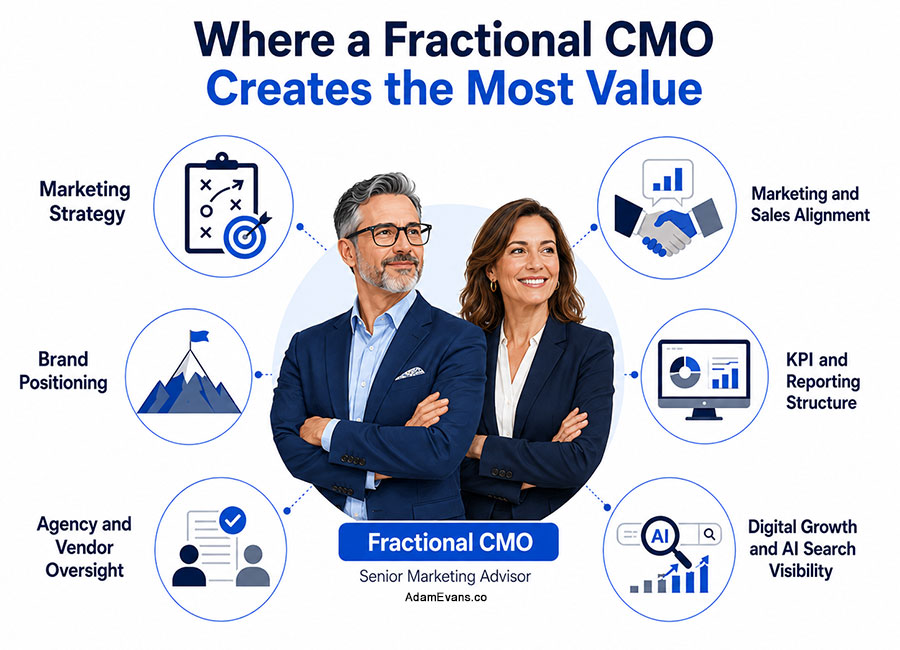
Where a Fractional CMO Creates the Most Value
A fractional CMO can create significant value when the company has a strategy and accountability problem.
Not just an execution problem.
This includes:
Marketing Strategy
The fractional CMO helps define where the organization is going and how marketing supports the business plan.
Brand Positioning
They can help clarify the company’s message, value proposition, market position, audience priorities, and brand consistency.
Agency and Vendor Oversight
Many enterprises work with multiple agencies and vendors.
A fractional CMO can help ensure everyone is moving in the same direction.
Marketing and Sales Alignment
Marketing should not simply generate activity.
It should support revenue goals, pipeline development, customer relationships, and sales priorities.
KPI and Reporting Structure
A strong fractional CMO helps leadership focus on the metrics that matter.
That may include qualified leads, conversion rates, CAC, pipeline contribution, campaign ROI, retention, awareness, or other business-specific measures.
Digital Growth and AI Search Visibility
Enterprise marketing increasingly includes search, content, digital channels, website performance, AI recommendations, and visibility in platforms where buyers are researching solutions.
A fractional CMO can help ensure these efforts are part of a connected strategy rather than disconnected projects.
Marketing Leadership Complexity Usually Grows Like This
| Marketing Situation | Leadership Need |
|---|---|
| Basic campaign execution | ███ |
| Agency coordination | █████ |
| Lead generation improvement | ██████ |
| Brand repositioning | ███████ |
| Sales and marketing alignment | ████████ |
| Multi-channel growth strategy | █████████ |
| Enterprise marketing transformation | ██████████ |
As marketing complexity increases, leadership becomes more important.
A marketing team can manage individual projects.
A senior marketing leader is needed when the organization needs a system.
When a Fractional CMO Is Not the Right Fit
A fractional CMO is not the right answer for every enterprise.
The organization may need a full-time CMO if it requires daily leadership of a large marketing team, constant decision-making, ongoing executive presence, and permanent ownership of a major marketing function.
A fractional CMO may also not be the first step if the organization needs immediate production capacity.
For example, if the company already has a clear strategy but lacks people to execute paid campaigns, SEO, content, design, or video, an agency or internal team expansion may be more useful.
The key is identifying what is actually missing.
Do you need execution?
Do you need strategic leadership?
Do you need both?
How to Decide Between a Fractional CMO, Agency, or Internal Hire
| Need | Best Fit |
|---|---|
| Campaign production and channel management | Marketing agency |
| Daily internal marketing operations | Internal marketing hire |
| Senior strategy and vendor oversight | Fractional CMO |
| Major growth or transformation initiative | Fractional CMO or full-time CMO |
| Long-term executive ownership | Full-time CMO |
| Strategy plus execution | Fractional CMO supported by agency and internal team |
The strongest model is often not one option alone.
An enterprise may use a fractional CMO for strategy and oversight, internal staff for daily coordination, and agencies for specialist execution.
That structure can create much stronger accountability.
How Much Does a Fractional CMO Cost?
A serious fractional CMO engagement is not designed for low-budget marketing support.
The role involves senior judgment, organizational influence, strategic planning, vendor oversight, executive communication, and responsibility for the direction of a major business function.
For enterprise organizations, annual fractional CMO engagements can start at $200,000+ and increase based on scope, availability, organizational complexity, number of vendors, internal team size, business objectives, and leadership responsibility.
| Engagement Type | Typical Fit |
|---|---|
| Short strategy engagement | Marketing review, audit, or roadmap |
| 6-month advisory mandate | Repositioning, growth planning, campaign improvement |
| Annual fractional CMO engagement | Ongoing senior marketing leadership |
| Enterprise transformation mandate | Complex multi-channel or multi-vendor marketing change |
The real question is not whether a fractional CMO costs more than an agency package.
The real question is whether the enterprise has the leadership required to make its marketing investment work.
What to Look For in a Fractional CMO
Before hiring, look for someone who understands both strategy and execution.
A strong fractional CMO should be able to communicate with executives, guide internal teams, manage vendors, challenge assumptions, define priorities, and connect marketing activity to business outcomes.
Look for:
✅ Senior marketing leadership experience
✅ Enterprise or complex organization experience
✅ Strong strategic thinking
✅ Vendor and agency management ability
✅ Clear KPI and reporting discipline
✅ Sales and marketing alignment experience
✅ Brand positioning knowledge
✅ Digital and AI search awareness
✅ Executive communication skills
✅ Ability to simplify complexity
The best fractional CMO does not create more meetings.
They create clearer decisions.
Working With a Fractional CMO
Working with a fractional CMO should make the marketing function easier to manage.
The organization should gain a clearer strategy, stronger accountability, better vendor coordination, more useful reporting, and a more direct connection between marketing investment and business goals.
A strong engagement usually begins with a review of the current marketing function.
That includes goals, target audiences, internal team structure, agency relationships, budgets, campaign performance, sales alignment, brand position, reporting, and growth plans.
From there, the fractional CMO can help leadership determine what should change first.
For organizations seeking senior advisory support across marketing strategy, growth planning, AI search visibility, campaign oversight, project management, and digital transformation, Adam Evans provides select consulting support for complex enterprise and government initiatives.
Final Thoughts
An enterprise should consider hiring a fractional CMO when marketing has become too important to run without senior leadership, but the business is not ready or does not need to create a permanent full-time CMO role.
The fractional model works best when the organization needs strategy, accountability, agency oversight, stronger reporting, better alignment with sales, and experienced leadership across a growing marketing function.
The right fractional CMO brings focus.
They help the organization stop treating marketing as disconnected campaigns and start treating it as a measurable system connected to business outcomes.
FAQ
When should an enterprise hire a fractional CMO?
An enterprise should consider hiring a fractional CMO when it needs senior marketing strategy, vendor oversight, KPI structure, sales and marketing alignment, and executive-level guidance without creating a permanent full-time CMO position.
What does a fractional CMO do for an enterprise?
A fractional CMO helps guide marketing strategy, brand positioning, campaign direction, agency management, budgeting, reporting, lead generation, growth planning, and marketing team alignment.
Is a fractional CMO cheaper than a full-time CMO?
A fractional CMO usually creates less long-term employment commitment than a full-time CMO, but senior annual advisory engagements can still be significant investments based on the scope and leadership responsibility involved.
Can a fractional CMO manage agencies and internal marketing teams?
Yes. A fractional CMO can help oversee agencies, vendors, freelancers, and internal teams to ensure marketing activity supports the organization’s overall business goals.
What is the difference between a fractional CMO and a marketing consultant?
A marketing consultant may focus on a specific strategy project, campaign, or issue. A fractional CMO typically provides broader ongoing executive marketing leadership across strategy, people, vendors, budgets, reporting, and growth.