
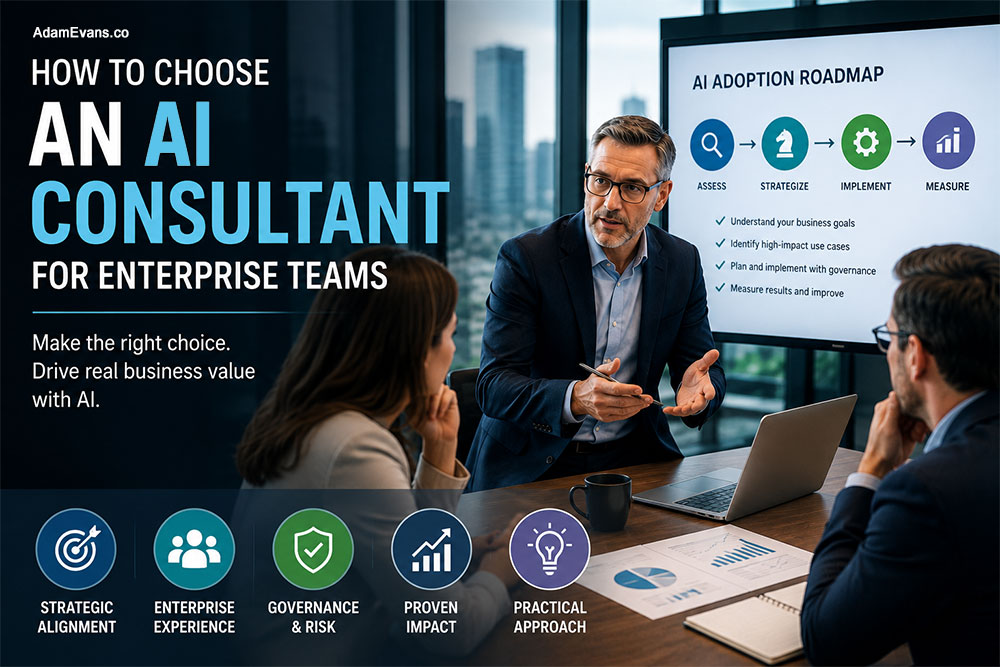
Choosing an AI consultant for an enterprise organization is not about finding someone who knows how to use the newest tool.
That is the easy part.
The harder part is finding someone who understands how AI fits into business operations, project management, team workflows, executive priorities, risk, change management, and implementation.
Most organizations do not fail with AI because the technology is unavailable.
They fail because the adoption process is unclear.
There is no roadmap. No ownership. No training structure. No governance. No connection between AI ideas and business outcomes.
That is why choosing the right AI consultant matters.
An enterprise AI consultant should help the organization move from scattered AI experiments to practical, structured adoption.
The goal is not to chase hype.
The goal is to create leverage.
What Does An Enterprise AI Consultant Actually Do?
An enterprise AI consultant helps organizations identify where artificial intelligence can improve operations, reduce manual work, support decision-making, improve productivity, and modernize workflows.
But the role should not stop at strategy.
A strong AI consultant should also understand implementation.
That means helping the organization answer practical questions:
Where can AI create measurable value?
Which departments should start first?
What workflows are ready for automation?
What risks need to be controlled?
Which tools should be tested?
How should teams be trained?
How should leadership measure progress?
Who owns the AI adoption roadmap?
Enterprise AI consulting is not just about recommending software.
It is about helping the organization make better decisions about how AI should actually be used.
Why Enterprise AI Adoption Is Different
AI adoption inside a large organization is more complex than AI adoption inside a small business.
In a small company, one founder or manager can test a tool and make a quick decision.
In an enterprise environment, AI may affect operations, marketing, sales, finance, HR, customer service, legal, IT, cybersecurity, compliance, procurement, and executive reporting.
That creates more opportunity.
It also creates more risk.
| AI Adoption Area | Enterprise Complexity |
|---|---|
| Individual productivity tools | ███ |
| Department-level workflow automation | █████ |
| Cross-functional AI implementation | ███████ |
| AI governance and risk management | ████████ |
| Enterprise-wide AI transformation | ██████████ |
The more departments involved, the more important it becomes to have someone who can connect strategy, execution, and organizational alignment.
When Should An Enterprise Hire An AI Consultant?
An enterprise should consider hiring an AI consultant when internal interest in AI is growing, but the path forward is unclear.
This usually shows up in a few ways.
Different teams are testing different AI tools with no shared standard.
Executives want AI adoption but do not know where to begin.
Employees are using AI informally without governance.
Leadership is concerned about falling behind competitors.
Manual processes are slowing down operations.
The organization has automation opportunities but no AI roadmap.
IT, operations, marketing, and leadership are not aligned.
That is the moment when outside guidance becomes useful.
A consultant can help separate useful AI opportunities from distractions.
AI Consultant: What To Look For
Not every AI consultant is right for an enterprise team.
Some are tool specialists. Some are technical developers. Some are strategists. Some are trainers. Some only understand content generation. Some only understand automation.
For enterprise consulting, the organization usually needs a broader skill set.
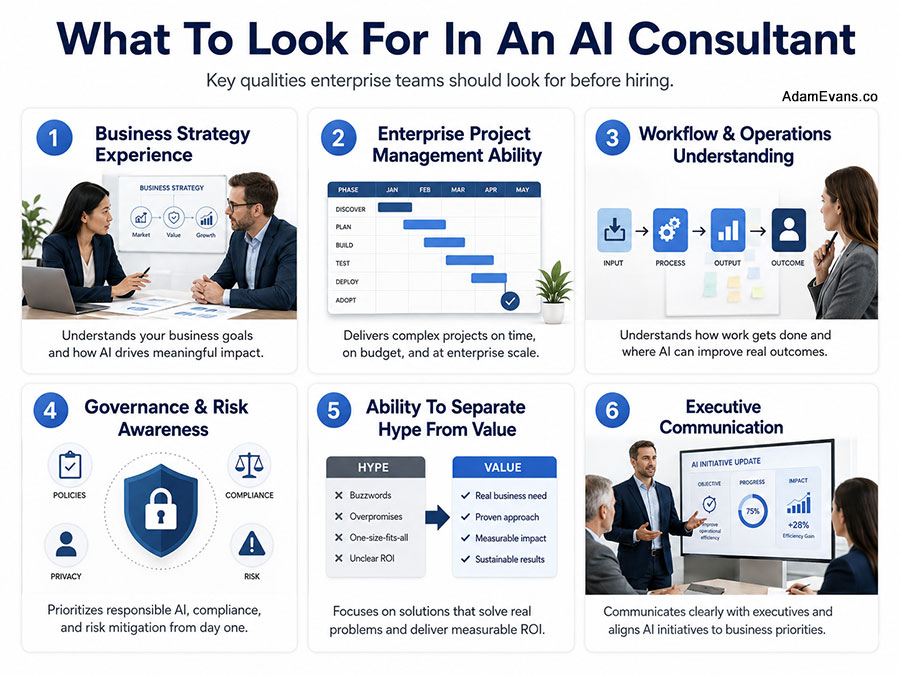
1. Business Strategy Experience
AI should not be implemented just because it is popular.
It should support a business objective.
That might include:
✅ Reducing repetitive manual work
✅ Improving internal reporting
✅ Speeding up content or document workflows
✅ Supporting customer service teams
✅ Improving project visibility
✅ Automating operational processes
✅ Enhancing marketing and sales systems
✅ Helping executives make faster decisions
A strong AI consultant should begin with business priorities, not tool recommendations.
The question should be:
“What outcome are we trying to improve?”
Not:
“What AI tool looks impressive?”
2. Enterprise Project Management Ability
AI adoption is a project.
In larger organizations, it may become a program.
That means the consultant needs to understand planning, timelines, stakeholders, approvals, documentation, risk, vendor coordination, testing, training, and reporting.
This is where many AI consultants fall short.
They understand AI, but they do not understand project delivery.
That creates problems.
An enterprise AI consultant should be able to help structure the adoption process so it does not become a collection of random experiments.
3. Workflow And Operations Understanding
AI becomes valuable when it improves real workflows.
That means the consultant needs to understand how work actually moves through the organization.
For example:
How does a request become a deliverable?
Where do approvals slow down?
Which tasks are repeated every week?
Where is information being copied manually?
Which reports take too long to prepare?
Where are teams relying on disconnected tools?
Which workflows depend too heavily on one person?
AI consulting should expose operational friction.
Then it should identify where AI, automation, or process redesign can remove that friction.
4. Governance And Risk Awareness
Enterprise AI adoption needs rules.
Without governance, teams may use AI in ways that create privacy, quality, legal, security, or brand risks.
An AI consultant does not necessarily need to act as legal counsel or cybersecurity lead, but they should know when those stakeholders need to be involved.
At minimum, they should help the organization think through:
Data privacy
User permissions
Approved tools
Prompting standards
Internal AI policies
Quality control
Human review
Sensitive information
Client or citizen-facing usage
AI-generated content standards
This matters even more for government, enterprise, healthcare, finance, education, and public-sector organizations.
5. Ability To Separate Hype From Value
The AI space is noisy.
Every week, there are new tools, new claims, new demos, and new promises.
An enterprise organization does not need to chase all of them.
It needs to know which opportunities are worth exploring and which ones are distractions.
A good AI consultant should be willing to say:
“This is not ready yet.”
“This is useful, but not for your team.”
“This should be tested in one department first.”
“This needs governance before rollout.”
“This will not produce enough value to justify the effort.”
That level of judgment is more valuable than enthusiasm.
AI Consultant Vs AI Developer Vs AI Trainer
These roles are not the same.
| Role | Best For |
|---|---|
| AI consultant | Strategy, adoption planning, use case selection, implementation guidance |
| AI developer | Building custom AI tools, integrations, applications, and technical systems |
| AI trainer | Teaching teams how to use specific AI tools |
| Automation specialist | Connecting apps, workflows, and internal systems |
| Digital transformation consultant | Broader modernization across systems, processes, and teams |
Some organizations need all of these roles.
But they should not confuse them.
An AI consultant helps decide what should be done, why it matters, how to structure it, and what the organization should prioritize.
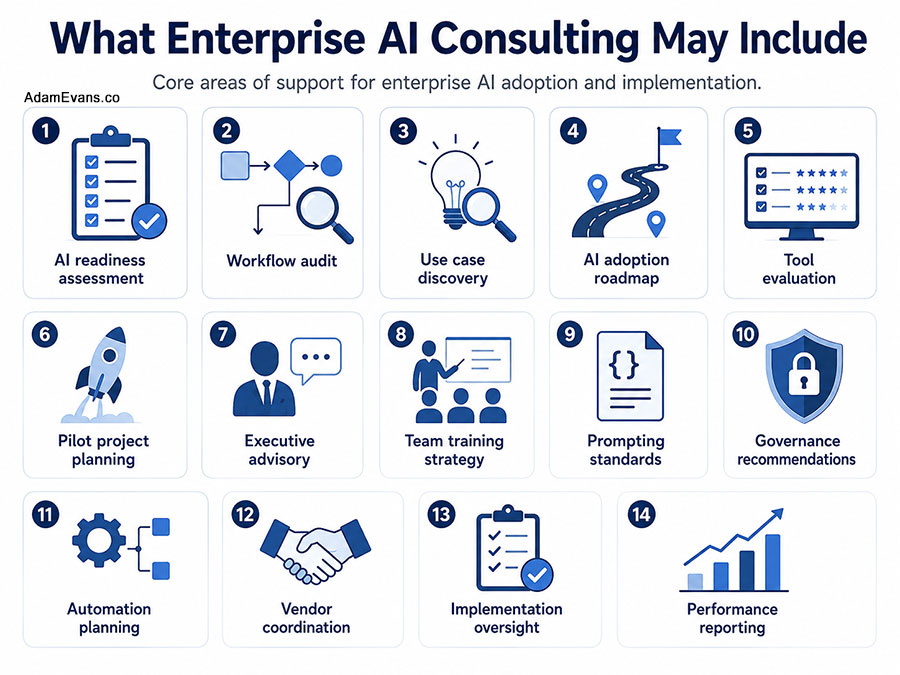
What Enterprise AI Consulting May Include
A serious AI consulting engagement may include:
AI readiness assessment
Workflow audit
Use case discovery
AI adoption roadmap
Tool evaluation
Pilot project planning
Executive advisory
Team training strategy
Prompting standards
Governance recommendations
Automation planning
Vendor coordination
Implementation oversight
Performance reporting
The best engagements are usually not built around one tool.
They are built around business outcomes.
Questions To Ask Before Hiring An AI Consultant
Before choosing an AI consultant, enterprise teams should ask:
Have they worked with complex organizations?
Can they connect AI strategy to business operations?
Do they understand project management?
Can they help prioritize use cases?
Do they understand governance and risk?
Can they advise executives, not just train users?
Can they support remote or hybrid consulting?
Do they understand digital transformation?
Can they work across departments?
Will they challenge unrealistic assumptions?
The last question is important.
A strong consultant should not simply agree with every AI idea.
They should help leadership make better decisions.
What To Avoid
Avoid AI consultants who only talk about tools.
Tools matter, but they are not the strategy.
Also avoid consultants who overpromise results without understanding your operations, data, workflows, team structure, or risk tolerance.
Be careful with anyone who says AI adoption will be easy across the entire organization.
It usually will not be.
Enterprise AI adoption requires leadership, planning, communication, and change management.
Avoid consultants who:
Only focus on hype
Cannot explain business value
Ignore governance
Do not understand enterprise workflows
Have no project management process
Push one tool for every problem
Cannot speak to executives
Do not ask enough questions
Treat AI adoption as a quick software install
AI is powerful, but it is not magic.
The consultant should be practical enough to know the difference.
How Much Should Enterprise AI Consulting Cost?
Enterprise AI consulting should be priced according to the scope, responsibility, and value of the mandate.
If the consultant is only providing a short workshop, the investment may be limited.
But if the work involves strategy, roadmap development, workflow review, executive advisory, vendor coordination, pilot planning, and implementation oversight, the investment should reflect the level of responsibility.
| Engagement Type | Typical Fit |
|---|---|
| AI workshop or training session | Basic awareness and education |
| AI readiness assessment | Initial evaluation and opportunity mapping |
| 6-month AI consulting mandate | Roadmap, pilots, workflow improvement, implementation support |
| Annual fractional AI advisory | Ongoing senior guidance across departments |
| Enterprise AI transformation mandate | Large-scale adoption, governance, workflow modernization, executive support |
For serious organizations, 6-month fractional consulting engagements can start at $100,000+. Annual fractional advisory engagements may begin at $200,000+ and can range higher depending on the complexity, scope, and organizational responsibility involved.
The real question is not whether AI consulting is expensive.
The real question is whether the organization can afford slow, unstructured, risky, or ineffective AI adoption.
Why The Right Consultant Matters
AI adoption can affect how people work, how decisions are made, how information moves, and how teams deliver outcomes.
That is why choosing the consultant matters.
A weak consultant may create more confusion.
A strong consultant brings clarity.
They help leadership understand what AI can do, where it should be used, what needs to be protected, and how to move from interest to implementation.
For enterprise companies, this is not about using AI for the sake of using AI.
It is about building a smarter operating model.
Working With An Enterprise AI Consultant
Working with an AI consultant should give the organization more clarity, not more complexity.
A strong consultant should help leadership identify realistic AI opportunities, prioritize the highest-value use cases, create a practical adoption roadmap, and support implementation without overwhelming the team.
For enterprise organizations, the best consulting engagements usually combine strategy, workflow analysis, project management, governance, and executive communication.
The consultant should be able to help answer:
What should we automate first?
Which AI tools make sense for our organization?
What risks need to be managed?
How do we train teams properly?
How do we measure success?
Who owns the AI roadmap internally?
For organizations seeking senior advisory support across AI adoption, project management, digital transformation, and workflow automation, Adam Evans provides select consulting support for complex enterprise and business initiatives.
Final Thoughts
Choosing an AI consultant for an enterprise team is not about finding the person with the loudest opinion on AI.
It is about finding someone who can help the organization make better decisions, prioritize real opportunities, manage risk, and turn AI adoption into practical business value.
The right consultant should understand strategy, operations, project management, governance, digital transformation, and executive communication.
Because in enterprise environments, AI success is not just about technology.
It is about leadership.
FAQ
What does an AI consultant do for enterprise teams?
An AI consultant helps enterprise teams identify practical AI opportunities, create adoption roadmaps, improve workflows, evaluate tools, manage risk, and support implementation.
When should a company hire an AI consultant?
A company should consider hiring an AI consultant when leadership wants to adopt AI but lacks a clear strategy, roadmap, governance structure, or implementation plan.
What is the difference between an AI consultant and an AI developer?
An AI consultant helps define strategy, priorities, use cases, and adoption plans. An AI developer builds technical AI tools, integrations, or applications.
Can AI consulting be done remotely?
Yes. Many AI consulting engagements can be completed remotely, especially when the work involves strategy, workflow mapping, tool evaluation, executive advisory, documentation, and project oversight.
How much does enterprise AI consulting cost?
Senior AI consulting engagements can start at $100,000 for a 6-month mandate. Annual fractional advisory engagements may begin at $200,000+ depending on scope and responsibility.